

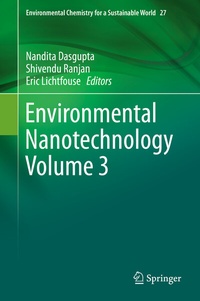
Environmental Nanotechnology Volume 3
Description

This third volume on environmental nanotechnology includes chapters dealing with topics such nanoremediation, waste water purification, nanosensors, nanomedicine, and nanofiltration. It also highlights the safety aspects and risk assessment and management related to several toxins, as well as nanotechnology related solutions for these challenges. The book also discusses new nanomaterials from the nexus of environment, water, remediation and total environment.
More details
Other editions
Additional editions
Persons
Dr. Nandita Dasgupta has vast working experience in nanoscience and is working as Assistant Professor at Department of Biotechnology, Institute of Engineering and Technology, Lucknow, India. She has worked on Mesenchymal stem cell derived exosomes for the treatment of uveitis. She has successfully engineered micro-vehicles for model drug molecules. Her areas of interest include nanomaterial fabrication and its applications in medicine, food, environment, agriculture and biomedical.She is the associate editor of Environmental Chemistry Letters. She has received several awards and recognitions from different national and international organizations.
Dr. Shivendu Ranjan is scientist at the DST-Centre for Policy Research, Lucknow, India. He is also serving as a senior research associate, adjunct, at the Faculty of Engineering and Built Environment, University of Johannesburg, South Africa. His research interests include nanotechnology, nanomedicine, science policy and diplomacy.He is associate editor of Environmental Chemistry Letters and editorial board member of Biotechnology and Biotechnological Equipment. He has received 20 awards and honors.
Dr. Eric Lichtfouse is an environmental chemist working at the University of Aix-Marseille, France. He has invented carbon-13 dating. He is teaching scientific writing and communication, and has published the book Scientific Writing for Impact Factors. He is founder and Chief Editor of scientific journals and series in environmental chemistry and agriculture. He got the Analytical Chemistry Prize from the French Chemical Society, the Grand Prize of the Universities of Nancy and Metz, and a Journal Citation Award by the Essential Indicators.
