

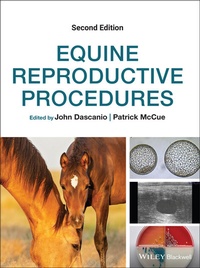
Equine Reproductive Procedures
Description

The book covers topics related to the reproductive management of horses, including diagnostic techniques and therapeutic procedures for stallions, mares, and foals. Procedures highlighted in the book are supported with clear descriptions and photographs. Readers will also find a list of required supplies for the procedure and a reference list.
* Provides step-by-step descriptions of techniques related to equine theriogenology
* Serves as a valuable practice tool
* Offers 39 new techniques not found in the first edition
* Includes key updates to existing techniques
Those studying equine reproduction and specialists in theriogenology will find this an essential 'how-to' guide for their practice library.
More details
Other editions
Additional editions
Persons
THE EDITORS
JOHN DASCANIO, VMD, Diplomate ACT, Diplomate ABVP (Equine) is the Senior Associate Dean for Academic and Student Affairs and a Professor of Theriogenology at the Texas Tech University School of Veterinary Medicine in Amarillo, Texas, USA and was named the 2018 Theriogenologist of the Year by the American College of Theriogenologists.
PATRICK MCCUE, DVM, PhD, Diplomate ACT is the Iron Rose Ranch Professor of Equine Reproduction at Colorado State University College of Veterinary Medicine and Biomedical Sciences in Fort Collins, Colorado, USA and was named the 2017 Theriogenologist of the Year by the American College of Theriogenologists.
Content
List of Contributors xiii
Preface xv
Part I Non-Pregnant Mare 1
1 Reproductive Evaluation 3 Patrick M. McCue
2 Teasing 7 Patrick M. McCue
3 Tail Wrap and Preparation/Washing of the Perineum 11 John J. Dascanio
4 Placement of a Tail Rope 17 John J. Dascanio
5 Perineal Conformation Evaluation 21 John J. Dascanio
6 Removal of a Persistent Hymen 25 John J. Dascanio
7 Palpation of the Reproductive Tract 27 Patrick M. McCue
8 Ultrasound Evaluation 31 Patrick M. McCue
9 Prediction of Ovulation 37 Patrick M. McCue
10 Speculum Examination of the Vagina 41 John J. Dascanio
11 Digital Examination of the Vagina/Cervix 45 Sofie Sitters
12 Uterine Culture Collection: Swab/Brush 49 John J. Dascanio
13 Antimicrobiotic Sensitivity Testing 53 Jillian Bishop and Patrick M. McCue
14 Microbiology: Microbial Culture 5 Patrick M. McCue and Jillian Bishop
15 Microbiology: Gram Stain 59 Jillian Bishop and Patrick M. McCue
16 qPCR Assay for the Diagnosis of Infectious Endometritis 61 Ryan A. Ferris and Patrick M. McCue
17 Uterine Cytology Collection: Swab/Brush 67 John J. Dascanio and Ryan A. Ferris
18 Uterine Culture/Cytology: Low Volume Lavage 73 John J. Dascanio
19 Endometrial Biopsy 77 Patrick M. McCue
20 Hysteroscopic Examination of the Uterus 81 Patrick M. McCue
21 Endometrial Cyst Removal 85 John J. Dascanio
22 Chromosomal Analysis 89 Terje Raudsepp
23 Endocrinological Examination 97 Patrick M. McCue
24 Laparoscopic Examination of the Female Reproductive Track with Ovarian Biopsy 99 Dean A. Hendrickson
25 Evaluation of the Mammary Gland 103 Patrick M. McCue
26 Antisperm Antibody Testing 107 Patrick M. McCue
27 Starch Granule Test for the Evaluation of Oviductal Patency 109 Sofie Sitters and John J. Dascanio
28 Fluorescent Microspheres Test for Evaluation of Oviductal Patency 111 Sofie Sitters and John J. Dascanio
29 Oviductal Flush Procedure for the Evaluation of Oviductal Patency 113 Sofie Sitters and Patrick M. McCue
30 Prostaglandin E2 Treatment for Blocked Oviducts 117 Patrick M. McCue, Sofie Sitters and Charles F. Scoggin
31 Prostaglandin E1 Treatment for Blocked Oviducts 119 Patrick M. McCue and Charles F. Scoggin
32 Hysteroscopic Hydrotubation of the Oviducts 121 Charles F. Scoggin
33 Transvaginal Ovarian Biopsy 123 Claire E. Card
34 Uterine Lavage 127 John J. Dascanio
35 Uterine Infusion 131 John J. Dascanio
36 Therapeutics for Infectious Endometritis 133 Ryan A. Ferris
37 Bacterial Biofilm and Endometritis 137 Ryan A. Ferris
38 Latent Uterine Bacterial Infections 141 Morten Rønn Petersen and Anders Miki Bojesen
39 Acupuncture in Mare Reproduction 143 Kristina Lu and Lauren Javernick
40 Restraint for Breeding 149 John J. Dascanio
41 Natural Service: Pasture Breeding 151 Patrick M. McCue
42 Natural Service: In-hand Breeding 153 Charles F. Scoggin
43 Breeding Stitches 157 Charles F. Scoggin
44 Reinforcement Breeding 159 Charles F. Scoggin
45 Breeding with Fresh or Cooled Semen 161 John J. Dascanio and Patrick M. McCue
46 Insemination Through a Vaginal Speculum 165 Patrick M. McCue
47 Breeding with Frozen Semen 167 John J. Dascanio
48 Deep Horn Insemination 171 John J. Dascanio
49 Hysteroscopic (Low Dose) Insemination 173 Patrick M. McCue
50 Transvaginal Oocyte Pickup 177 Jennifer N. Hatzel
51 Packaging and transport of oocytes 183 Jennifer N. Hatzel
52 Intracytoplasmic Sperm Injection 187 Jennifer N. Hatzel and JoAnne Stokes
53 Caslick Operation or Vulvoplasty 191 John J. Dascanio
54 Contagious Equine Metritis Testing 195 John J. Dascanio
55 Management of Seasonal Anestrus: Artificial Photoperiod 199 Patrick M. McCue
56 Management of Seasonal Anestrus: Hormone Therapy 201 Patrick M. McCue
57 Hormone Therapy in Cycling Mares 205 Patrick M. McCue
58 Estrus Suppression 211 Patrick M. McCue
59 Intrauterine Devices for Estrus Suppression 215 Carlos M. Gradil
60 Immunocontraception 221 Patrick M. McCue
61 Harvesting and Shipping Ovaries for Oocyte Recovery 223 Patrick M. McCue
Part II Pregnant Mare 225
62 Embryo Collection 227 Patrick M. McCue
63 Embryo Evaluation 231 Patrick M. McCue
64 Embryo Biopsy 235 Patrick M. McCue
65 Embryo Packaging for Cooled Transport 237 Patrick M. McCue
66 Embryo Cryopreservation 241 Patrick M. McCue
67 Non-Surgical Embryo Transfer 245 Patrick M. McCue
68 Autogenous Transfer of ICSI-Derived Embryos 249 Jennifer N. Hatzel
69 Palpation per Rectum of the Pregnant Reproductive Tract 253 Sofie Sitters
70 Ultrasound Examination of the Pregnant Reproductive Tract 257 Patrick M. McCue
71 Speculum Examination of the Pregnant Mare 263 Sofie Sitters
72 Determination of Fetal Sex at 55-200 days 265 Richard D. Holder
73 Assessment of Late-Term Fetal Well-being 273 John J. Dascanio
74 Combined Thickness of the Uterus and Placenta 277 Patrick M. McCue
75 Placentitis: Diagnosis and Treatment 281 Justin W. McNaughten and Margo L. Macpherson
76 Doppler Ultrasonography 287 John J. Dascanio
77 Prediction of Fetal Age 291 John J. Dascanio
78 Twin Reduction: Manual Technique 295 John J. Dascanio
79 Twin Reduction: Transvaginal Aspiration 299 John J. Dascanio
80 Twin Reduction: Cranio-Cervical Dislocation 303 Karen Wolfsdorf
81 Twin Reduction: Thoracic Compression 307 Patrick M. McCue
82 Twin Reduction: Transabdominal Fetal Cardiac Puncture 309 John J. Dascanio
83 Elective Termination of Pregnancy 313 John J. Dascanio
84 Abortion Diagnostic Evaluation: Sample Collection in the Field and Submission 317 Julie T. Cecere and John J. Dascanio
85 Endocrine Evaluation of Pregnancy 319 Patrick M. McCue
86 Treatment of Vaginal Varicosities 323 John J. Dascanio
87 Manual Correction of Uterine Torsion 327 John J. Dascanio
88 Preparation for Foaling 331 John J. Dascanio
89 Assessment of Mammary Gland Secretions to Predict Foaling 335 John J. Dascanio
90 Assessment of pH of Mammary Gland Secretions to Predict Foaling 339 Patrick M. McCue
91 Monitoring of Peri-Parturient Mares Using Video and Web Cameras 343 Ryan A. Ferris
92 Foaling Alert: Vulvar Device 345 John J. Dascanio
93 Positional Labor Alert Devices 347 Ryan A. Ferris
94 Induction of Parturition 351 John J. Dascanio
95 Normal Foaling 355 John J. Dascanio
96 Premature Separation of the Placenta 361 Patrick M. McCue
97 Dystocia Management 365 Patrick M. McCue and Sofie Sitters
98 Dystocia Correction 369 John J. Dascanio
99 Fetotomy 375 John J. Dascanio
100 Epidural 381 John J. Dascanio
101 Induction of Lactation to Create a Nurse Mare 383 Pouya Dini and Peter F. Daels
102 Screening to Prevent Neonatal Isoerythrolysis 385 Patrick M. McCue
Part III Postpartum Mare 387
103 Evaluation of Colostrum Specific Gravity 389 Patrick M. McCue
104 Evaluation of Colostrum Quality: Brix Refractometry 393 Patrick M. McCue
105 Colostrum Banking 395 Patrick M. McCue
106 Obtaining Milk from the Mare 399 John J. Dascanio
107 Placental Evaluation 401 Patrick M. McCue
108 Removal of Retained Placenta 407 John J. Dascanio
109 Abdominocentesis 413 John J. Dascanio
110 Uterine Prolapse Treatment 415 John J. Dascanio
111 Buhner Needle Placement of a Perivulvar Suture 419 John J. Dascanio
Part IV Stallion 423
112 Breeding Soundness Evaluation 425 Patrick M. McCue
113 Training the Stallion to Use a Phantom 429 John J. Dascanio
114 Missouri Artificial Vagina 433 John J. Dascanio and Lynda M. J. Miller
115 Colorado Model Artificial Vagina 437 Patrick M. McCue
116 Roanoke Artificial Vagina 441 John J. Dascanio
117 Hannover Artificial Vagina 445 Sofie Sitters
118 Teaser Stallions 447 Charles F. Scoggin
119 Standing Semen Collection 449 John J. Dascanio
120 Collection of Semen Using an Open-Ended Artificial Vagina 453 Patrick M. McCue
121 Chemical Ejaculation 455 Patrick M. McCue
122 Preparation of a Jump Mare or a Mare for Natural Cover 457 John J. Dascanio
123 Washing the Penis 459 John J. Dascanio
124 Evaluation of Sexual Behavior 463 John J. Dascanio and Sue M. McDonnell
125 Enhancement of Sexual Interest and Response 467 Sue M. McDonnell
126 Management of Ejaculation Difficulty 471 Sue M. McDonnell
127 Calibrated Spectrophotometer Evaluation of Sperm Concentration 475 John J. Dascanio
128 Hemocytometer Evaluation of Sperm Concentration 479 John J. Dascanio
129 NucleoCounter® Evaluation of Sperm Concentration and Viability 483 Patrick M. McCue
130 Visual Evaluation of Sperm Motility 489 Patrick M. McCue
131 Computer-Assisted Sperm Analysis 491 John J. Dascanio and Lynda M. J. Miller
132 Eosin-Nigrosin Staining in the Evaluation of Sperm 495 Julie T. Cecere
133 Evaluation of Sperm Morphology 499 Leonardo Brito
134 Determination of Daily Sperm Output 505 Patrick M. McCue
135 Measurement of Testicular Size and Estimation of Daily Sperm Output 507 Patrick M. McCue
136 Wet Mount Evaluation of Sperm 511 John J. Dascanio
137 Diff-Quik® Evaluation of Round Cells and Sperm 513 John J. Dascanio and Lynda M. J. Miller
138 Electron Microscopy of Constituents of Seminal Ejaculates 515 D. N. Rao Veeramachaneni
139 Bacterial Culture 519 John J. Dascanio
140 Evaluation of pH and Osmolarity of Semen 521 Patrick M. McCue
141 Alkaline Phosphatase: A Marker for Ejaculation 523 Patrick M. McCue
142 Diagnosis and Management of Urospermia 525 John J. Dascanio
143 Hemospermia 529 Patrick M. McCue
144 Semen Extenders and Sperm Media 533 Patrick M. McCue
145 Preparation of Semen for Cooled Transport 537 Etta A. Bradecamp
146 Packing Semen for Cooled Transport 541 Etta A. Bradecamp
147 Longevity Testing of Sperm 547 John J. Dascanio
148 Calculation of g Force for Centrifuging Semen 549 John J. Dascanio
149 Centrifugation of Semen: Standard Technique 551 Etta A. Bradecamp
150 Centrifugation of Semen: Cushion Technique 557 Etta A. Bradecamp
151 Centrifugation of Semen: Selection of Motile Sperm Using a Single Layer Colloid Technique 561 Etta A. Bradecamp
152 Use of a SpermFilter 563 Marco A. Alvarenga and Lorenzo G. T. M. Segabinazzi
153 Semen Freezing 567 Patrick M. McCue
154 Refreezing Semen 573 Patrick M. McCue
155 Thawing Frozen Semen 577 John J. Dascanio
156 Semen Processing for Intracytoplasmic Sperm Injection 581 Patrick M. McCue
157 Preparing a Vapor Shipper 585 Julie T. Cecere and Paul Loomis
158 Loading a Vapor Shipper 589 Julie T. Cecere and Paul Loomis
159 Maintaining a Long-Term Frozen Semen Storage Tank 591 John J. Dascanio
160 International Transport of Frozen Semen 593 Paul Loomis
161 Harvesting and Shipping Testes 597 John J. Dascanio
162 Epididymal Sperm Recovery 599 John J. Dascanio and Lynda M. J. Miller
163 Endoscopic Examination of the Urethra 603 Patrick M. McCue
164 Endoscopic-Guided Cannulation of the Seminal Vesicles 607 Patrick M. McCue
165 Palpation and Ultrasonography of the Testis, Epididymis, and Spermatic Cord 609 Sofie Sitters
166 Palpation and Ultrasonography of the Accessory Sex Glands 615 Sofie Sitters
167 Radiographic Examination of the Penis 621 Patrick M. McCue
168 Testicular Biopsy and Aspiration 623 John J. Dascanio
169 Assessment of Sperm Plasma Membrane Integrity and Viability: Propidium Iodide/SYBR-14 627 Amanda I. Glazar, and Patrick M. McCue
170 Sperm Chromatin Structure Assay 629 Charles Love
171 Hypo-Osmotic Swelling Test 633 Patrick M. McCue
172 Assessment of Sperm Acrosomal Status: PE-PNA 635 Amanda I. Glazar and Patrick M. McCue
173 Assessment of Sperm Mitochondrial Function: JC-1 and Rhodamine 123 637 Amanda I. Glazar, and Patrick M. McCue
174 Equine Viral Arteritis Testing 639 G. Reed Holyoak and Udeni B. R. Balasuriya
175 Diagnostic Endocrinology: Baseline Hormone Levels 645 Patrick M. McCue
176 Diagnostic Endocrinology: GnRH Stimulation Tests 647 Patrick M. McCue
177 Diagnostic Endocrinology: hCG Stimulation Test 649 Patrick M. McCue
178 Diagnostic Endocrinology: Estrogen Conjugate Assay 653 Patrick M. McCue
179 Diagnostic Tests for Cryptorchidism 655 Patrick M. McCue
180 Probang Apparatus 659 Julie T. Cecere
181 Support Apparatus for Paraphimosis 663 John J. Dascanio
182 Equine Castration Techniques 667 Stacy Anderson
183 Stallion Acupuncture 671 Rhonda A. Rathgeber
Part V Newborn Foal 675
184 Birth Resuscitation 677 Patrick M. McCue
185 Handling and Restraint 681 Undine Christmann
186 Madigan Foal Squeeze Technique 687 John Madigan
187 Evaluation of Passive Transfer 691 Patrick M. McCue
188 Colostral Administration via Naso-Gastric Intubation 695 John J. Dascanio
189 Sedation 699 Undine Christmann
190 Intravenous Catheter Placement 701 Undine Christmann
191 Plasma Therapy in the Foal 707 Undine Christmann
192 Acupuncture in the Neonate 711 Peter Morresey
193 Routine Care 713 Patrick M. McCue
194 Foal Rejection 719 Patrick M. McCue
195 Fostering a Foal onto a Nurse Mare 723 Peter F. Daels and Pouya Dini
196 Entropion 725 John J. Dascanio
197 Umbilical Ultrasound 727 Undine Christmann
198 Management of Soft Tissue Laxity 733 Stacy Anderson
199 Management of Angular Limb Deformities 735 Stacy Anderson
200 Management of Congenital Flexural Limb Deformities 739 Stacy Anderson
Part VI Appendices 745
Appendix A Society for Theriogenology Stallion Reproductive Evaluation Form 745
Appendix B Mare Breeding Soundness Evaluation Form 749
Appendix C Formulary for Equine Reproduction 751
Appendix D Foaling Kit and Associated Equipment and Supplies 759
Index 761
1
Reproductive Evaluation
Patrick M. McCue
Equine Reproduction Laboratory, Colorado State University, US
Introduction
The goals of a mare reproductive evaluation or breeding soundness examination (BSE) are to identify known or potential reproductive abnormalities and to evaluate the potential of a mare to become pregnant and carry a foal successfully to term. Mare reproductive examinations are performed in open (non-pregnant) mares prior to the onset of the breeding season, in problem mares during the breeding season, in barren mares at the end of the breeding season, as well as in mares with a history of embryonic loss, abortion, or other reproductive problems, or as part of a pre-purchase examination. The goal of this chapter is to provide an overview of the mare breeding soundness evaluation. Details on specific examinations will be covered in other chapters.
Equipment and Supplies
Obstetrical sleeve (non-sterile), obstetrical lubricant (non-sterile), tail wrap, metal bucket and plastic bag liner, non-irritant soap, roll cotton, vaginal speculum, obstetrical lubricant (sterile), obstetrical sleeve (sterile), uterine culture device, culture transport system (optional), uterine cytology device, glass slides, uterine biopsy forceps, formalin.
Examination Technique
Identification
All mares should be properly identified, and the breed, registration name, registration number, and date of birth recorded. Photographs should be taken or accurate drawings of markings and tattoos recorded.
Reproductive History
A complete breeding history should be obtained, including current reproductive status (maiden, open, barren, pregnant, or foaling), number of cycles bred during the last season, date of last breeding, breeding technique used (artificial insemination, natural cover, or pasture breeding), number of stallions, date of last foal, number of previous foals, and any previous history of abnormal estrous cycles, uterine infections, embryonic loss, or abortion.
Physical Examination
A general physical examination should be performed to assess whether the mare has the capacity to carry a foal to term. The evaluation should include, but is not limited to, examination of the oral cavity, eyes, and the respiratory, cardiac, and musculoskeletal systems. In addition, diet and body condition should be evaluated.
Perineal Conformation
See also Chapter 5. The external genitalia (vulva) should be evaluated for conformation and muscular tone. The optimal perineal conformation consists of a vulva in a nearly vertical position with two thirds of the vulva ventral to the brim of the pelvis. The muscular tone of the vulva should be sufficient to prevent or minimize aspiration of air into the vestibule or vagina. Horizontal sloping of the vulva secondary to recession of the anus or poor muscular tone to the labia of the vulva may predispose the mare to an ascending infection of the uterus.
Estrous Detection
See also Chapter 2. The mare should be exposed to a stallion with good libido to evaluate estrous cycle stage. Adequate time should be taken to allow shy or nervous mares to express behavioral estrus. When teasing a mare with a foal, the foal must be restrained, and the mare may need to be restrained with a twitch before signs of estrus are exhibited.
Palpation Per Rectum
See also Chapter 7. The entire reproductive tract, including the cervix, uterus, and ovaries, should be thoroughly and systematically examined by palpation per rectum. The tone of the uterus and cervix, size and consistency of ovarian follicles, and the presence of a recent ovulation or a corpus hemorrhagicum should be recorded. The presence of abnormal ovarian, parovarian (i.e., fimbrial cysts), or uterine structures should be recorded.
Ultrasonography Per Rectum
See also Chapter 8. Manual palpation should be followed by a systematic ultrasound evaluation of the entire reproductive tract. Ultrasound is used in broodmares to visualize structures in the reproductive tract that cannot be palpated or differentiated on palpation per rectum, and in the early diagnosis of pregnancy, diagnosis of twins, and evaluation of potential ovarian or uterine pathology.
Vaginal Speculum Examination
See also Chapter 10. A vaginal speculum examination is performed to evaluate the anatomy of the vagina and the external os of the cervix. Speculum examination is useful in determination of the stage of the estrous cycle (via cervical morphology and vaginal mucous membrane changes), and detection of urine pooling and the presence of cervical/vaginal inflammation or discharge.
Digital Examination of the Cervix
See also Chapter 11. After the speculum examination is completed, the cervix should be examined manually for patency and the presence of abnormalities, such as adhesions, lacerations, or other cervical defects.
Uterine Culture
See also Chapter 12. Culture of the uterine lumen is usually performed in conjunction with cytology for the diagnosis of endometritis. Endometritis can be suspected in mares that exhibit an abnormally short estrous cycle, vaginal or cervical discharge, inflamed cervix on speculum examination, and free fluid in the uterus during diestrus detected on ultrasound.
Endometrial Cytology
See also Chapter 17. Cytologic evaluation of the uterus involves the collection and interpretation of cells lining the uterus (endometrium) and within the uterine lumen. Cytology is used in conjunction with culture and biopsy in the diagnosis of endometritis. Advantages of endometrial cytology for the diagnosis of endometritis include the ease of sample collection, low cost, and rapid availability of results.
Endometrial Biopsy
See also Chapter 19. Endometrial biopsy involves collection of a small sample of the uterine lining (endometrium) for histologic evaluation. It is primarily used as an aid in the diagnosis of uterine disease and as a prognostic indicator of the ability of a mare to carry a foal to term. An endometrial biopsy can also be used as the sample source for culture and cytologic evaluation.
Other Tests
The standard examination procedures in the mare BSE may not identify the cause of subfertility. Consequently, other examinations may be indicated (Table 1.1).
Additional Comments
Interpretation of the results of a mare BSE should take into account the mare's age, reproductive history, breed, stallion, breeding management, and other factors. Ultimately the goals are to determine the potential for fertility and detect abnormalities that may be associated with reduced fertility. Management and therapeutic options may be outlined to help optimize a successful outcome. It is important to emphasize that a mare BSE is only an evaluation of potential fertility and that the true assessment of fertility is the ability of the mare to conceive and carry a foal to term.
Table 1.1 Diagnostic tests that may be performed in addition to the standard tests in a mare breeding soundness evaluation.
Test Indication Chromosomeanalysis (karyotype) Evaluate numeric or structural changes in chromosomes Hormone analysis Evaluate pituitary and/or ovarian endocrine function. Most commonly used to evaluate corpus luteum function and in the detection of an ovarian granulosa cell tumor Hysteroscopy Direct visualization of the interior of the uterus to detect intrauterine adhesions and other localized lesions, as well as inflammation and fibrosis Laparoscopy Direct visualization of the serosal surface of the ovary, oviduct, uterus, and abdominal cavity. Also used in ovarian biopsy, evaluation of oviductal patency, and the application of prostaglandin E2 (PGE2) to the oviductal surface Low volume lavage Collection of uterine samples for culture, cytology, and other evaluations (e.g., polymerase chain reaction). The effluent fluid may also be evaluated for clarity and pH Oviductal flush Performed by laparotomy, laparoscopy, or via videoendoscopy; used both diagnostically and therapeutically in suspected cases of oviductal blockage Oviductal patency test Deposition of fluorescent microbeads or starch granules onto the surface of the ovary or possibly within the infundibulum of the oviduct and subsequent examination of the uterine lumen for passage of the test material is used diagnostically to evaluate oviductal patency Oviductal PGE2 application Direct application of PGE2 can be used diagnostically and therapeutically in suspected cases of oviductal blockage Ovarian biopsy Laparoscopic collection of ovarian tissue for histologic evaluation may be used in the diagnosis of ovarian...
