

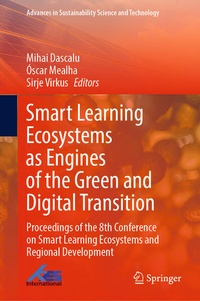
Smart Learning Ecosystems as Engines of the Green and Digital Transition
Description

The book brings together the contributions of the 8th International Conference on Smart Learning Ecosystems and Regional Development aimed at promoting reflection and discussion on the relevance of smart learning ecosystems for regional development and social innovation (e.g., schools, campuses, working places, informal learning contexts) and on how the effectiveness of the relation of citizens and smart ecosystems can be boosted. This forum is interested in understanding how technology-mediated instruments can foster the citizen's engagement with learning ecosystems and territories, namely by understanding innovative human-centric design and development models/techniques, education/training practices, informal social learning, innovative citizen-driven policies, technology-mediated experiences, and their impact. This set of concerns contributes to fostering the social innovation sectors and ICT, economic development, and deployment strategies alongside new policies for smarter proactive citizens.
More details
Other editions
Additional editions
Persons
Mihai Dascalu is a professor at the University Politehnica of Bucharest with a strong background in Computer Science applied to Education. He has extensive experience in national and international research projects with more than 300 published papers, including 30 articles at top-tier conferences, 100+ papers indexed by ISI at renowned international conferences, and 10+ Q1 journal papers. Complementary to his competencies in NLP, technology-enhanced learning, and discourse analysis, Mihai holds a multitude of professional certifications and extensive experience on strategic projects on non-refundable funds. Moreover, Mihai obtained a Senior Fulbright scholarship in 2015, has become a Fulbright ambassador since 2018, and holds a US patent. Mihai is also a corresponding member of the Academy of Romanian Scientists.
Óscar Mealha is a full professor at the Department of Communication and Art, University of Aveiro (UA), Portugal. He develops his research at DigiMedia Research Centre/UA, in the area of "Information and Communication in Digital Platforms" in the context of "Knowledge Media and Connected Communities" with several projects, masters and doctoral supervisions, and publications on interaction design and analysis techniques and methods, namely for UX design and evaluation, usability evaluation, and visualization of interaction/infocommunication activity. He is involved in infocommunication mediation projects such as "Unified Communication & Collaboration" with IT companies, "Visualization of Open Data Dashboards for Citizen Engagement and Learning" in municipalities and smart territories, and "Knowledge Interface School-Society (KISS)" with school clusters within the scientific network ASLERD. He is currently the director of 2 doctoral programs: one on New Media and the other on Information and Communication in Digital Platforms, a joint program of the University of Aveiro and University of Porto.Sirje Virkus is a professor of Information Science and Head of the Study Area of Information Sciences at the School of Digital Technologies at Tallinn University. She holds a Ph.D. in Information and Communication Studies from the Manchester Metropolitan University. She has an extensive experience working with educational innovation and research in the higher education sector in Estonia. She was one of the initiators and teachers of the international collaborative Erasmus Mundus MA program Digital Library Learning (DILL) (2007-2020). Her research interests are focused on the development of information-related competencies (data literacy, information literacy, digital literacy, media literacy), ICT innovation in education, and internationalization. She has written more than 250 research publications. She belongs to the editorial board of several high-quality scientific journals and conference program committees and book series. She has received the State Decoration with the Order of the White Star (4th Class) of the Estonian President in 2021 and appointed as an alumni of the Century of Tallinn University (among 100 people who have made a significant contribution to the development of Estonian society, education, and culture) in 2019.
