

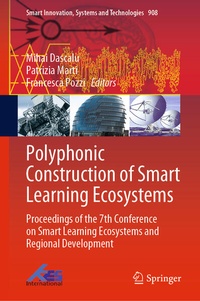
Polyphonic Construction of Smart Learning Ecosystems
Description

The book brings together the contributions of the 7th International Conference on Smart Learning Ecosystems and Regional Development (SLERD 2022), which aims at promoting reflection and discussion concerning R&D work, policies, case studies, and entrepreneur experiences with a special focus on understanding the relevance of smart learning ecosystems (e.g., schools, campus, working places, informal learning contexts, etc.) for regional development and social innovation and how the effectiveness of the relation of citizens and smart ecosystems can be boosted. This forum has a special interest in understanding how technology mediated instruments can foster the citizen's engagement with learning ecosystems and territories, namely by understanding innovative human-centric design and development models/techniques, education/training practices, informal social learning, innovative citizen-driven policies, technology mediated experiences, and their impact. This set of concerns will contribute to foster the social innovation sectors and ICT and economic development and deployment strategies alongside new policies for smarter proactive citizens.
More details
Other editions
Additional editions
Persons
Mihai Dascalu is a professor at University Politehnica of Bucharest with a strong background in Computer Science applied in Education. He has extensive experience in national and international research projects with more than 200 published papers, including 30 articles at top-tier conferences, 80+ papers indexed ISI at renowned international conferences, and 10+ Q1 journal papers. Complementary to his competencies in NLP, technology-enhanced learning and discourse analysis, Mihai holds a multitude of professional certifications and extensive experience on strategic projects on non-refundable funds. Moreover, Mihai has obtained a Senior Fulbright scholarship in 2015, has become a fulbright ambassador since 2018, and holds the US patent. Mihai is also a corresponding member of the Academy of Romanian Scientists.
Patrizia Marti is a professor of Experience Design at the University of Siena. She is the director and Rector's delegate of Santa Chiara Fab Lab where she manages several participatory innovation projects with external partners. Patrizia has an interdisciplinary background in design, philosophy, and computing and a Ph.D. in Interaction Design. Her research activity concerns designing interactive systems in various fields of application including special education for people with disability also mediated by robots. He has been a principal investigator on many EU-funded projects. She has been an expert advisor to many EU and international bodies, including EU Commission, EU Future & Emerging Technologies Program, EU Intelligent Information Interfaces, Eurocontrol, EU Disappearing Computer, UX group at University of Warsaw (Poland), and Swedish Agency for Innovation Systems. She has been an invited keynote speaker at various international conferences. She has also been the editor for special issues of international journals.
Francesca Pozzi is a lead researcher at the Istituto Tecnologie Didattiche (ITD) - CNR (Consiglio Nazionale delle Ricerche), where her main research area is the theory and practice of Technology Enhanced Learning (TEL). In particular, her main research interests include learning design; collaborative learning; computer supported collaborative learning (CSCL); teacher training and innovation in education; from formal to non-formal learning: ICT in cultural heritage education; technology enhanced learning for healthcare professionals' training. She is the co-editor of the Italian Journal of Educational Technology (IJET) and is a member of various scientific boards and committees of international journals and conferences of the field. She has participated in and led several international research projects in TEL. She has published over 180 scientific papers, including +10 on Q1 journals, and several on books and conference proceedings (overall about 90 papers indexed in Scopus, 19 h-index).
