

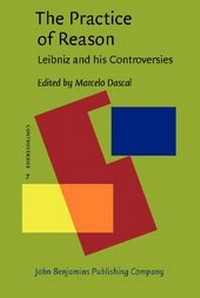
The Practice of Reason
Leibniz and his Controversies
1st Edition
Published on 4. March 2010
XVI, 359 pages
978-90-272-8867-7 (ISBN)
Description

Gottfried Wilhelm Leibniz (1646-1716) dedicated much of his life to some of the most central debates of his time. For him, our chance of progress towards the happiness of mankind lies in the capacity to recognize the value of the different perspectives through which humans approach the world. Controversies supply the opportunity to exercise this capacity by approaching the opponent not as an adversary but as someone from whose point of view we can enrich our own viewpoint and improve our knowledge.
This approach inspired the creation of this series. The book - the first in the series devoted to Leibniz - presents his views through actual controversies in which he participated, in several domains. Leibniz's original 'theory of controversies' thus appears not only as what the thinker thinks about how one should use reason in a controversy, but also how he puts in practice the kind of rationality he preaches.
This approach inspired the creation of this series. The book - the first in the series devoted to Leibniz - presents his views through actual controversies in which he participated, in several domains. Leibniz's original 'theory of controversies' thus appears not only as what the thinker thinks about how one should use reason in a controversy, but also how he puts in practice the kind of rationality he preaches.
More details
Other editions
Additional editions
Book
03/2010
John Benjamins Publishing Co
€111.30
Shipment within 10-15 days
Person
Content
- The Practice of Reason
- Editorial page
- Title page
- LCC data
- Table of contents
- Foreword
- Abbreviations
- Contributors
- 1. The principle of continuity and the 'paradox' of Leibnizian mathematics
- 1. Introduction
- 2. "New Calculus" and "Combinatorial Game"
- 3. The Leibnizian 'paradox'
- 4. The letter to Varignon
- 5. The principle of continuity as a solution of the paradox
- 6. The reception of the calculus
- 7. Variations about the "principle"
- 8. Architectonics?
- 9. The principle of continuity and some of its consequences in current mathematics: The schema of "proof by continuity"
- 10. The continuity schema and "mathematical intuition"
- Notes
- References
- 2. Geometrization or mathematization
- 1. Infinitesimal methods in Huygens's works
- 2. Huygens vs. Leibniz on the mathematization of physics
- 3. Conclusions
- Notes
- References
- 3. Leibniz and the vis viva controversy
- 1. Introduction
- 2. Descartes's principle of conservation of quantity of motion
- 3. Leibniz's criticism of the Cartesian conservation principle
- 4. Descartes's mistake
- 5. Leibniz's positive view - suppressing mv
- 6. Metaphysical reasons for preferring living force over "progress"
- 7. Some speculations on Leibniz's motives
- 7.1 The case of Malebranch e
- 8. Conclusion
- Notes
- References
- 4. The controversy between Leibniz and Papin
- 1. Introduction
- 2. What kind of relation obtains between the public controversy and the correspondence?
- 3. The obviousness of a difference
- 3.1 The stakes in the correspondence
- 3.2 The objects of the public controversy reshaped by the correspondence
- 3.3 The principles of conservation discussed in the correspondence:The status of "insensible matter"
- 4. Leibniz attempts to bring Papin over to his dynamics
- 5. The effects of the controversy on Leibniz's thought
- 6. Conclusion
- Notes
- References
- 5. Leibniz vs. Stahl
- 1. Introduction
- 2. The medical controversy
- 2.1 Old and modern controversy concerning the concept of cause
- 2.2 The artificial and the natural
- 2.3 Anatomy and phy siology
- 2.4 The model's status: Reduction or analogy
- 2.5 The touch stone for the passage from the machine to the living:The infinite
- 2.6 Medical value of the heart's and the body's union theory
- 2.7 The living, air, water, and pl aces
- 2.8 Medicine and phy sics: Continuity or rupture?
- 3. Chemistry
- 3.1 The element and the mixed
- 3.2 The laws of the mix
- 3.3 Is there continuity or rupture between the mixed and the living?
- 4. Philosophy of nature
- 4.1 Nature
- 4.2 Natures
- Notes
- References
- 6. Leibniz's conciliatory approaches in scientific controversies
- 1. Introduction
- 2. The disjunctive option: "Both explanations are good"
- 2.1 Leibniz on reconciliation
- 2.2 The mech anistic opp osition
- 2.3 The optics case
- 2.4 Expression, signs, and conciliation
- 3. Integrating the opposites
- 3.1 On what it takes to conciliate
- 4. The metaphysical link
- 5. A final note
- Notes
- References
- 7. Leibniz vs. Lamy
- 1. Introduction
- 2. Lamy vs. Leibniz on incomplete entities and confused perception
- 3. Leibniz and the controversy over the co-extension of soul and body in early modern Aristotelianism
- 4. Incomplete entities and confused perception in Leibniz's correspondence with Rémond
- Notes
- References
- 8. Leibniz vs. Foucher
- 1. Introduction
- 2. The purpose of the SN and the differences between the different versions
- 3. Leibniz's argumentative strategies in the SN
- 4. The contents of SN
- 5. The prehistory of SN and the controversy with Foucher
- 6. The SN and the correspondence between Leibniz and Foucher
- 7. The public confrontation, or the controversy itself
- 8. Leibniz's text and Foucher's reaction
- 9. Leibniz's answer
- 10. Conclusion
- Notes
- References
- 9. Quantification of natural and positive laws
- 1. Introduction
- 2. The safeties and privileges theory
- 3. The problem to solve
- 4. The way to resolve the problem
- Notes
- References
- 10. Leibniz's critique of Pufendorf
- 1. Introduction
- Notes
- References
- 11. Leibniz vs. Jablonski
- 1. The problem
- 2. Impulses of an intra-Protestant reconciliation around 1697
- 3. Jablonski's Kurtze Vorstellung (1697)
- 4. The position of Molanus
- 5. Leibniz's method
- Notes
- References
- 12. The golden rule
- 1. Introduction
- 2. The satanic stratagem
- 3. Schism and innovation
- 4. Innovators in philosophy and theology
- 5. The method of the ignorant
- 6. The method of moderation
- 7. The golden rule I: The first test of generalization
- 8. True love and prudence
- 9. The golden rule II: The second test of generalization
- 10. Conclusion
- Notes
- References
- 13. Leibniz vs. Bossuet
- 1. Controversy or negotiation?
- 1.1 Negotiation: An "expedient"
- 1.2 Controversy: The obstacl e
- 2. The art of controversy
- 2.1 From controversy to conversion
- 2.2 The logic of controversy
- 2.3 Controversy in matters of religion
- Notes
- References
- Name index
- Subject index
- The series Controversies
