

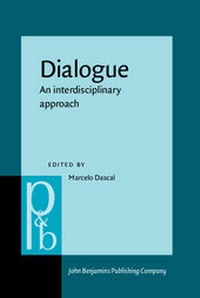
Dialogue
An interdisciplinary approach
1st Edition
Published on 1. January 1985
XIV, 473 pages
978-90-272-7955-2 (ISBN)
Description

Dialogue: An interdisciplinary approach is a pioneering collection of papers that take Dialogue Studies out of its 'classic' narrow definition into the study of the complexities and processes in dialogue. It is a first move toward interdisciplinary research in Dialogue Studies.
More details
Other editions
Additional editions
Book
01/1985
John Benjamins Publishing Co
€165.36
Shipment within 10-15 days
Persons
Content
- DIALOGUE
- Editorial page
- Title page
- Copyright page
- Table of contents
- LIST OF CONTRIBUTORS
- PREFACE
- INTRODUCTION
- NOTES
- REFERENCES
- I. FOUNDATIONS
- 2. COMMUNICATION AND CONVENTION
- NOTES
- REFERENCES
- 3. DU DIALOGISMEALA FORME DIALOGUEE: SUR LES FONDEMENTS DE L'APPROCHE PRAGMATIQUE
- NOTES
- REFERENCES
- 4. METAPHOR, FOLK THEORIES, AND THE POSSIBILITIES OF DIALOGUE
- 0. Introduction
- 1. Conceptual metaphors
- 1.1 Orientational metaphors
- 1.2. Ontological metaphors
- 1.3. Structural metaphors
- 2. Metaphors have entailments
- 3. Metaphorical definitions: Partial, inconsistent, and overlapping
- 4. The grounding of metaphorical concepts in experience
- 5. Metaphor, folk theory, and discourse
- 6. What the CONDUIT metaphor can t do
- NOTE
- REFERENCES
- 5. TOWARD A PRAXIS-ORIENTED THEORY OF ARGUMENTATION
- 1. Problems of interpretation of statements made in the course of a discussion
- 2. Models for rational discussion and formal dialectics
- 3. Dialogical logic
- 4. Development of dialectically useful languages
- 5. Fallacies
- 6. Rules for verbal and other behavior that will help to promote or to improve a climate of discussion
- 7. Dialectical companies
- 8. Models of wager (betting)
- 9. Adversary statistics
- 10. Connections with action theory
- 11. The reformulation of modern semantic theories
- 12. The study of anti-dialectical attitudes, anti-dialectical concepts of rationality, and anti-dialectical aspects of current 'natural' languages
- NOTE
- REFERENCES
- II. THE GENESIS OF DIALOGUE
- 6. QUESTION-ANSWERINGAND OPERATIONS IMPLIED IN INFORMATIVE INTERACTIONBETWEEN THE AGES OF 3.0 AND 4.4 YEARS
- NOTES
- REFERENCES
- 7. ON CONDITIONALS AS DIALOGUE CONSTRUCTS
- NOTES
- REFERENCES
- 8. DIALOGUE SUSTENTION STRATEGIESANDTHE ADULT VIEW OF PHONOLOGICAL DEVELOPMENT
- ACKNOWLEDGEMENT
- NOTES
- REFERENCES
- III. THE MECHANISMS OF DIALOGUE
- 9. LOGICFOR RATIONAL DIALOGUE
- NOTE
- REFERENCES
- 10. ON A FORMAL STRUCTURE OF DIALOGUE
- 1. Introduction
- 2. Units in dialogue actions
- 3. Meaning
- 4. Meaning of a unit
- 5. Units and their contexts
- 6. Verbal and praxical copies
- 7. Perception of a unit
- REFERENCES
- 11. ARGUMENTATIVE OPERATORS AND DIALOGUE
- NOTES
- REFERENCES
- 12. CONTEXTS AS CONSTRAINTS ON UNDERSTANDING IN A DIALOGUE SITUATION
- NOTES
- REFERENCES
- IV. SPEECH ACTS REVISITED
- 13. WHAT IS AN ILLOCUTIONARY FORCE?
- 0. Introduction
- 1. The components of illocutionary force
- 1.1. Illocutionary point
- 1.2. The mode of achievement
- 1.3. The degree of strength of the illocutionary point
- 1.4. Propositional content conditions
- 1.5. Preparatory conditions
- 1.6. Sincerity conditions
- 1.7. Degree of strength of sincerity conditions
- 1.8. Definition of the notion of illocutionary force
- 1.9. Definition of the conditions of success
- 1.10.Definitionofa non-defective illocutionary act
- 1.11. Definition of the conditions of satisfaction
- 1.12. Definition of an ideal speech act
- 2. A recursive definition of the set of all illocutionary forces
- 2.1. On primitive illocutionary forces
- 2.2. On the operations on illocutionary forces
- 3. Illocutionary entailment
- 4. The cooperative principles of conversation
- REFERENCES
- 14. TO HELL WITH SPEECH ACT THEORY
- REFERENCES
- 15. PRAGMATIC UNIVERSALS AND COMMUNICATIVE ACTION
- NOTES
- REFERENCES
- APPENDIX
- WHY AND FOR WHAT
- V. IALOGUEAND THE STRUCTURE OF LANGUAGE
- 16. SENTENCESIN CONVERSATIONAL TURNS: A CASE OF SYNTACTIC 'DOUBLE BIND
- 1. Introduction
- 2. Double-bind sentence structures
- 3. Contextual functions
- 4. Conclusions
- NOTES
- REFERENCES
- 17. DIALOGUEAND THE SELECTION OF DATA FOR A GRAMMAR
- 1. Introduction
- 1.1. The problem
- 1.2. The thesis
- 2. Homogeneity
- 2.1. Introduction
- 2.2. Evidence
- 3. Heterogeneity and dialogue
- 3.1. Introduction
- 3.2.2. A proposed solution
- 3.2. Evidence from Pirahä
- 3.2.1. The situation
- 3.3. Multiple competence approach
- 3.4. Further evidence
- 3.4.1. Synchronic studies
- 3.4.2. Diachronic studies
- 4. Conclusion
- 4.1. Systematicity vs. regularity
- 4.2. Alternative models
- 4.3. Final notes
- NOTES
- REFERENCES
- 18. THE BELIZEAN COPULA: A CASE OF SEMANTACTIC SHIFT
- 1. Introduction
- 2. Methodology
- 3. Distribution of da/a and de
- 4. Arguments contra popular da/a
- 4.1. da/a and the anterior marker me
- 4.2. da/a and negation
- 5. da/a as focusing element
- 6. Da/aas shift in creolization
- 7. Conclusion
- NOTES
- REFERENCES
- VI. DIALOGUE,INTERSUBJECTIVITY, AND THE MIND
- 19. INTENTIONALITY AND ITS LANGUAGE-DEPENDENCY
- NOTES
- REFERENCES
- 20. COMMUNICATING ABOUT THE CONTENTS OF OTHER MINDS
- NOTE
- REFERENCES
- 21. WHAT DOES TALKING TO ONESELF' MEAN?
- REFERENCES
- 22. MARTIN BUBER'S CENTRALINSIGHT: IMPLICATIONS FOR HIS PHILOSOPHY OF DIALOGUE
- 0. Introduction
- 1. Buber's central insight
- 2. Implications of the central insight
- 2.1. Spirit
- 2.2. Faith
- 2.3. Trust
- 3. Meaning the other
- 4. Relationships between Buber and Gadamer
- 5. Conclusion
- NOTES
- POSTSCRIPT
- REFERENCES
- VII. KINDSOF DIALOGUE
- 23. DISCUSSING OR CONVINCING:AN APPROACH TOWARDS A PRAGMATICAL STUDY OFTHE LANGUAGES OF SCIENCE.
- 1. Formal symbolism and scientific communication
- 2. A polemic tract: Pascal's letter to the Reverend Noël (October 29, 1647)and to Mr. Le Pailleur (February 16, 1648)
- 3. A heuristic dialogue
- 4. An example of didactic presentation
- 5. Science and its languages
- NOTES
- REFERENCES
- 24. SCIENCE AND CONTROVERSY
- NOTES
- REFERENCES
- 25. GRIPING' AS A VERBALRITUAL INSOME ISRAELI DISCOURSE
- 1. Introduction
- 2. The Griping Ritual
- 2.1. Topic
- 2.2. Purpose
- 2.3. Channel
- 2.4. Participants
- 2.5. Setting
- 2.6. Key
- 2.7. Act sequence
- 3. Concluding remarks
- NOTES
- REFERENCES
- 26. SCHOOL DISCOURSE AS DIALOGUE?
- 0. Introduction
- 1. Emphatic conceptions of dialogue for classroom instruction
- 2. Teaching-learning discourse
- 3. Classroom discourse
- 4. Forms of linguistic action in classroom discourse
- 4.1. Scholastic and non-scholastic forms of action
- 4.2. The didactic question
- 4.3. Delivering solutions
- 4.4. Turn organization
- 4.5. The futility of student criticism of the teacher
- 5. Classroom discourse and dialogue
- NOTES
- REFERENCES
- VIII. RUPTURE IN DIALOGUE
- 27. DIALOGUE BREAKDOWNS
- REFERENCES
- 28. THE MAKING AND BREAKING OF DIALOGUE
- REFERENCES
- 29. THE RELEVANCE OF MISUNDERSTANDING
- NOTES
- REFERENCES
- SUBJECT INDEX
- NAME INDEX
