

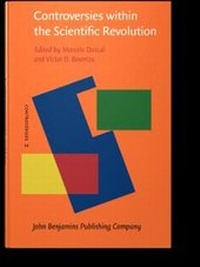
Controversies Within the Scientific Revolution
1st Edition
Published in December 2011
VI, 287 pages
978-90-272-8254-5 (ISBN)
Description

From the beginning of the Scientific Revolution around the late sixteenth century to its final crystallization in the early eighteenth century, hardly an observational result, an experimental technique, a theory, a mathematical proof, a methodological principle, or the award of recognition and reputation remained unquestioned for long. The essays collected in this book examine the rich texture of debates that comprised the Scientific Revolution from which the modern conception of science emerged. Were controversies marginal episodes, restricted to certain fields, or were they the rule in the majority of scientific domains? To what extent did scientific controversies share a typical pattern, which distinguished them from debates in other fields? Answers to these historical and philosophical questions are sought through a close attention to specific controversies within and across the changing scientific disciplines as well as across the borders of the natural and the human sciences, philosophy, theology, and technology.
More details
Other editions
Additional editions
Marcelo Dascal | Victor D. Boantza
Controversies Within the Scientific Revolution
Book
11/2011
John Benjamins Publishing Co
€111.30
Shipment within 10-15 days
Persons
Content
- Controversies Within the Scientific Revolution
- Editorial page
- Title page
- LCC data
- Table of contents
- Introduction: Controversies and the dialectical texture of the Scientific Revolution
- Part I. Astronomy and mechanics
- Honoré Fabri S. J. and Galileo's law of fall: What kind of controversy?
- 1. Introduction
- 2. The emergence of Fabri's theory of free fall
- 3. Fabri's argument in context
- References
- Galileo, the Jesuits, and the controversy over the comets
- 1. Introduction
- 2. The arguments
- 3. The Assayer
- 4. The price: Back to Aristotelianism
- 5. The rival: The Jesuits' mild instrumentalism
- 6. The supremacy of the instrument
- 7. Radical instrumentalism
- References
- Fair-mindedness versus sophistry in the Galileo affair
- 1. Introduction
- 2. Antonio Querenghi
- 3. Querenghi's reports on Galileo in Rome in 1615-1616
- 4. Misinterpretations of Querenghi's reports
- 5. More careful critical analysis of Querenghi's reports
- 6. Deeper analysis of Querenghi's key point: Fair-mindedness
- 7. Galileo's reflective formulation of the fairness principle
- 8. Galileo's fair-minded practice: Venus objection
- 9. Galileo's fair-minded practice: Extrusion objection
- 10. Recapitulation and next step
- 11. Strengthening the sophistry objection vs. Galileo
- 12. Additional strengthening of the sophistry objection
- 13. Conclusion
- References
- Part II. Light and gravity
- From cohesion to pesanteur: The origins of the 1669 debate on the causes of gravity
- 1. Introduction
- 2. The causes of gravity
- 3. The Newtonian context: Forces, big and small
- 4. The causes of coagulation: Chymistry and mechanism
- 5. Conclusion
- References
- Leibniz versus Newton on the nature of gravity and planetary motion
- 1. Introduction
- 2. Two competing theories
- 3. Natural versus miraculous
- 4. Methodology and the role of hypotheses
- 5. Conclusion
- References
- The argumentative use of methodology: Lessons from a controversy following Newton's first optical paper
- 1. Scientific debates and the emergence of modern science
- 2. A brief overview of the controversy and its historiography
- 3. The methodology of reconstruction and the position of the protagonist
- 4. Understanding the position of the historian
- 5. The natural, the social, and the argumentative
- 6. How to read charitably
- 7. The consequences of 'radical dialectification'
- 8. Conclusions
- Acknowledgements
- References
- Part III. Physiology and vitalism
- Salient theories in the fossil debate in the early Royal Society
- 1. Introduction
- 2. Context
- 3. Martin Lister and his theory of fossils: A refutation of Helmont
- 4. Robert Plot and fossilisation
- 5. Conclusion
- Acknowledgements
- References
- Were the arguments of William Harvey convincing to his contemporaries?
- 1. Introduction
- 2. Harvey: Between observation and reasoning
- 3. Blood circulation: Discovery and invention
- 4. Blood circulation: Justification and demonstration
- 5. Blood circulation: Fulfillment and acceptance
- 6. Harvey's proof as argumentation
- References
- Why was there no controversy over life in the Scientific Revolution?
- 1. Introduction
- 2. Was life a controversial topic in early modern natural philosophy?
- 3. Machines of nature, ferments, and chemical metaphysics
- 4. Constitutive materialist ontology of life or gradual constitution of biology?
- 5. Conclusion
- References
- Part IV. Human sciences and theology
- The pre-Adamite controversy and the problem of racial difference in seventeenth-century natural phil
- 1. Introduction
- 2. Early modern polygenesis theory
- 3. Hale's bio-geographical account of human diversity
- 4. François Bernier's "New Division of the Earth"
- 5. Leibniz: Race as generational series
- 6. Conclusion
- References
- Scientific revolution in the moral sciences: The controversy between Samuel Pufendorf and the Luther
- 1. The controversy on the foundations of natural law
- 2. Two eras in the history of moral doctrines
- 3. Two eras in the history of controversy
- References
- Contributors
- Index
