

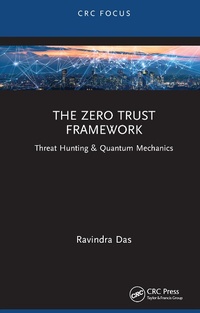
The Zero Trust Framework
Threat Hunting & Quantum Mechanics
1st Edition
Published on 25. May 2023
158 pages
978-1-000-92247-9 (ISBN)
Description

The Cybersecurity landscape is a daunting one today. It is nothing like it was 10 years ago. Now, it has become very complex, covert, dynamic, and stealthy. It has literally become a cat and mouse game, in which the Cyberattacker is still one step ahead. This is despite all of the technology that is available to us a society, which includes Artificial Intelligence (AI) and Machine Learning.
Part of the other problem is that human beings are resistant to change. For example, the password is still the favored way of authenticating and authorizing an individual, but it too has shown its grave limitations. Despite the use of Password Managers, which can create long and complex passwords, people still resort to their old fashioned ways of doing things.
So what is needed now is an extreme change, in which, unfortunately, people have no choice in whether or not they will participate. It is called the Zero Trust Framework, and in this methodology, absolutely nobody can be trusted in either the internal or the external environments. The mantra here is to keep verifying everybody, all the time.
The Zero Trust Framework also involves the concept of segmentation, in which the IT and Network Infrastructure of a business is broken down into smaller components, much like a Subnet. Each component will have its own layer of security, and every individual must be authenticated via the use of Multifactor Authentication (MFA).
In this book, we review both the concepts and mechanics behind the Zero Trust Framework. We also introduce advanced technologies into it, including the use of Biometrics, the Public Key Infrastructure, and Quantum Mechanics/Quantum Cryptography.
Part of the other problem is that human beings are resistant to change. For example, the password is still the favored way of authenticating and authorizing an individual, but it too has shown its grave limitations. Despite the use of Password Managers, which can create long and complex passwords, people still resort to their old fashioned ways of doing things.
So what is needed now is an extreme change, in which, unfortunately, people have no choice in whether or not they will participate. It is called the Zero Trust Framework, and in this methodology, absolutely nobody can be trusted in either the internal or the external environments. The mantra here is to keep verifying everybody, all the time.
The Zero Trust Framework also involves the concept of segmentation, in which the IT and Network Infrastructure of a business is broken down into smaller components, much like a Subnet. Each component will have its own layer of security, and every individual must be authenticated via the use of Multifactor Authentication (MFA).
In this book, we review both the concepts and mechanics behind the Zero Trust Framework. We also introduce advanced technologies into it, including the use of Biometrics, the Public Key Infrastructure, and Quantum Mechanics/Quantum Cryptography.
More details
Edition
1. Auflage
Language
English
Place of publication
London
United Kingdom
Publishing group
Taylor & Francis Ltd
Target group
College/higher education
Professional and scholarly
Illustrations
4 Tables, black and white; 25 Line drawings, black and white; 8 Halftones, black and white; 33 Illustrations, black and white
ISBN-13
978-1-000-92247-9 (9781000922479)
Copyright in bibliographic data and cover images is held by Nielsen Book Services Limited or by the publishers or by their respective licensors: all rights reserved.
Schweitzer Classification
Other editions
Additional editions
Book
11/2024
1st Edition
CRC Press
€31.00
Shipment within 10-20 days
Book
05/2023
1st Edition
CRC Press
€78.00
Shipment within 10-20 days
Person
Ravindra Das is a Cybersecurity Consultant with his own practice, RaviDas.Tech, Inc. (ravidas.consulting). He is Certified in Cybersecurity by the ISC(2), and has written and published 9 books with CRC Press, and self-published 24 eBooks on Amazon. His portfolio can be seen at: cybersecuritycontent.news
Content
1. Introduction. 2. The Fundamental Components of the Zero Trust Framework. 3. The Public Key Infrastructure and Bio Cryptography. 4. The Zero Trust Framework. 5. Threat Modeling/Threat Hunting. 6. Conclusions.
