

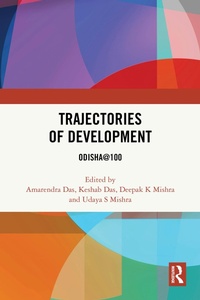
Trajectories of Development
Odisha@100
Published on 29. May 2026
560 pages
978-1-040-92530-0 (ISBN)
Description

Trajectories of Development: Odisha@100 offers a comprehensive, interdisciplinary and interpretative analysis of Odisha's tryst with the economic, social and governance challenges through policy and parastatal initiatives since the state's formation in 1936 to the present day. Positioned within the global debates on uneven regional growth, the volume examines Odisha's recent economic resurgence while probing its distributional, ecological and social implications.
The book traces the Indian state's historical antecedents-marked by colonial exploitation and disparate functioning of the myriad princely states-and its transformation into a formally unified subnational entity. Sector-specific chapters analyse agriculture, mining, manufacturing, and services, complemented by district-level insights. The volume explores developments in education, health, and demography, and examines possibilities of emerging frontiers of tourism, and tribal economy. Additional chapters assess poverty, unemployment, food security, fiscal management, disaster governance, neglect of natural resources, displacement, distress migration, unfolding of media, and roles of private and civil society actors.
This volume will benefit scholars of development studies, economics, political economy, regional planning, and public policy, as well as practitioners and administrators of development. Readers will gain a nuanced, empirically grounded understanding of Odisha's developmental journey and a forward-looking roadmap as the state approaches its centenary in 2036.
The book traces the Indian state's historical antecedents-marked by colonial exploitation and disparate functioning of the myriad princely states-and its transformation into a formally unified subnational entity. Sector-specific chapters analyse agriculture, mining, manufacturing, and services, complemented by district-level insights. The volume explores developments in education, health, and demography, and examines possibilities of emerging frontiers of tourism, and tribal economy. Additional chapters assess poverty, unemployment, food security, fiscal management, disaster governance, neglect of natural resources, displacement, distress migration, unfolding of media, and roles of private and civil society actors.
This volume will benefit scholars of development studies, economics, political economy, regional planning, and public policy, as well as practitioners and administrators of development. Readers will gain a nuanced, empirically grounded understanding of Odisha's developmental journey and a forward-looking roadmap as the state approaches its centenary in 2036.
Reviews / Votes
'This book is a commendable stock taking effort on the socio-economic development process of Odisha since its formation. With an extensive coverage of issues from the perspective of various disciplines, it will contribute to policy making and public debate as the state marches forward in the coming years.'- Manoj Panda, Member, Sixteenth Finance Commission of India and Former Director of Institute of Economic Growth, Delhi
'This fascinating book offers a rigorous, interdisciplinary analysis of Odisha's development journey, combining historical depth and institutions with sectoral insights. It is a must read for policymakers, scholars, and practitioners interested in Odisha's future and transformation.'
- Sudipta Sarangi, Professor of Economics, Virginia Tech
'This book offers a rigorous, interdisciplinary account of Odisha's development, from colonial exploitation and regional disparities to recent gains in education, governance, disaster management, urbanisation and sustainability. With an extensive coverage of issues, it provides valuable insights for policymakers and scholars as Odisha advances toward an inclusive Vision 2036.'
- Shruti Mohapatra, CEO Swabhiman, author, scholar, inclusion and accessibility expert
More details
Language
English
Place of publication
London
United Kingdom
Publishing group
Taylor & Francis Ltd
Target group
College/higher education
Product notice
Reflowable
Illustrations
161 Tables, black and white; 94 Line drawings, black and white; 13 Halftones, black and white; 107 Illustrations, black and white
File size
18,97 MB
ISBN-13
978-1-040-92530-0 (9781040925300)
Copyright in bibliographic data and cover images is held by Nielsen Book Services Limited or by the publishers or by their respective licensors: all rights reserved.
Schweitzer Classification
Other editions
Additional editions
Book
05/2026
1st Edition
Routledge
€201.50
Shipment within 15-20 days
Persons
Amarendra Das is an Associate Professor at the School of Humanities and Social Sciences, NISER Bhubaneswar, and founder of its DST-Centre for Policy Research on Energy Transition. He previously served as Deputy Director in the 14th Finance Commission and taught at Utkal University. He was the secretary of the Odisha Economic Association during 2018 to 2023. He received the Global Development Medal in 2009. He holds an MA from Utkal University and an MPhil and PhD from CDS-JNU.
Keshab Das is Visiting Professor, Institute for Human Development, New Delhi; Adjunct Professor, Institute for Studies in Industrial Development, New Delhi; and Director, Centre for Research in Regions & Development, Bhubaneswar. With M.Phil. (Applied Economics) and Ph.D. (Economics) degrees from Jawaharlal Nehru University (through Centre for Development studies, Trivandrum) he is a recipient of the VKRV Rao Prize in Social Sciences (Economics). He is the Editor-in-Chief of Odisha Economic Journal and a former President of Odisha Economic Association.
Deepak K Mishra is a Professor of Economics at the Centre for the Study of Regional Development, School of Social Sciences, Jawaharlal Nehru University, New Delhi. His recent books include Global Poverty: Rethinking Causality (co-edited, Brill, 2023) and Internal Migration in Contemporary India (edited, Routledge, 2026).
Udaya S Mishra, a Statistician/Demographer is professor in the dept of Epidemiology and Bio-statistics at the International Institute for Population Sciences, Mumbai and formerly professor at the Centre for Development Studies Trivandrum, Kerala. He is engaged in research and teaching on population and development issues with a number of national and international publications to his credit.
Keshab Das is Visiting Professor, Institute for Human Development, New Delhi; Adjunct Professor, Institute for Studies in Industrial Development, New Delhi; and Director, Centre for Research in Regions & Development, Bhubaneswar. With M.Phil. (Applied Economics) and Ph.D. (Economics) degrees from Jawaharlal Nehru University (through Centre for Development studies, Trivandrum) he is a recipient of the VKRV Rao Prize in Social Sciences (Economics). He is the Editor-in-Chief of Odisha Economic Journal and a former President of Odisha Economic Association.
Deepak K Mishra is a Professor of Economics at the Centre for the Study of Regional Development, School of Social Sciences, Jawaharlal Nehru University, New Delhi. His recent books include Global Poverty: Rethinking Causality (co-edited, Brill, 2023) and Internal Migration in Contemporary India (edited, Routledge, 2026).
Udaya S Mishra, a Statistician/Demographer is professor in the dept of Epidemiology and Bio-statistics at the International Institute for Population Sciences, Mumbai and formerly professor at the Centre for Development Studies Trivandrum, Kerala. He is engaged in research and teaching on population and development issues with a number of national and international publications to his credit.
Content
1. Introduction: Odisha's Development Trajectory 2. The Making of Modern Odisha: A Historical Perspective 3. Roots of Economic Retrogression in Colonial Odisha 4. Odisha's Economic Growth Transition Amidst Distributional Concerns 5. Agenda Towards a People's Political Economy of Development in Odisha 6. Fiscal Trajectories of Odisha: From Subsistence to Surplus 7. Demography is Destiny: Tracing the Demographic Transition and its Prospects in Odisha 8. Evolving Social Context of Odisha 9. Towards a Sustainable and Equitable Development of Odisha Agriculture 10. Industrialisation in Odisha: Potential and Policy Prejudice 11. Export Performance and Policy Dynamics in Odisha: An Evolving Industrial Landscape 12. Employment: Employment and Migration in Odisha: Emerging Challenges and Opportunities 13. Poverty in Odisha: Past, Present, and Future 14. Healthcare In Odisha: A Historical Sketch, Current Challenges and Future Strategies 15. Food Security and Nutrition in Odisha for Achieving Sdg-2 16. Preparing Odisha for a Knowledge Economy: Education and Skills 17. Development of Scheduled Tribes in Odisha: Status, Gaps and Prospects 18. Urbanisation in Odisha: Challenges, Opportunities, and Policy Directions 19. Tourism: Odisha's Unrealized Potential 20. Marginalisation, Dispossession and Natural Resource-based Livelihoods: What Eludes Odisha? 21. Environment, Climate Change and Natural Disaster in Odisha 22. Regional Disparities and Uneven Development in Odisha 23. Role of State and Non-State Actors in Odisha's Development 24. Conclusion and the Way Forward
