

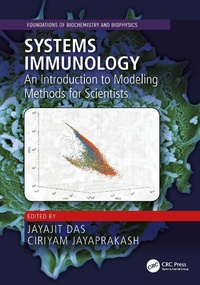
Systems Immunology
An Introduction to Modeling Methods for Scientists
1st Edition
Published on 3. September 2018
354 pages
978-1-4987-1741-0 (ISBN)
Description

"Taken together, the body of information contained in this book provides readers with a bird's-eye view of different aspects of exciting work at the convergence of disciplines that will ultimately lead to a future where we understand how immunity is regulated, and how we can harness this knowledge toward practical ends that reduce human suffering. I commend the editors for putting this volume together."
-Arup K. Chakraborty, Robert T. Haslam Professor of Chemical Engineering, and Professor of Physics, Chemistry, and Biological Engineering, Massachusetts Institute of Technology, Cambridge, USA
New experimental techniques in immunology have produced large and complex data sets that require quantitative modeling for analysis. This book provides a complete overview of computational immunology, from basic concepts to mathematical modeling at the single molecule, cellular, organism, and population levels. It showcases modern mechanistic models and their use in making predictions, designing experiments, and elucidating underlying biochemical processes. It begins with an introduction to data analysis, approximations, and assumptions used in model building. Core chapters address models and methods for studying immune responses, with fundamental concepts clearly defined.
Readers from immunology, quantitative biology, and applied physics will benefit from the following:
Fundamental principles of computational immunology and modern quantitative methods for studying immune response at the single molecule, cellular, organism, and population levels.
An overview of basic concepts in modeling and data analysis.
Coverage of topics where mechanistic modeling has contributed substantially to current understanding.
Discussion of genetic diversity of the immune system, cell signaling in the immune system, immune response at the cell population scale, and ecology of host-pathogen interactions.
-Arup K. Chakraborty, Robert T. Haslam Professor of Chemical Engineering, and Professor of Physics, Chemistry, and Biological Engineering, Massachusetts Institute of Technology, Cambridge, USA
New experimental techniques in immunology have produced large and complex data sets that require quantitative modeling for analysis. This book provides a complete overview of computational immunology, from basic concepts to mathematical modeling at the single molecule, cellular, organism, and population levels. It showcases modern mechanistic models and their use in making predictions, designing experiments, and elucidating underlying biochemical processes. It begins with an introduction to data analysis, approximations, and assumptions used in model building. Core chapters address models and methods for studying immune responses, with fundamental concepts clearly defined.
Readers from immunology, quantitative biology, and applied physics will benefit from the following:
Fundamental principles of computational immunology and modern quantitative methods for studying immune response at the single molecule, cellular, organism, and population levels.
An overview of basic concepts in modeling and data analysis.
Coverage of topics where mechanistic modeling has contributed substantially to current understanding.
Discussion of genetic diversity of the immune system, cell signaling in the immune system, immune response at the cell population scale, and ecology of host-pathogen interactions.
More details
Series
Edition
1. Auflage
Language
English
Place of publication
London
United Kingdom
Publishing group
Taylor & Francis Ltd
Target group
College/higher education
Illustrations
10 Tables, black and white; 73 Illustrations, black and white
File size
29,38 MB
ISBN-13
978-1-4987-1741-0 (9781498717410)
Copyright in bibliographic data and cover images is held by Nielsen Book Services Limited or by the publishers or by their respective licensors: all rights reserved.
Schweitzer Classification
Other editions
Additional editions
Jayajit Das | Ciriyam Jayaprakash
Systems Immunology
An Introduction to Modeling Methods for Scientists
Book
03/2021
1st Edition
CRC Press
€75.10
Shipment within 15-20 days
Jayajit Das | Ciriyam Jayaprakash
Systems Immunology
An Introduction to Modeling Methods for Scientists
Book
09/2018
CRC Press
€349.12
Shipment within 15-20 days
Persons
Jayajit Das, Ph.D., is Assistant Professor of Pediatrics at the Wexner Medical Center, The Ohio State University, and Battelle Center for Mathematical Medicine, The Research Institute at Nationwide Children's Hospital, both in Columbus, Ohio. He obtained his Ph.D. in statistical physics from The Institute of Mathematical Sciences and Raman Research Institute, India. He was a postdoctoral research associate at Virginia Tech, University of California, Berkeley, and Massachusetts Institute of Technology, prior to joining OSU. He is a member of the American Physical Society, author of many published journal articles, and invited speaker at numerous international conferences.
Ciriyam Jayaprakash, Ph.D., is Professor in the Department of Physics at The Ohio State University in Columbus, Ohio. He earned his doctorate in physics from the University of Illinois at Urbana-Champaign, and was a postdoctoral associate at Cornell University as well as a visiting scientist at the IBM Watson Research Center prior to joining the faculty of OSU. He is the recipient of a prestigious Alfred P. Sloan Foundation Fellowship and NSF Presidential Young Investigator Award, and is an elected Fellow of the American Physical Society. His current research interests include modeling of viral antagonists and immune system response, stochastic effects in subcellular processes, and applications of nonlinear dynamics.
Ciriyam Jayaprakash, Ph.D., is Professor in the Department of Physics at The Ohio State University in Columbus, Ohio. He earned his doctorate in physics from the University of Illinois at Urbana-Champaign, and was a postdoctoral associate at Cornell University as well as a visiting scientist at the IBM Watson Research Center prior to joining the faculty of OSU. He is the recipient of a prestigious Alfred P. Sloan Foundation Fellowship and NSF Presidential Young Investigator Award, and is an elected Fellow of the American Physical Society. His current research interests include modeling of viral antagonists and immune system response, stochastic effects in subcellular processes, and applications of nonlinear dynamics.
Content
1. Introduction to Basic Concepts in Immunology 2. Overview of Mechanistic Modeling: Techniques, Approximations, and Assumptions 3. The Fundamentals of Statistical Data Analysis 4. Using Data to Guide Model Construction: Application of Principal Component Analysis and Related Methods in Immunology Research 5. An Introduction to Rule-based Modeling of Immune Receptor Signaling 6. Boolean Models in Immunology 7. From evolutionary computation to phenotypic spandrels: inverse problem for immune ligand recognition 8. Zen and the Art of Parameter Estimation in Systems Biology 9. Spatial Kinetics in Immunological Modeling 10. Analysis and modeling of single cell data 11. Quantifying lymphocyte receptor diversity 12. Antigen receptor diversification during immune responses 13. Quantitative Modeling of Mast Cell Signaling 14. Physical models in immune signaling 15. Population Dynamics of Host and Pathogens 16. Viral fitness landscapes: A physical sciences perspective 17. A wish-list for modeling immunological synapses
