

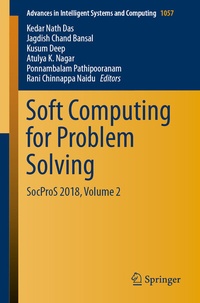
Soft Computing for Problem Solving
Description

More details
Other editions
Additional editions
Persons
Dr. Kedar Nath Das is an Assistant Professor at the Department of Mathematics, National Institute of Technology, Silchar, Assam, India. Over the past 10 years, he has made substantial contributions to research on soft computing, and has published several research papers in prominent national and international journals. His chief area of interest is in evolutionary and bio-inspired algorithms for optimization.
Dr. Jagdish Chand Bansal is an Associate Professor at the South Asian University, New Delhi, India and visiting research fellow at Liverpool Hope University, Liverpool, UK. He has an excellent academic record and is a leading researcher in the field of swarm intelligence. Further, he has published numerous research papers in respected international and national journals.
Prof. Kusum Deep is a Professor at the Department of Mathematics, Indian Institute of Technology Roorkee, India. Over the past 25 years, her research has made hera central international figure in the areas of nature-inspired optimization techniques, genetic algorithms and particle swarm optimization.
Prof. Atulya Nagar holds the Foundation Chair as Professor of Mathematical Sciences and is Dean of the Faculty of Science at Liverpool Hope University, UK. Prof. Nagar is an internationally respected scholar working at the cutting edge of theoretical computer science, applied mathematical analysis, operations research, and systems engineering. He received a prestigious Commonwealth Fellowship for pursuing his doctorate (DPhil) in Applied Non-Linear Mathematics, which he earned from the University of York (UK) in 1996; and he holds BSc (Hons.), MSc, and MPhil (with Distinction) from the MDS University of Ajmer, India.
Prof. P. Ponnambalam is an Associate Professor at the School of Electrical Engineering, VIT University, India. His areas of research interests are Multilevel Converters, Fuzzy controller for multilevel converters, MPC controllers, Thermoelectric Generators for Solar Photo voltaic cells areas in which he is actively publishing. He is having 15 years of teaching experience.
Prof. Rani Chinnappa Naidu received the B.Eng. and M.Tech. degrees from VIT University, Vellore, India, and Ph.D. degree from Northumbria University, Newcastle upon Tyne, UK., all in Electrical Engineering. After that, she joined as a Postdoctoral Researcher in Northumbria Photovoltaic Applications Centre, Northumbria University, UK. She is currently an Associate Professor at VIT University. She is an Senior member in IEEE. She leads an appreciable number of research groups and projects in the areas such as solar photovoltaic, wind energy, power generation dispatch, power system optimization, and artificial intelligence techniques.
Content
