

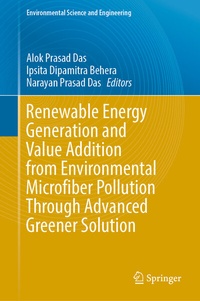
Renewable Energy Generation and Value Addition from Environmental Microfiber Pollution Through Advanced Greener Solution
Description

The majority of clothes we use regularly are made up of plastic-based materials like polyester, rayon, nylon, and acrylic. When these garments are washed in laundries, they give out tiny plastic fragments termed microfibers which end up in the environment and more precisely in the oceans. Plastic and synthetic polymer wastes which are often irresponsibly discarded into natural habitats undergo bio-fragmentation to give out huge amounts of microplastics and microfibers. Synthetic microfiber pollution has been reported in diverse ecosystems ranging from land and aquatic ecosystem to shorelines and seafloors. Due to the miniature size of the microfibers, it is difficult to detect, investigate, and prevent this type of pollution that is occurring on a larger scale. It is estimated that millions of tons of microfibers are released into the ocean from various sources. They are more toxic because they are more persistent and take a long time to degrade, and it gets accumulated in the environment along with other pollutants. This increases the chances of living organisms in the biosphere ingesting the synthetic microfibers causing harm to the ecosystem and entering into the food chain adversely affecting human beings. It had become a great field of research because of its abundance and the challenges in the identification of synthetic and semisynthetic microfibers from the environmental samples and the time it takes to be degraded. This book focuses on renewable energy generation and value addition from environmental microfiber pollution through advanced greener solution, thus building an economic supportable society as an elementary need of developing countries.
More details
Other editions
Additional editions
Persons
Dr. Ipsita D Behera is Assistant Professor, Department of Chemical Engineering, Indira Gandhi Institute of Technology, Saranga, Odisha, India. Her research is focused on development of bioremediation technology and process modernization in the area of petroleum waste management. She has published several research articles in leading and high impact journals of international repute. She is Academician and Author of several Journal articles. She has more than 14 years of teaching experience. Her area of expertise is environmental pollution control, petroleum hydrocarbon pollution, and its sustainable management. Dr. Narayan Prasad Das is Emeritus Scientist, Toxicology Department, State Forensic Science Laboratory, Odisha, India. His research is focused on aquatic pesticide pollution, its effect on aquatic species, and bioremediation technology. He has more than 20 years of research experience. His area of expertise is aquatic pesticide pollution and its impact on aquaticspecies, sustainable management of the environment pollutants.
