

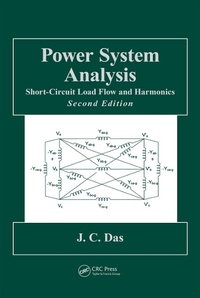
Power System Analysis
Short-Circuit Load Flow and Harmonics, Second Edition
2nd Edition
Published on 19. December 2017
1092 pages
978-1-4398-2080-3 (ISBN)
Description

Fundamental to the planning, design, and operating stages of any electrical engineering endeavor, power system analysis continues to be shaped by dramatic advances and improvements that reflect today's changing energy needs. Highlighting the latest directions in the field, Power System Analysis: Short-Circuit Load Flow and Harmonics, Second Edition includes investigations into arc flash hazard analysis and its migration in electrical systems, as well as wind power generation and its integration into utility systems.
Designed to illustrate the practical application of power system analysis to real-world problems, this book provides detailed descriptions and models of major electrical equipment, such as transformers, generators, motors, transmission lines, and power cables. With 22 chapters and 7 appendices that feature new figures and mathematical equations, coverage includes:
Short-circuit analyses, symmetrical components, unsymmetrical faults, and matrix methods
Rating structures of breakers
Current interruption in AC circuits, and short-circuiting of rotating machines
Calculations according to the new IEC and ANSI/IEEE standards and methodologies
Load flow, transmission lines and cables, and reactive power flow and control
Techniques of optimization, FACT controllers, three-phase load flow, and optimal power flow
A step-by-step guide to harmonic generation and related analyses, effects, limits, and mitigation, as well as new converter topologies and practical harmonic passive filter designs-with examples
More than 2000 equations and figures, as well as solved examples, cases studies, problems, and references
Maintaining the structure, organization, and simplified language of the first edition, longtime power system engineer J.C. Das seamlessly melds coverage of theory and practical applications to explore the most commonly required short-circuit, load-flow, and harmonic analyses. This book requires only a beginning knowledge of the per-unit system, electrical circuits and machinery, and matrices, and it offers significant updates and additional information, enhancing technical content and presentation of subject matter. As an instructional tool for computer simulation, it uses numerous examples and problems to present new insights while making readers comfortable with procedure and methodology.
Designed to illustrate the practical application of power system analysis to real-world problems, this book provides detailed descriptions and models of major electrical equipment, such as transformers, generators, motors, transmission lines, and power cables. With 22 chapters and 7 appendices that feature new figures and mathematical equations, coverage includes:
Short-circuit analyses, symmetrical components, unsymmetrical faults, and matrix methods
Rating structures of breakers
Current interruption in AC circuits, and short-circuiting of rotating machines
Calculations according to the new IEC and ANSI/IEEE standards and methodologies
Load flow, transmission lines and cables, and reactive power flow and control
Techniques of optimization, FACT controllers, three-phase load flow, and optimal power flow
A step-by-step guide to harmonic generation and related analyses, effects, limits, and mitigation, as well as new converter topologies and practical harmonic passive filter designs-with examples
More than 2000 equations and figures, as well as solved examples, cases studies, problems, and references
Maintaining the structure, organization, and simplified language of the first edition, longtime power system engineer J.C. Das seamlessly melds coverage of theory and practical applications to explore the most commonly required short-circuit, load-flow, and harmonic analyses. This book requires only a beginning knowledge of the per-unit system, electrical circuits and machinery, and matrices, and it offers significant updates and additional information, enhancing technical content and presentation of subject matter. As an instructional tool for computer simulation, it uses numerous examples and problems to present new insights while making readers comfortable with procedure and methodology.
Reviews / Votes
"The usefulness of this text comes from showing how to calculate and analyze many aspects of the power system without relying on a computer analysis. ... [A] very useful text for an undergraduate or even graduate course in power engineering. ... It would also make for a good reference book for practicing power system engineers."- IEEE Electrical Insulation Magazine, Vol. 20, No. 1, Jan/Feb 2004
More details
Series
Edition
2nd edition
Language
English
Place of publication
Baton Rouge
United States
Publishing group
Taylor & Francis Inc
Target group
College/higher education
Undergraduate and graduate students in power engineering and circuits, researchers, those currently working in power engineering or circuits.
Edition type
Revised edition
Illustrations
479 s/w Abbildungen, 154 s/w Tabellen
154 Tables, black and white; 479 Illustrations, black and white
File size
20,61 MB
ISBN-13
978-1-4398-2080-3 (9781439820803)
Copyright in bibliographic data and cover images is held by Nielsen Book Services Limited or by the publishers or by their respective licensors: all rights reserved.
Schweitzer Classification
Other editions
Additional editions
Book
03/2017
2nd Edition
CRC Press
€156.50
Shipment within 10-20 days
Book
07/2011
2nd Edition
CRC Press
€383.30
Shipment within 15-20 days
Person
J.C. Das is a consultant with Electrical Power Systems in Atlanta, Georgia.
Content
Short-Circuit Currents and Symmetrical Components. Unsymmetrical Fault Calculations. Matrix Methods for Network Solutions. Current Interruption in AC Networks. Application and Ratings of Circuit Breakers and Fuses according to ANSI Standards. Short Circuit of Synchronous and Induction Machines. Short-Circuit Calculations according to ANSI Standards. Short-Circuit Calculations according to IEC Standards. Calculations of Short-Circuit Currents in DC Systems. Load Flow over Power Transmission Lines. Load Flow Methods: Part I. Load Flow Methods: Part II. Reactive Power Flow and Control. Three-Phase and Distribution System Load Flow. Optimization Techniques. Optimal Power Flow. Harmonics Generation. Effects of Harmonics. Harmonic Analysis. Harmonic Mitigation and Filters. Arc Flash Hazard Analysis. Wind Power. Appendices.
