

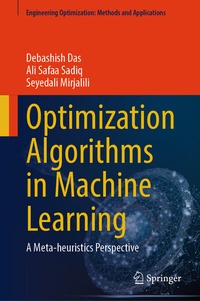
Optimization Algorithms in Machine Learning
Description

This book explores the development of several new learning algorithms that utilize recent optimization techniques and meta-heuristics. It addresses well-known models such as particle swarm optimization, genetic algorithm, ant colony optimization, evolutionary strategy, population-based incremental learning, and grey wolf optimizer for training neural networks. Additionally, the book examines the challenges associated with these processes in detail. This volume will serve as a valuable reference for individuals in both academia and industry.
More details
Other editions
Additional editions
Persons
Debashish Das is currently teaching at the Faculty of Computer, Engineering & The Built Environment at Birmingham City University, United Kingdom. He obtained his BSc, Master's, and Ph.D. degrees in Computer Science in 1999, 2002, and 2019, respectively. With over 22 years of teaching and research experience at prominent universities in the UK, Malta, Malaysia, and Bangladesh, his research interests encompass artificial intelligence, optimization, data science, machine learning algorithms, biomedical applications, and programming languages. He has authored numerous scientific and research articles in reputable national and international journals and conferences.
Ali Safa Sadiq received his B.Sc., M.Sc., and Ph.D. degrees in computer science in 2004, 2011, and 2014, respectively. He has served as a Lecturer in the School of Information Technology at Monash University, Malaysia, and as a Senior Lecturer in the Department of Computer Systems and Networking at the Faculty of Computer Systems and Software Engineering, University Malaysia Pahang, Malaysia. Currently, he is a faculty member at the School of Science and Technology at Nottingham Trent University, UK. Sadiq has published several research articles in well-known international journals and conferences. He has been involved in five research projects, three of which focus on network and security, while the others focus on analyzing and forecasting floods in Malaysia. He has supervised three Ph.D. students, three Master's students, and various undergraduate final year projects. His current research interests include wireless communications, network security, and AI applications in networking.
Seyedali Mirjalili is a Professor at the Center for Artificial Intelligence Research and Optimization at Torrens University. He is internationally recognized for his contributions to nature-inspired artificial intelligence techniques, with over 600 published works. The Australian newspaper acknowledged him as a global leader in Artificial Intelligence and a national leader in the fields of Evolutionary Computation and Fuzzy Systems. Dr. Mirjalili is a senior member of IEEE and holds editorial positions at several top AI journals.
Content
Challenges and opportunities in Machine Learning using optimization techniques.- Optimization methods: traditional versus stochastic.- Heuristic and meta-heuristic optimization algorithms.- A comprehensive review of evolutionary algorithms and swarm intelligence methods.- Artificial Neural Networks: structure and learning.- A survey of Neural Networks trained by optimization algorithms and meta-heuristics.
