

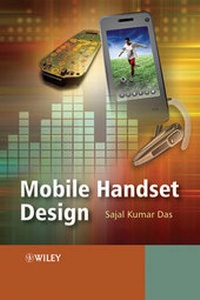
Mobile Handset Design
Description

More details
Other editions
Additional editions

Person
Sajal Kumar Das is a Senior Team Leader for GSM/GPRS/EDGE Solution Development at the Nokia R&D Center in Bangalore, India. He has over a decade of industry experience in software development, wireless telecommunication systems, protocol stack development, as well as design and programming of Layer 1, DSP, and embedded systems. In addition to his time with Nokia, Das has worked at Texas Instruments, STMicroelectronics, Lucent Technologies, and Bharat Electronics. Das holds joint BS degrees in Physics and Electronics and Communication Engineering from Calcutta University along with a Masters from IIT Kharagpur in Electronics and Telecommunication Engineering, specializing in microwave signal and system engineering.
Content
Introduction.
1 Introduction to Mobile Handsets.
1.1 Introduction to Telecommunication.
1.2 Introduction to Wireless Telecommunication Systems.
1.3 Evolution of Wireless Communication Systems.
2 Problem Analysis in Mobile Communication System.
2.1 Introduction to Wireless Channels.
2.2 Impact of Signal Propagation on Radio Channel.
2.3 Signal Attenuation and Path Loss.
2.4 Link Budget Analysis.
2.5 Multipath Effect.
2.6 Delay Spread.
2.6.1 Coherent BW (Bc).
2.7 Doppler Spread.
2.8 Fading.
2.9 Signal Fading Statistics.
2.10 Interference.
2.11 Noise.
3 Design Solutions Analysis for Mobile Handsets.
3.1 Introduction.
3.2 Diversity.
3.3 Channel Estimation and Equalization.
3.4 Different Techniques for Interference Mitigation.
3.5 Channel Coding.
3.6 Automatic Repeat Request (ARQ) and Incremental Redundancy.
3.7 Interleaving.
3.8 Modulation.
3.9 Bit Rate, Baud Rate, and Symbol Rate.
3.10 Inband Signaling.
Further Reading.
4 Mobile RF Transmitter and Receiver Design Solutions.
4.1 Introduction to RF Transceiver.
4.2 Mixer Implementations.
4.3 Receiver Front-End Architecture.
4.4 Receiver Performance Evaluation Parameters.
4.5 Transmitter Front-End Architecture.
4.6 Transmitter Architecture Design.
4.7 Transmitter Performance Measure.
5 Wireless Channel Multiple Access Techniques for Mobile Phones.
5.1 Introduction to Multiple Access Techniques.
5.2 Frequency Division Multiplexing.
5.3 Duplexing Techniques.
5.4 Spectral Efficiency.
5.5 Code Division Multiple Access.
5.6 Orthogonal Frequency Division Multiplex Access (OFDMA).
References.
Further Reading.
6 GSM System (2G) Overview.
6.1 Introduction.
6.2 History of GSM.
6.3 Overview of GSM Network Architecture.
6.4 PLMN and Network Operators.
6.5 GSM Mobility and Roaming.
6.6 GSM PLMN Services.
6.7 GSM Interfaces.
6.8 GSM Subscriber and Equipment Identity.
Further Reading.
7 GSM Radio Modem Design: From Speech to Radio Wave.
7.1 Introduction.
7.2 GSM Logical Channels.
7.3 GSM Physical Channel.
7.4 GSM Bursts.
7.5 Burst RF Output Spectrum.
7.6 Channel Allocation.
7.7 GSM Frame Structure.
7.8 Combination of Logical Channels.
7.9 Physical Layer Processing for Logical Channel Transmission and Reception Procedures.
7.10 Design of Transmitter and Receiver Blocks for GSM Radio Modem.
Further Reading.
8 GSM Mobile Phone Software Design.
8.1 Introduction to GSM Mobile Handset Software.
8.2 Operating System Software.
8.3 Device Driver Software.
8.4 GSM System Protocol Software.
8.5 Speech and Multimedia Application Software.
References.
9 GSM Mobile Phone Operations and Procedures.
9.1 Initial Procedures after Mobile Power ON.
9.2 Idle Mode.
9.3 Location Updating.
9.4 Security Procedure.
9.5 Access Mode.
9.6 Handover.
9.7 Radio Resource Control Procedure.
9.8 Mobility Management Procedure.
9.9 Call Routing.
9.10 Power Control.
9.11 Discontinuous Transmission and Reception.
9.12 Frequency Hopping.
Further Reading.
10 Anatomy of a GSM Mobile Handset.
10.1 Introduction to the GSM Handset.
10.2 Functional Blocks Inside a GSM Mobile Phone.
10.3 Hardware Block Diagram of a Mobile Phone.
10.4 GSM Transmitter and Receiver Module.
10.5 Antenna.
10.6 Analog to Digital Conversion (ADC) Module.
10.7 Automatic Gain Control (AGC) Module.
10.8 Automatic Frequency Correction Module.
10.9 Loudspeaker.
10.10 Microphone (MIC).
10.11 Subscriber Identity Module (SIM).
10.12 Application Processing Unit.
10.13 Camera.
10.14 LCD Display.
10.15 Keypad.
10.16 Connectivity Modules.
10.17 Battery.
10.18 Clocking Scheme.
10.19 Alert Signal Generation.
10.20 Memory.
10.21 GSM Receiver Performance.
References.
Further Reading.
11 Introduction to GPRS and EDGE (2.5G) Supported Mobile Phones.
11.1 Introduction.
11.2 System Architecture.
11.3 Services.
11.4 Session Management, Mobility Management, and Routing.
11.5 GPRS Protocol Architecture.
11.6 Air Interface-Physical Layer.
11.7 Packet Data Transport Across Layers.
11.8 Channel Coding and Puncturing.
11.9 Cell Re-selection.
11.10 Radio Environment Monitoring.
11.11 Multi-Slot Class.
11.12 Dual Transfer Mode (DTM).
11.13 EDGE (Enhanced Data Rates for GSM Evolution) Overview.
11.14 Latest Advancements in GERAN (GSM/GPRS/EDGE Radio Access Network) Standard.
Further Reading.
12 UMTS System (3G) Overview.
12.1 Introduction.
12.2 Evolution of the 3G Network.
12.3 UTRAN Architecture.
12.4 Different Interfaces in the UMTS System.
12.5 Data Rate Support.
12.6 Service Requirement and Frequency Spectrum.
12.7 Cell Structure.
12.8 UTRAN Function Description.
12.9 Function Partition Over Iub.
Further Reading.
13 UMTS Radio Modem Design: From Speech to Radio Wave.
13.1 Introduction.
13.1.1 FDD System Technical Parameters.
13.2 Frequency Bands.
13.3 Radio Link Frame Structure.
13.4 Channel Structure.
13.5 Spreading, Scrambling, and Modulation.
13.6 Uplink Physical Channels.
13.7 Downlink Physical Channels.
13.8 Timing Relationship between Physical Channels.
13.9 Transmitter Characteristics.
13.10 Different Channel Usage in Various Scenarios.
13.11 Compressed Mode.
Further Reading.
14 UMTS Mobile Phone Software and Operations.
14.1 Introduction to UMTS Protocol Architecture.
14.2 Protocol Structure.
14.3 UE Protocol Architecture.
14.4 Procedures in the UE.
14.5 Mobility Procedures in Connected Mode.
14.6 Other Procedures during Connected Mode.
14.7 Security Procedures.
14.8 Measurement Procedures.
14.9 Handover Procedure.
14.10 Cell Update.
14.11 High-Speed Downlink Packet Access (HSDPA).
14.12 High-Speed Uplink Packet Access (HSUPA).
14.13 IP Multimedia Subsystem (IMS).
Further Reading.
15 Anatomy of a UMTS Mobile Handset.
15.1 Introduction.
15.2 Mobile System Architecture.
15.3 UE Hardware Architecture and Components.
15.4 Multirate User Data Transmission.
15.5 Implementation of UE System Procedures.
15.5.2 Power Control.
15.6 Design of the UMTS Layer-1 Operation States.
Further Reading.
16 Next Generation Mobile Phones.
16.1 Introduction.
16.2 3GPP LTE.
16.3 LTE System Design.
16.4 IEEE 802.16 System.
16.5 4G Mobile System.
16.6 Key Challenges in Designing 4G Mobile Systems and Research Areas.
16.7 Cognitive Radio.
Further Reading.
17 Competitive Edge in Mobile Phone System Design.
17.1 Introduction.
17.2 Key Challenges in Mobile Phone System Design.
17.3 System Design Goal.
17.4 Protocol Architecture Design Optimization.
17.5 Hardware/Software Partitioning.
17.6 System Performance.
17.7 Adaptability.
17.8 Verification, Validation, and Testing.
17.9 Productization.
Further Reading.
Index.
