

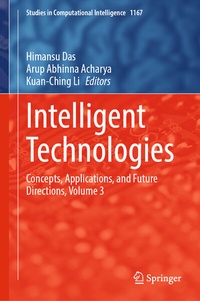
Intelligent Technologies
Description

This book discusses automated computing systems which are mostly powered by intelligent technologies like artificial intelligence, machine learning, image recognition, speech processing, cloud computing, etc., to perform complex automated tasks which are not possible by traditional computing systems. The chapters are extended version of research works presented at third PhD Research Symposium in various advanced technologies used in the field of computer science. This book provides an opportunity for the researchers to get ideas regarding the ongoing works that help them in formulating problems of their interest. The academicians can also be benefited to know about the current research trends that smooth the way to guide their students to carry out research work in the proper direction. The industry people will be also facilitated to know about the current advances in research work and materialize the research work into industrial applications.
More details
Other editions
Additional editions
Persons
Himansu Das, works as Associate Professor in the School of Computer Engineering, Kalinga Institute of Industrial Technology (KIIT), Deemed to be University, Bhubaneswar, India. He has received Ph.D. in Engineering degree from Veer Surendra Sai University of Technology (VSSUT), Odisha. He has received M.Tech degree in Computer Science and Engineering from the National Institute of Science and Technology, Odisha. He has also received B.Tech degree from the Institute of Technical Education and Research, Odisha, India. He has published several research papers in various international journals and has presented at conferences. He has also edited several books published by IGI Global, Springer, CRC press, and Elsevier. He has also served on many journals and conferences as editorial or reviewer board member. He is proficient in the field of Computer Science Engineering and served as an organizing chair, a publicity chair and acted as a member of the technical program committees of many national and international conferences. He is also associated with various educational and research societies such as IET, IACSIT, ISTE, UACEE, CSI, IAENG, and ISCA. His research interests include the field of Data Mining, Soft Computing, and Machine Learning. He has also more than twelve years of teaching and research experience in various engineering colleges and universities.
Arup Abhinna Acharya is currently an Associate Professor and Dean Academics in the School of Computer Engineering at the Kalinga Institute of Industrial Technology (KIIT), Deemed to be University, Bhubaneswar, India. He has received his Ph.D. and M.Tech degree in Computer Science and Engineering from the Kalinga Institute of Industrial Technology (KIIT), Deemed to be University, Bhubaneswar, India. He has also received B.Tech degree from the Utkal University, Bhubaneswar, Odisha, India. He has published several research papers in various international journals and has presented at conferences. Heis proficient in the field of Computer Science Engineering and served as an organizing chair, a publicity chair and acted as a member of the technical program committees of many national and international conferences. He is also associated with various educational and research societies such as IET, ISTE, CSI, IAENG, and ISCA. His topics of interest include software engineering, and software testing.
Kuan-Ching Li is currently a Professor in the Department of Computer Science and Information Engineering at the Providence University, Taiwan.Dr. Li is the Editor-in-Chief of technical publications International Journal of Computational Science and Engineering (IJCSE), International Journal of Embedded Systems (IJES) and International Journal of High Performance Computing and Networking (IJHPCN), all published by Interscience, also serving a number of journal's editorial boards and guest editorship. His topics of interest include networked computing, GPU computing, parallel software design, and performance evaluation and benchmarking. Dr. Li is a Fellow of the IET and a senior member of the IEEE.
Content
Enhancing Healthcare with Optimized Computational Models for Disease Diagnosis Using Gene Expression Dataset.- A Unified Deep Learning Framework for Sentiment Analysis of Reviews.- An Efficient Infectious Disease Detection in Plants Using Deep Learning.- Analysis of Cardiovascular Diseases prediction using various Machine Learning and Deep Learning algorithms.- Identifying Humans through Gait Features.
