

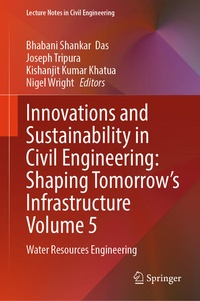
Innovations and Sustainability in Civil Engineering: Shaping Tomorrow's Infrastructure Volume 5
Description

This book represents a seminal collection of advanced research, novel methodologies, and transformative practices within the domains of water resources engineering, hydraulic engineering, and hydrology, with a strong emphasis on the integration of artificial intelligence and machine learning (AI/ML) in civil engineering.
This book embodies the progressive vision and interdisciplinary dialogue of a global academic and professional community committed to revolutionizing water infrastructure and management systems for a resilient and sustainable future. The compendium explores contemporary issues and scientific breakthroughs across a diverse range of topics such as hydrologic modeling, flood forecasting and mitigation, watershed management, groundwater assessment, climate-resilient water infrastructure, and urban storm water systems. It offers comprehensive insights into the design and optimization of hydraulic structures, sediment transport dynamics, erosion control, river engineering, and eco-hydraulics. Special attention is given to sustainable water resource planning, water quality modeling, and integrated water management strategies, reflecting the urgent need for adaptive solutions in the face of climate change and urban expansion.
A significant dimension of this volume is the exploration of AI/ML-driven approaches in civil and water resources engineering. Contributions demonstrate how machine learning algorithms, deep learning models, and data-driven techniques are revolutionizing flood prediction, rainfall-runoff modeling, real-time monitoring, water distribution networks, and decision support systems. These innovations enable more accurate forecasting, enhanced system efficiency, and informed policy making. Serving as an essential reference for researchers, academicians, industry professionals, and policymakers, this book offers a deep dive into state-of-the-art technologies and sustainable practices shaping the next generation of water infrastructure. The breadth and depth of its contributions provide actionable knowledge and strategic insights, fostering a sustainable, data-smart approach to water and hydraulic systems in a rapidly evolving environmental and technological landscape.
More details
Other editions
Additional editions
Persons
Dr. Bhabani Shankar Das is Assistant Professor in the Department of Civil Engineering at the National Institute of Technology (NIT), Patna, specializing in hydraulics and water resources engineering. He obtained his B.Tech. degree from ITER, Bhubaneswar, and subsequently completed his M.Tech. and Ph.D. from NIT Rourkela. His research interests encompass fluvial hydraulics, computational fluid dynamics (CFD), river confluence dynamics, and the application of artificial intelligence and machine learning in water resources engineering. He has authored over 80 peer-reviewed research publications and has presented his work at several international conferences. Dr. Das is Active Reviewer for reputed peer-reviewed journals and has reviewed more than 120 research articles across multiple international journals. Since 2024, he has been serving as Member of the Editorial Board of Scientific Reports. He has also contributed significantly to the academic community through leadership roles at international conferences.
Dr. Joseph Tripura
is Dedicated Assistant Professor specializing in water resources engineering (WRE) at the National Institute of Technology (NIT) Patna. He holds a Ph.D. in water resources engineering, which has equipped him with advanced knowledge and expertise in the field. Additionally, he earned his master's degree (M.Tech.) in water resources engineering, providing him with a solid foundation for his academic and research pursuits. With a good academic background, Dr. Tripura has made significant contributions to civil engineering, particularly in hydrology dynamics, flood risk modeling, and watershed management strategies. His research interests also encompass predictive analytics in hydrology and the application of IoT for water monitoring. In addition to his teaching responsibilities, Dr. Tripura has taken on various administrative roles, including Assistant Co-Coordinator for the Unnat Bharat Abhiyan (UBA) and Assistant Faculty In-Charge for the National Service Scheme (NSS) at NIT Hamirpur.
Prof. K.K. Khatua
is Distinguished Professor of civil engineering who was Former Dean (AIIR) at National Institute of Technology Rourkela, with over 30 years of teaching/research/administrative experiences in the field of water resources engineering, river hydraulics and hydrology, computational fluid mechanics. After completing his Ph.D. from NIT Rourkela and B. Tech. and master from VSSUT Burla, he has been continuously striving to enrich the research and development in the field of river hydraulics, computational fluid dynamics, and river and flood management. He has supervised 14 doctoral and 150 master and 50 graduate thesis mostly in the area of free surface flow and fluid dynamics. Prof Khatua is currently handling the charge of Coordinator and Head, Centre for Mahanadi Basin Management and Studies at NIT Rourkela (sponsored by Ministry of Jala Shakti, GoI).
Professor Nigel Wright has held several senior academic leadership roles, including the Deputy Vice-Chancellor (Research and Enterprise) at Nottingham Trent University and Pro Vice-Chancellor (Research) at De Montfort University. He was also Professor at the University of Leeds and held dual appointments at the UNESCO-IHE and the Technical University of Delft, advancing education and research in river basin development and hydraulic engineering on a global scale. His academic foundation includes a Ph.D. in mechanical engineering from the University of Leeds and a B.Sc. (Hons) in mathematics from the University of Bristol. His extensive research has focused on flood resilience, sediment transport, urban water systems, and the impacts of climate change on hydrological processes. He has authored more than 140 peer-reviewed publications, including in high-impact journals such as Nature, Geophysical Research Letters, and Journal of Hydrology.
Content
Strategies to improve flood resilience in Kosi River basin of Northern Bihar.- Flow Modelling Using Conveyance Estimation System: A Case Study of Musi River.- AI-Based Estimation of Scour Depths for Stronger Structures.- Numerical Simulation of Local Scour around a Circular Bridge Pier.- Experimental Study of Flow and Scour around circular bridge pier using protection measures.- Hydrodynamic Simulation of a Hypothetical Breach of the Hirakud Dam Using HEC-RAS.- Prediction of Scour Depth around Bridge Pier using HEC-RAS.- Hydrodynamic Effects of Ripple-Induced Bedforms on Flow Velocity in Open Channels.- Comparative Analysis of Machine Learning Models for Water Level Prediction in the Gandak River Basin.- SWMM-Based Modeling and Assessment of Open Drainage System: A case study of the Proposed New NIT Campus at Bihta, Patna.- Predicting discharge of meandering compound channel using CNN, RNN & LSTM forecasting of rainfall using Arima model.- Geospatial Analysis of Groundwater Recharge Zones in Bengaluru.- Evaluating the Impact of Rainwater Harvesting on Urban Runoff Reduction in Bengaluru.- Effect of Varying Cross-Section Profile on Flood Inundation Modeling in HEC-RAS: A Case Study of Bhima River, India.
