

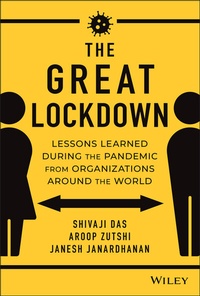
The Great Lockdown
Description

In The Great Lockdown: Lessons Learned During the Pandemic from Organizations Around the Globe, expert strategists Shivaji Das, Aroop Zutshi , and Janesh Janardhanan deliver an insightful exploration of this once-in-a-lifetime event to unearth invaluable learnings for the future. Told through the experiences of CXOs at billion-dollar companies, star start-ups, and non-profits from around the world, the book chronicles the ups and downs of sophisticated organizations as they navigated the COVID-19 crisis through initiatives impacting people, processes, and technology.
* Revealing case studies contributed by the CXOs of companies spanning multiple geographies - from the USA to Iran, Uganda to Hong Kong, and multiple sectors - social media, technology, aviation, luxury retail, healthcare, etc.
* Incisive analyses of the techniques and strategies that worked--or didn't--for organizations during the COVID-19 pandemic, covering the role and evolution of leadership, organizational culture, innovation and digitization
* Practical guidance for business leaders to apply to their own firms in times of great economic upheaval: the next pandemic, climate disasters, cyber-attacks
The leaders contributing their organization's survival and revival stories include those from Julius Baer, SAP, Terumo, IndiGrid, Tapsi, Fonterra, Hornet Networks, Globalization Partners, beCuriou, GoGoX, Abacus Pharma, Real Wear Inc, SOS Children's Villages, Bangalore International Airport, and A Lange & Sohne.
Perfect for executives, managers, and other business leaders, The Great Lockdown is an invaluable addition to the libraries of anyone interested in case studies of corporate resilience and endurance in the face of unprecedented economic challenges.
More details
Other editions
Additional editions
Persons
AROOP ZUTSHI is Global President and Managing Partner at Frost & Sullivan and an advisor to billion-dollar organizations and government agencies around the world. He is a regular speaker at industry events, including Intelligent Mobility Japan, the Growth, Innovation & Leadership Summit, and Impact of COVID-19 on industries.
JANESH JANARDHANAN is Senior Director at Frost & Sullivan. He advises companies in a range of industries, including aerospace, defense, security, transportation, and logistics. He regularly speaks at industry events, including the Impact of COVID-19 on industries, Intelligent Mobility Japan, and other Frost & Sullivan events.
Content
1 Introduction 1
2 A. Lange & Söhne 19
3 Abacus Pharma 33
4 Bangalore International Airport 49
5 beCuriou 67
6 Fonterra 81
7 Globalization Partners 95
8 GOGOX 113
9 Hornet 127
10 IndiGrid 143
11 Julius Baer 157
12 RealWear, Inc 169
13 SAP 179
14 SOS Children's Villages 209
15 Tapsi 225
16 Terumo 241
17 Conclusion 259
About The Authors 265
Index 267
CHAPTER 1
Introduction
By Shivaji Das, Aroop Zutshi, and Janesh Janardhanan
With input from David Frigstad (Chairman, Frost & Sullivan)
COVID-19 has had an unprecedented impact on businesses and daily life. The virus forced the whole world to go into lockdown. As of May 8, 2021,1 more than 3.2 million lives have been lost. The equivalent of 255 million full-time jobs were lost in 2020 alone.2 Industries such as aviation and tourism saw massive declines. Countries, provinces, cities, and even neighborhoods imposed strict controls on movement outside their "borders." Airport terminals were closed, while schools and exhibition venues were converted into treatment and isolation centers. Political upheavals followed, and governments even toppled because of their supposed ineffective handling of the situation. People's behavior changed as they began washing groceries in soapy water and wearing masks when leaving their homes. Suicide rates increased in some societies.
In this context, organizations - for-profit and nonprofit - faced unforeseen challenges. Factories were shut down, supply chains were disrupted, receivables went unpaid, facilities had to be quickly transformed for alternate purposes, and employees fell sick, died, or struggled to turn up at work. Yet the impact was different for various industries. In response, enormous government support schemes were rolled out in major economies. With such support and through quick adaptation to the new conditions, most economies began to see better performance in the second half of 2020. As vaccinations gradually rolled out, the general expectation was that 2022 would witness a global GDP recovery to pre-pandemic levels, despite the devastating COVID-19 second waves in large economies such as India.
This book is an attempt to document the journey of a diverse group of organizations during this tumultuous period that began in early 2020. We selected organizations that come from industries that were most affected by the COVID-19 crisis such as Bangalore International Airport (airport), beCurio (travel), and Tapsi (ride-hailing). We featured organizations such as Terumo, Abacus Pharma (both in healthcare), and SAP (information and communications technology), from sectors that largely benefited from the crisis. We have also included not-for-profit organization such as SOS Children's Villages. These organizations come from all over the world: Uganda, Iran, New Zealand, Hong Kong, India, the US, and Norway, to name a few. We have also ensured that the featured organizations span the range from small and medium enterprises to large global conglomerates, and from young organizations to those with centuries of history. The contributing authors are all chief executive officers or senior leaders in their respective organizations, thereby providing a perspective on the different aspects of economic impact and strategy implementation in order to survive and rebound: human resources, sales, customer experience, finance, operations, technology, and so on.
While the long-term effects as well as any statistical evaluation of the impact of COVID-19 across organizations of different categories will be possible only a few years down the line, through our book we have sought to reveal the early findings of what helped these organizations survive and even excel during the present crisis. This might seem to present the book as a historical account of the business victors, given that many other organizations have disappeared over the last year. A point to note, however, is that the socioeconomic fallout of COVID-19 is far from over, and therefore one of the factors influencing our curatorial choices was to ensure that the showcased organizations have at least made it through the complete unfurling of the current crisis.
Before the Great Lockdown
The years 2010-2019 made for an eventful decade. Some of the world's largest economies saw leadership changes that had significant geopolitical consequences. Xi Jinping came to power in China in the early 2010s. India elected Narendra Modi as prime minister in 2014, and political outsider Donald Trump won the US presidential election in 2016.
The decade saw the Occupy Wall Street protests in 2011, the Eurozone debt crisis, volatile oil prices, Brexit, the emergence of Black Lives Matter in 2013, skirmishes in the South China Sea, the European refugee crisis, rising trade tensions, natural disasters, and the #MeToo movement in 2017.
The world was also more interconnected than ever before. Global trade reached new highs. Approximately 4.5 billion passengers took a scheduled flight in 2019 - the highest number in history. Digital technologies touched businesses and personal lives in significant ways. E-commerce, m-commerce, streaming, and mobile payments were becoming hugely popular worldwide. Automation, artificial intelligence (AI), and robotics took center stage in multiple industries.
In 2018, Apple became the first company with a trillion-dollar market capitalization, quickly followed by Amazon, Microsoft, and Alphabet. Electric cars and solar-powered homes promised a new, sustainable future.
As 2019 drew to a close, the world looked forward to welcoming a new year and a new decade. The global economic prospects looked strong. There were big challenges to be tackled - climate change, income inequality, hunger, water, sanitation, peace - that needed the united attention of the entire world. While new technologies promised to address some of these challenges, the world had its work cut out for the next decade.
But there was troubling news coming out of China. On December 31, 2019, China alerted the World Health Organization (WHO) of 27 cases of viral pneumonia in Wuhan. On January 11, 2020, China reported its first death from the virus. By the third week of January, reports started emerging from Japan, South Korea, Thailand, and the US about cases of the virus. Fears of a scenario like the SARS epidemic of 2002-3 or the swine flu of 2009-10 took hold.
The Unfolding of the COVID-19 Crisis
The seriousness of the "novel coronavirus" became obvious when on January 23, 2020, China decided to completely isolate Wuhan, a city of 11 million people, from the rest of the country. Although only 17 people had died from the virus at this stage, the rising number of international cases showed how quickly the situation was getting out of control.
The WHO declared the disease a global health emergency on January 30.
By February 2, 360 people had died, including the first death outside of China - in the Philippines. On February 7, Chinese doctor Li Wenliang, who had tried to raise the alarm about the disease, died of it. On February 11, the WHO named the virus "Severe Acute Respiratory Syndrome Corona Virus 2 (SARS-CoV-2)" and the disease it caused as "Corona Virus Disease (COVID-19)."
The number of cases began rising sharply around the world even as travel to and from China was halted. By the end of February, deaths were reported in France, Italy, Iran, and the US. The situation was especially serious in Italy and Iran as cases and deaths surged. On March 11, the WHO declared the COVID-19 outbreak a global pandemic. By the end of March, the US led the world in the number of confirmed cases at more than 81,000, with over a thousand deaths. By the end of April, the global deaths surpassed 200,000, with confirmed cases touching 3 million and affecting over 170 countries worldwide.
Hospitals around the world struggled with shortages of isolation wards, beds, ventilators, and personal protective equipment (PPE), and there was no clear line of treatment for COVID-19. Countries had to figure out ways to "flatten the curve," which meant reducing the number of community transmissions in such a way as not to overwhelm hospitals and ICU capacities. Unprecedented times called for unprecedented measures, and countries turned to lockdowns, partial or complete.
By March 20, 2020, countries such as Italy, Saudi Arabia, Denmark, Ireland, Poland, Iran, Spain, the Netherlands, the Philippines, Brazil, Canada, France, Switzerland, Belgium, Malaysia, Argentina, Portugal, and the US had announced either a national or region-specific lockdown. On March 24 India announced a 21-day lockdown for its 1.3 billion people - the longest during the pandemic. By the end of March, over 100 countries had implemented a nationwide or partial lockdown.3
Lockdowns severely disrupted economic activity. For the hundreds of millions of people who depend on daily wages, this meant having no income - and consequently no food. Some governments sprang into action with relief and support programs. In many cases, it fell far short of what would be needed for those most impacted.
The economic disparities and the digital divide in society became even more pronounced during the COVID-19 lockdowns. Millions of logistics and gig economy workers put themselves in harm's way to deliver food and other essentials. While families with computers and good Internet connections switched to online schooling, others who didn't have the means to do so were forced to suspend or stop education.
The COVID-19 pandemic also witnessed something of a healthcare miracle. A vaccine for the disease was developed in less than 12 months - the fastest ever in the history of mankind.
The impact of the COVID-19 lockdowns varied greatly across industries and geographies. While many industries saw a sharp decline as people had to...
