

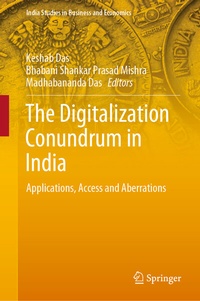
The Digitalization Conundrum in India
Description

More details
Other editions
Additional editions
Persons
Keshab Das is a Professor at the Gujarat Institute of Development Research, Ahmedabad, India. He holds M.Phil. (Applied Economics) and Ph.D. (Economics) degrees from the Jawaharlal Nehru University, New Delhi (through the Centre for Development Studies, Trivandrum). A recipient of the VKRV Rao Prize in Social Sciences (Economics), he has been a Visiting Research Fellow/Faculty at the Tshwane University of Technology, South Africa; University of Insubria, Italy; International Institute of Social Studies, Netherlands; University of Manchester, UK; Institute of Developing Economies, Japan; CNRS-REGARDS, France; Maison des Sciences de l'Homme, France; and Institute of Development Studies, UK. Having published extensively, his research focuses on issues in local and regional development; industrialization strategies; informal sector; MSMEs; innovation; labor; and infrastructure.
Bhabani Shankar Prasad Mishra has been an Associate Professor at the School of Computer Engineering, KIIT University, Bhubaneswar, Odisha, since 2006. He holds a Ph.D. degree in Computer Science from the F.M. University, Balasore, Odisha. He completed his Postdoctoral Research at the Soft Computing Laboratory, Yonsei University, Seoul, South Korea. His research interests include evolutionary computation, neural networks, pattern recognition, data warehousing and mining, and big data. In addition to having published or contributed to more than 40 research papers in peer-reviewed journals and conference proceedings, he has authored one book and co-edited four more. He also serves as an editorial board member for various journals.
Madhabananda Das is a Senior Professor at the School of Computer Engineering at KIIT University, Bhubaneswar, Odisha, with 38 years of working experience including 23 years of teaching and research experience and 15 years in the industry. He holds Ph.D. (KIIT University), M.Tech. (Sambalpur University)and M.B.A. (Xavier Institute of Management) degrees in Computer Science. He has been a faculty member at the University College of Engineering, Burla, and worked at Orissa State Electronics Development Corporation Limited. His research interests include artificial intelligence, soft computing, machine learning, deep learning and natural language processing. He has published or contributed more than 50 research papers in peer-reviewed journals and conference proceedings.
