

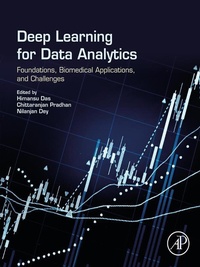
Deep Learning for Data Analytics
Foundations, Biomedical Applications, and Challenges
Published on 29. May 2020
218 pages
978-0-12-822608-7 (ISBN)
Description

Deep learning, a branch of Artificial Intelligence and machine learning, has led to new approaches to solving problems in a variety of domains including data science, data analytics and biomedical engineering. Deep Learning for Data Analytics: Foundations, Biomedical Applications and Challenges provides readers with a focused approach for the design and implementation of deep learning concepts using data analytics techniques in large scale environments. Deep learning algorithms are based on artificial neural network models to cascade multiple layers of nonlinear processing, which aids in feature extraction and learning in supervised and unsupervised ways, including classification and pattern analysis. Deep learning transforms data through a cascade of layers, helping systems analyze and process complex data sets. Deep learning algorithms extract high level complex data and process these complex sets to relatively simpler ideas formulated in the preceding level of the hierarchy. The authors of this book focus on suitable data analytics methods to solve complex real world problems such as medical image recognition, biomedical engineering, and object tracking using deep learning methodologies. The book provides a pragmatic direction for researchers who wish to analyze large volumes of data for business, engineering, and biomedical applications. Deep learning architectures including deep neural networks, recurrent neural networks, and deep belief networks can be used to help resolve problems in applications such as natural language processing, speech recognition, computer vision, bioinoformatics, audio recognition, drug design, and medical image analysis.
- Presents the latest advances in Deep Learning for data analytics and biomedical engineering applications.
- Discusses Deep Learning techniques as they are being applied in the real world of biomedical engineering and data science, including Deep Learning networks, deep feature learning, deep learning toolboxes, performance evaluation, Deep Learning optimization, deep auto-encoders, and deep neural networks
- Provides readers with an introduction to Deep Learning, along with coverage of deep belief networks, convolutional neural networks, Restricted Boltzmann Machines, data analytics basics, enterprise data science, predictive analysis, optimization for Deep Learning, and feature selection using Deep Learning
More details
Other editions
Additional editions
Himansu Das | Chittaranjan Pradhan | Nilanjan Dey
Deep Learning for Data Analytics
Foundations, Biomedical Applications, and Challenges
Book
05/2020
Academic Press
€167.50
Shipment within 15-20 days
Content
Section I Deep Learning Basics and Mathematical Background1. Introduction to Deep Learning2. Probability and information Theory3. Deep Learning Basics4. Deep Architectures5. Deep Auto-Encoders6. Multilayer Perceptron7. Artificial Neural Network8. Deep Neural Network9. Deep Belief Network10. Recurrent Neural Networks11. Convolutional Neural Networks12. Restricted Boltzmann Machines
Section II Deep Learning in Data Science13. Data Analytics Basics14. Enterprise Data Science15. Predictive Analysis16. Scalability of deep learning methods17. Statistical learning for mining and analysis of big data18. Computational Intelligence Methodology for Data Science19. Optimization for deep learning (e.g. model structure optimization, large-scale optimization, hyper-parameter optimization, etc)20. Feature selection using deep learning21. Novel methodologies using deep learning for classification, detection and segmentation
Section III Deep Learning in Engineering Applications22. Deep Learning for Pattern Recognition23. Deep Learning for Biomedical Engineering24. Deep Learning for Image Processing25. Deep Learning for Image Classification26. Deep Learning for Medical Image Recognition27. Deep learning for Remote Sensing image processing28. Deep Learning for Image and Video Retrieval29. Deep Learning for Visual Saliency30. Deep Learning for Visual Understanding31. Deep Learning for Visual Tracking32. Deep Learning for Object Segmentation and Shape Models33. Deep Learning for Object Detection and Recognition34. Deep Learning for Human Actions Recognition35. Deep Learning for Facial Recognition36. Deep Learning for Scene Understanding37. Deep Learning for Internet of Things38. Deep Learning for Big Data Analytics39. Deep Learning for Clinical and Health Informatics40. Deep Learning foe Sentiment Analysis
