

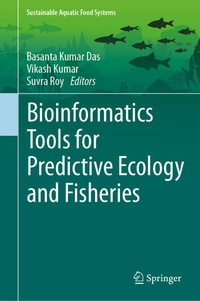
Bioinformatics Tools for Predictive Ecology and Fisheries
Description

This book covers information on bioinformatics tools along with their applications in predictive ecology and fisheries. With the generation of large molecular biological data, the analytical techniques have also undergone recent advancements. Novel algorithms that are specialized to deal with data associated with biological phenomenon, such as gene expression and protein interactions, have been generated. Ecological data analysis has also adopted these advanced bioinformatic tools for a more explorative approach. This book identifies and explains these advanced technologies. It also focuses on the development of models that identify functionally equivalent species in different fish communities to predict functional collapse. Each section of the book is detailed with practical information, step-by-step procedures and relevant illustrations.
This book is a resource for professionals and researchers working in the field of fisheries and bioinformatics.
More details
Other editions
Additional editions
Persons
Dr. Basanta Kumar Das (Director, ICAR-CIFRI) has over 30 years of experience in aquaculture and fish health management. Dr. Das have been associated with projects funded internationally or nationally (GIZ, WorldFish, BOBP, FAO, University of UK, Australia, and Canada, and CSR projects) in the areas of climate change, gender equity, SDG, economic empowerment of the socially backwards women, the Artha-Ganga concept through river ranching and basin approach. He has published more than 500 research papers, 10 books and 40 book chapters. He has 8 patents, 13 copyrights, 7 trademarks and 4 designs.
Dr. Vikash Kumar , working as a scientist at ICAR-CIFRI, completed his bachelor in fisheries science (B.F.Sc.) degree at the College of Fisheries, Central Agricultural University, India. He obtained his Master in Fisheries Science (M.F.Sc.) degree in fish health specialization from the ICAR - Central Institute of Fisheries Education (ICAR-CIFE), India. Later, he moved to Belgium and completed his PhD at the Laboratory of Aquaculture and Artemia Reference Center (ARC), Faculty of Bioscience Engineering, Ghent University, Belgium, in 2020. He has published more than 40 research papers in peer-reviewed journals, and has presented the scientific outputs of his research at international congresses.
Dr. Suvra Roy , working as a scientist at ICAR-CIFRI, completed his bachelor in fisheries science (B.F.Sc.) degree at the College of Fisheries, Central Agricultural University, India. She obtained her Master in Fisheries Science (M.F.Sc.) degree in fish biotechnology specialization from the ICAR - Central Institute of Fisheries Education, India. Later, she moved to Belgium and completed her PhD at the Laboratory of Aquaculture and Artemia Reference Center (ARC), Faculty of Bioscience Engineering, Ghent University, Belgium, in 2020. In the last 10-12 years she has worked on different aspects of the fisheries such as molecular nutrient regulation in fish, small indigenous fish diversity in rivers and associated ecosystems, epigenetics for health management, transgenerational plasticity, and immune priming in shrimp.
