

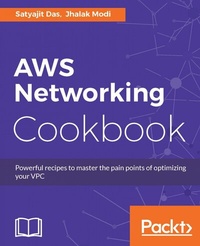
AWS Networking Cookbook
Powerful recipes to overcome the pain points of optimizing your Virtual Private Cloud (VPC)
Published on 8. July 2025
366 pages
978-1-78728-624-5 (ISBN)
Description

No detailed description available for "AWS Networking Cookbook".
All prices
More details
Edition
Digital original
Language
English
Place of publication
Birmingham
United Kingdom
Target group
Professional and scholarly
US School Grade: College Graduate Student
Edition type
Digital original
File size
18,67 MB
ISBN-13
978-1-78728-624-5 (9781787286245)
Copyright in bibliographic data and cover images is held by Nielsen Book Services Limited or by the publishers or by their respective licensors: all rights reserved.
Schweitzer Classification
Other editions
Additional editions
Satyajit Das | Jhalak Modi
AWS Networking Cookbook
Book
08/2017
Packt Publishing
€56.60
Shipment within 3-4 weeks
Person
Modi Jhalak :
Jhalak Modi is a DevOps engineer with a deep interest and expertise in implementing large-scale cloud, big data, CI/CD, and automation solutions on a variety of public/private/hybrid clouds, as well as on-premises. She is an AWS Certified Solutions Architect and DevOps professional with more than 10 certifications in trending technologies. She is also a public speaker at AWS events, universities, meet-ups, and corporate trainings. Currently, working with KOGENTiX, Singapore, she has previously worked with Wipro Technologies and Electromech Corporation.Das Satyajit :
Satyajit Das has sixteen years of industry experience including around four years of experience in AWS and Google cloud. He helped internal and external customers for defining architecture of applications to be hosted in cloud. He has defined migration factory and led teams for application migration. He has used Enterprise architecture framework to define application, data and infrastructure architecture and migrate solutions to AWS cloud. He applied architected, designed and implemented high available, scalable and fault-tolerant applications using Micro-Architecture paradigm and used cloud-native architecture in AWS. He has also been involved with cloud CoE and Governance setup, defining best practices, policies and guidelines for Service implementations. He has lead large teams for solution delivery and execution. He has experience across industry domains like manufacturing, finance, consulting, and government.
Jhalak Modi is a DevOps engineer with a deep interest and expertise in implementing large-scale cloud, big data, CI/CD, and automation solutions on a variety of public/private/hybrid clouds, as well as on-premises. She is an AWS Certified Solutions Architect and DevOps professional with more than 10 certifications in trending technologies. She is also a public speaker at AWS events, universities, meet-ups, and corporate trainings. Currently, working with KOGENTiX, Singapore, she has previously worked with Wipro Technologies and Electromech Corporation.Das Satyajit :
Satyajit Das has sixteen years of industry experience including around four years of experience in AWS and Google cloud. He helped internal and external customers for defining architecture of applications to be hosted in cloud. He has defined migration factory and led teams for application migration. He has used Enterprise architecture framework to define application, data and infrastructure architecture and migrate solutions to AWS cloud. He applied architected, designed and implemented high available, scalable and fault-tolerant applications using Micro-Architecture paradigm and used cloud-native architecture in AWS. He has also been involved with cloud CoE and Governance setup, defining best practices, policies and guidelines for Service implementations. He has lead large teams for solution delivery and execution. He has experience across industry domains like manufacturing, finance, consulting, and government.
Content
- Cover
- Title Page
- Copyright
- Credits
- About the Authors
- About the Reviewers
- www.PacktPub.com
- Customer Feedback
- Table of Contents
- Preface
- Chapter 1: Getting Started with AWS Networking Components
- Introduction
- Various AWS network services
- Creating an account in AWS
- Getting ready
- How to do it...
- There's more...
- Creating an admin user in AWS
- Getting ready
- How to do it...
- There's more...
- Creating a VPC and a subnet with IPv6
- Getting ready
- How to do it...
- Creating an EC2 with an IPv6 address
- Getting ready
- How to do it...
- How it works...
- Creating NAT on EC2 instance
- Getting ready
- How to do it...
- How it works...
- There's more...
- Working with network interfaces
- Getting ready
- How to do it...
- Configuring AWS CLI
- Getting ready
- How to do it...
- Chapter 2: Building Your Own Custom VPC
- Introduction
- Managing a VPC
- Getting ready
- How to do it...
- How it works...
- There's more...
- Managing public and private subnets
- Getting ready
- How to do it...
- There's more...
- Managing a Network ACL
- Getting ready
- How to do it...
- How it works...
- There's more...
- Managing a Security Group
- Getting ready
- How to do it...
- How it works...
- There's more...
- Managing an Internet Gateway
- Getting ready
- How to do it...
- How it works...
- There's more...
- Managing a NAT Gateway
- Getting ready
- How to do it...
- How it works...
- There's more...
- Managing a Route Table
- Getting ready
- How to do it...
- How it works...
- There's more...
- Managing EC2 instances
- Getting ready
- How to do it...
- How it works...
- There's more...
- Chapter 3: VPC Advanced Components
- Introduction
- Assigning multiple IPs to an instance and ENI
- Getting ready
- How to do it...
- There's more...
- Accessing an instance within the network
- Getting ready
- How to do it...
- How it works...
- Accessing an instance from outside AWS
- Getting ready
- How to do it...
- Creating an application ELB
- Getting ready
- How to do it...
- How it works...
- There's more...
- Creating a launch configuration
- Getting ready
- How to do it...
- There's more...
- Creating an Auto Scaling group
- Getting ready
- How to do it...
- There's more...
- Creating VPC peering
- Getting ready
- How to do it...
- Accepting VPC peering
- Getting ready
- How to do it...
- There's more...
- Configuring routes between multiple VPCs peered together
- Limitations of VPC peering connection
- Controlling access to VPC peering connections
- Configuring VPN connections to your Amazon VPC
- Getting ready
- How to do it...
- Chapter 4: Configuring Global Scale Infrastructure
- Introduction
- Creating a VPC and subnet from the CLI
- Getting ready
- How to do it...
- There's more...
- Creating a VPC to DC connectivity--VPN Tunneling
- Getting ready
- How to do it...
- There's more...
- Creating a VPC with a private subnet and connecting DC
- Getting ready
- How to do it...
- Creating a multi-region VPC communication
- Getting ready
- How to do it...
- There's more...
- Setting up a private DNS with a VPC
- Getting ready
- How to do it...
- There's more...
- Migrating to IPv6
- Getting ready
- How to do it...
- There's more...
- Chapter 5: Working with Infrastructure Automation
- Introduction
- Infrastructure as a Service
- Why do we need to automate?
- Infrastructure automation tools
- Creating, storing, and testing the template--CloudFormation
- Getting ready
- How to do it...
- Creating the template
- VPC
- Subnet
- Internet Gateway
- Elastic IP
- Nat Gateway
- Storing the template
- Testing the JSON template
- There's more...
- Creating a new stack--CloudFormation
- Getting ready
- How to do it...
- How it works...
- Modify the stack--CloudFormation
- Getting ready
- How to do it...
- Using change sets
- Using direct update
- Deleting the stack--CloudFormation
- Getting ready
- How to do it...
- There's more...
- Setting up Ansible
- Getting ready
- How to do it...
- Installing Ansible
- Creating Ansible playbooks for creating VPC
- How to do it...
- There's more...
- Chapter 6: Working with Route 53
- Introduction
- How does Route 53 DNS works?
- Supported DNS resource record types
- Alias resource record
- Routing policies
- Registering a new domain
- Getting ready
- How to do it...
- There's more...
- Transferring a domain into Amazon Route 53
- Getting ready
- How to do it...
- Creating hosted zones and record sets
- Getting ready
- How to do it...
- Deleting a public hosted zone
- Getting ready
- How to do it...
- Creating an Alias record set
- How to do it...
- There's more...
- Creating a private hosted zone
- Getting ready
- How to do it...
- There's more...
- Working with the weighted routing policy
- How to do it...
- How it works...
- Working with the failover routing policy and health checks
- How to do it...
- How it works...
- There's more...
- Chapter 7: Cloud Security and Network Compliance
- Introduction
- Types of attack
- Setting up CloudFront--EC2 origin
- Getting ready
- How to do it...
- How it works...
- There's more...
- Setting up CloudFront--S3 origin
- How to do it...
- There's more...
- Geographic restrictions with Amazon CloudFront
- How to do it...
- How it works...
- Customizing error responses in CloudFront
- Getting ready
- How to do it...
- How it works...
- Setting up CloudWatch monitoring
- Getting ready
- How to do it...
- There's more...
- Setting up ELB and Auto Scaling
- How to do it...
- How it works...
- Trusted Advisor
- Getting ready
- How to do it...
- How it works...
- Protecting log information--sending logs to CloudWatch
- Getting ready
- How to do it...
- There's more...
- Starting CloudTrail
- How to do it...
- How it works...
- There's more...
- Submitting a penetration testing request
- Getting ready
- How to do it...
- Chapter 8: Troubleshooting and VPC Limits
- Introduction
- Troubleshooting IP address overlapping
- Getting ready
- How to do it...
- There's more...
- Errors while connecting an EC2 instance in a VPC
- Getting ready
- How to do it...
- There's more...
- Internet not accessible in the instance
- Getting ready
- How to do it...
- There's more...
- Internet not accessible in the private subnet instance (NAT Gateway)
- How to do it...
- Not able to delete a VPC
- Getting ready
- How to do it...
- Enabling VPC flow logs
- Getting ready
- How to do it...
- There's more...
- Increasing VPC Limits
- Getting ready
- How to do it...
- Chapter 9: Pricing of VPC and Related Components
- Introduction
- VPC, VPN and Nat Gateway pricing
- Getting ready
- How to do it...
- There's more...
- EC2, ELB and Elastic IP pricing
- Getting ready
- How to do it...
- Route 53 pricing
- Getting ready
- How to do it...
- Direct Connect pricing
- Getting ready
- How to do it...
- CloudFront pricing
- Getting ready
- How to do it...
- WAF and Cloud Shield pricing
- Getting ready
- How to do it...
- Index

