

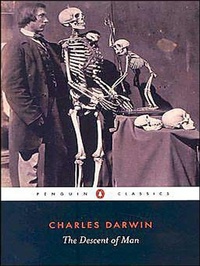
The Descent of Man
The Concise Edition
Published on 27. November 2007
448 pages
978-1-101-21352-0 (ISBN)
Description

Applying his controversial theory of evolution to the origins of the human species, Charles Darwin's The Descent of Man was the culmination of his life's work.
In The Origin of Species, Charles Darwin refused to discuss human evolution, believing the subject too 'surrounded with prejudices'. He had been reworking his notes since the 1830s, but only with trepidation did he finally publish The Descent of Man in 1871. The book notoriously put apes in our family tree and made the races one family, diversified by 'sexual selection' - Darwin's provocative theory that female choice among competing males leads to diverging racial characteristics. Named by Sigmund Freud as 'one of the ten most significant books' ever written, Darwin's Descent of Man continues to shape the way we think about what it is that makes us uniquely human.
In their introduction, James Moore and Adrian Desmond, acclaimed biographers of Charles Darwin, call for a radical re-assessment of the book, arguing that its core ideas on race were fired by Darwin's hatred of slavery. The text is the second and definitive edition and this volume also contains suggestions for further reading, a chronology and biographical sketches of prominent individuals mentioned.
For more than seventy years, Penguin has been the leading publisher of classic literature in the English-speaking world. With more than 1,700 titles, Penguin Classics represents a global bookshelf of the best works throughout history and across genres and disciplines. Readers trust the series to provide authoritative texts enhanced by introductions and notes by distinguished scholars and contemporary authors, as well as up-to-date translations by award-winning translators.
In The Origin of Species, Charles Darwin refused to discuss human evolution, believing the subject too 'surrounded with prejudices'. He had been reworking his notes since the 1830s, but only with trepidation did he finally publish The Descent of Man in 1871. The book notoriously put apes in our family tree and made the races one family, diversified by 'sexual selection' - Darwin's provocative theory that female choice among competing males leads to diverging racial characteristics. Named by Sigmund Freud as 'one of the ten most significant books' ever written, Darwin's Descent of Man continues to shape the way we think about what it is that makes us uniquely human.
In their introduction, James Moore and Adrian Desmond, acclaimed biographers of Charles Darwin, call for a radical re-assessment of the book, arguing that its core ideas on race were fired by Darwin's hatred of slavery. The text is the second and definitive edition and this volume also contains suggestions for further reading, a chronology and biographical sketches of prominent individuals mentioned.
For more than seventy years, Penguin has been the leading publisher of classic literature in the English-speaking world. With more than 1,700 titles, Penguin Classics represents a global bookshelf of the best works throughout history and across genres and disciplines. Readers trust the series to provide authoritative texts enhanced by introductions and notes by distinguished scholars and contemporary authors, as well as up-to-date translations by award-winning translators.
More details
Other editions
Additional editions
Book
11/2007
Plume
€25.70
Article exhausted; check different version
Persons
Charles Darwin, a Victorian scientist and naturalist, has become one of the most famous figures of science to date. Born in 1809 to an upper-middle-class medical family, he was destined for a career in either medicine or the Anglican Church. However, he never completed his medical education and his future changed entirely in 1831 when he joined HMS Beagle as a self-financing, independent naturalist. On returning to England in 1836 he began to write up his theories and observations which culminated in a series of books, most famously On the Origin of Species by Means of Natural Selection in 1859, where he challenged and contradicted contemporary biological and religious beliefs with two decades worth of scientific investigation and theory. Darwin's theory of natural selection is now the most widely accepted scientific model of how species evolve. He died in 1882 and was buried in Westminster Abbey.
Damien Hirst is an internationally renowned English artist, who has dominated the art scene in England since the 1990s. Known in particular for his series of works on death, Hirst here provides a contemporary, visual take on Darwin's theory of evolution - the struggle between life and death in nature.
William Bynum is Professor Emeritus of the History of Medicine at University College, London, and was for many years Head of the Academic Unit of the Wellcome Institute for the History of Medicine. He edited the scholarly journal Medical History from 1980 to 2001, and his previous publications include Science and the Practice of Medicine in the Nineteenth Century; The Companion Encyclopedia of the History of Medicine (co-edited with Roy Porter); The Oxford Dictionary of Scientific Quotations (with Roy Porter), The Dictionary of Medical Biography (with Helen Bynum), and History of Medicine: A Very Short Introduction. He lives in Suffolk.
Damien Hirst is an internationally renowned English artist, who has dominated the art scene in England since the 1990s. Known in particular for his series of works on death, Hirst here provides a contemporary, visual take on Darwin's theory of evolution - the struggle between life and death in nature.
William Bynum is Professor Emeritus of the History of Medicine at University College, London, and was for many years Head of the Academic Unit of the Wellcome Institute for the History of Medicine. He edited the scholarly journal Medical History from 1980 to 2001, and his previous publications include Science and the Practice of Medicine in the Nineteenth Century; The Companion Encyclopedia of the History of Medicine (co-edited with Roy Porter); The Oxford Dictionary of Scientific Quotations (with Roy Porter), The Dictionary of Medical Biography (with Helen Bynum), and History of Medicine: A Very Short Introduction. He lives in Suffolk.
