

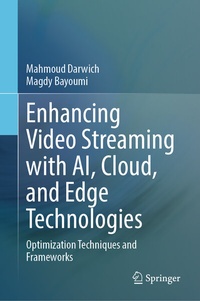
Enhancing Video Streaming with AI, Cloud, and Edge Technologies
Description

This book explores how artificial intelligence, cloud computing, and edge technologies are transforming video streaming systems. It delves into AI-driven adaptive bitrate streaming, predictive resource allocation, and federated learning for personalized recommendations. The integration of cloud and edge computing is highlighted as a solution for scalability and low-latency streaming, addressing challenges like bandwidth optimization, cost-efficiency, and Quality of Experience (QoE).
The book offers actionable insights into emerging technologies like 5G, quantum computing, and blockchain. It features case studies and real-world implementations, making it an essential resource for researchers, industry professionals, and students. Bridging theory and practice, the book provides a comprehensive guide to building the next generation of efficient and scalable video streaming infrastructures.
More details
Other editions
Additional editions
Persons
Dr. Mahmoud Darwich is an Assistant Professor of Computer Science at the University of Mount Union, Ohio, USA. He received his Bachelor's degree from Beirut Arab University, Lebanon, in 2006. Subsequently, he completed his master's and doctorate degrees in Computer Engineering from the University of Louisiana at Lafayette in 2013 and 2017, respectively.. His research focuses on artificial intelligence, cloud computing, and edge technologies for optimizing video streaming systems.
Dr. Magdy Bayoumi is a Life Fellow of IEEE and the Department Head of Electrical and Computer Engineering at the University of Louisiana at Lafayette. He earned his Ph.D. in Electrical Engineering from the University of Windsor, Canada. Dr. Bayoumi's research spans VLSI design, digital signal processing, and wireless sensor networks. He is a recipient of several awards, including the IEEE Circuits and Systems Society Education Award.
Content
Part I Foundations and Challenges in Video Streaming.- Chapter 1 Introduction to Video Streaming Systems and Challenges.- Part II AI-Driven Approaches for Video Streaming.- Chapter 2 AI-Driven Video Quality Assessment and Enhancement Techniques.- Chapter 3 Federated Learning for Scalable Video Streaming.- Chapter 4 Deep Learning for Adaptive Video Quality.- Part III Cloud and Edge Computing in Video Streaming.- Chapter 5 Cloud-Enhanced Video Streaming: Storage and Resource Management.- Chapter 6 Edge Computing for Low-Latency Video Streaming.- Chapter 7 Swarm Intelligence for Efficient Video Data Distribution in Edge Networks.- Part IV Emerging Technologies in Video Streaming.- Chapter 8 Blockchain-Enhanced Distributed Storage for Cloud-Based Video Streaming.- Chapter 9 AI-Driven Resource Allocation and Optimization in Video Streaming.- Part V Practical Implementations and Future Trends.- Chapter 10 Case Studies and Real-World Implementations of AI, Cloud, and Edge in Video Streaming.- Chapter 11 Conclusion and Future Directions for Video Streaming Enhancements.
