

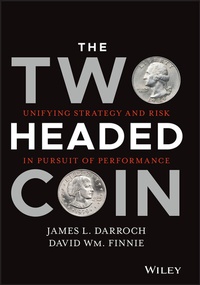
The Two Headed Coin
Description

In The Two Headed Coin, accomplished authors James L. Darroch and David Wm. Finnie deliver an insightful exploration of the interplay between strategy and risk that underlies the operational framework of successful organizations. You'll learn which risks are fundamental to the strategic positioning and goals of your organization and which are not. You'll also discover the importance of an independent risk function, e,g., the CRO, and its invaluable role as part of the strategic process.
You'll also find:
* A thorough discussion of the notion of competitive advantage and how it relates to risk
* An exploration of consumer perception and reputation as an asset to be managed
* How to use scenario planning and real options to provide a framework for managing uncertainty
* How a focus on culture and ethics can minimize the risk of large losses due to adverse behaviors
Perfect for risk management and strategy professionals The Two Headed Coin will also earn a place in the libraries of executives and managers who wish to improve their ability to integrate strategic and risk thinking to create competitive advantage.
More details
Other editions
Additional editions
Persons
DAVID WM. FINNIE is a senior corporate executive with over 20 years' experience leading large and mid-sized multinationals and Fortune 100 companies in the building and optimization of their financial, capital, and risk management strategies and capabilities. In addition to risk management expertise, he also offers strengths as a strategic business leader helping to define and implement business growth strategies and drive new business development. David has published four short articles on risk management, governance, and strategy.
Content
Acknowledgments xxv
About the Authors xxix
Chapter 1 Strategy and Risk: Two Sides of the Same Coin 1
Strategic Positioning and Risk 6
Strategy and Risk in a Start-Up 7
Chapter 2 Executing on the Plan and Discovering New Risks 17
The Assumption of Goal Congruence and the Importance of Culture 21
Conclusion 27
Chapter 3 Which Risks to Keep 31
Strategic Positioning and Risk Governance 38
How Does Risk Management Help Close the Gap Between Strategy Formulation and Execution? 40
Conclusion: Embracing and Managing Risk 42
Chapter 4 How Do We Achieve Independent Risk Governance and Improve Performance? 47
What Do We Mean by ERM? 51
Chapter 5 Who Has the Specific Knowledge to Design the Risk Architecture? Why You Need an Independent Risk Function 61
The Strategy-Risk-Governance Process 61
Meeting the Objective and the Categorization of Risks 69
The Risk Architecture 71
Creation of a Risk Function 73
Conclusion 76
Chapter 6 Enterprise Risk Management and Competitive Advantage 79
How Does Strategy Affect Randomness? 86
Chapter 7 What Reputation Do We Want? With Whom? 91
Managing Reputation Risk 99
Chapter 8 Uncertainty, Scenario Planning, and Real Options 105
Real Options 113
Conclusion 116
Chapter 9 Risk Culture and Ethics: Can You Have Excellence and Consistency at the Same Time? 121
The Advisor-Customer Encounter 124
Control Systems, Discretion, and Ethics 127
Culture, Ethics, Performance, and Risk Management 135
Chapter 10 The Top of the Pyramid: The CEO as Integrator of Strategy and Risk and the Board as the Fourth Line of Defense 141
The CEO: The Operational Integration of Strategy and Risk 145
The Board: The Governance Integration of Strategy and Risk 145
The Board Provides More Than Oversight 146
Epilogue: Decision-Making at the Restaurant: Creating and Executing a Risk-Aware Strategy 151
Appendix I: Risk Transformation and the Need for an Integrated Risk Approach 157
Appendix II: Resiliency 161
Bibliography 167
Index 183
CHAPTER 1
Strategy and Risk: Two Sides of the Same Coin
Strategy and risk are two sides of the same coin. Both aspire to create profits in an uncertain future.1 The classic strategy question is: What business is the organization in? This starting point determines the organization's purpose, that is, what problem it is solving for its targeted market, and should make clear what inherent risks it will face. For example, if you are a detergent maker in 2020, it is important that your product not only cleans safely but also is environmentally friendly and childproof. Because a major goal of the firm is to create economic value, not just accounting profits, risk management with the calculation of economic capital is fundamental to the strategy process. Both strategy and risk management confront important cash flow, income statement, and balance sheet issues. Strategy and risk meet in pricing and capital because these are the two tools to deal with expected losses (ELs) and unexpected losses (ULs) arising from the risks that an organization takes in creating and claiming value.2 Because we will say more about economic capital later, for now, let us provide a simple definition. Economic capital is the capital required to support the economics of the business including the necessary infrastructure (critical assets for operations) and risks. This means if the unexpected happens, you have a reserve that enables you to survive for a length of time calculated by probability and market conditions. The higher the relative economic capital, the longer you are likely to stay in business. But the more challenging it is to achieve return on equity (ROE) or return on asset (ROA) goals, the higher the capital reserve you'll likely need.
However, it is important to realize that the firm's strategy, specifically the goals and the position created by the value proposition, is the starting point: it initiates the dialogue that leads to strategy formulation and implementation. In practical terms this means that the strategic processes determine what risks/uncertainty the firm must accept and manage. By manage we simply mean that the firm first identifies, then accepts, certain risks, mitigates others, and transfers others. In the strategy-risk-governance process shown in Figure 1.1, it is important to recognize the feedback loops linking strategy and risk. Strategy informs risk and, in turn, risk informs strategy.
FIGURE 1.1 The Strategy-Risk-Governance Process
Table 1.1 illustrates the similarities and complementarities among strategy, risk, and brand management. We decided to include brand management and culture because it helps to illustrate that management of risk involves the entire organization, as does brand management, and it is affected by the organization's culture. This is not to downplay the role of the C-Suite specialists, but rather to highlight that the specialists coordinate the activities of the entire organization to achieve the desired outcomes. This will be amplified in our later discussion of the three lines of defense model.3
If risk-taking is fundamental to business and profits, then it must be understood ex ante in order to deal with identifiable risks through pricing and contingency reserves (capital), and this requires that it be an essential part of the strategy formulation and execution process.5 Once one starts to probe the relationship between pricing and positioning in the classic Porter6 sense, as well as the role of capital in sustainable competitive advantage, it becomes obvious that risk identification and management is built into the DNA of strategy; the only question is whether it is explicit or implicit. Fundamental to our approach is to portray how the process of resource allocation basic to strategy, suggests the development of risk capacity as part of the implementation process. In order to avoid execution pitfalls, including mispricing, the creation of risk capacity must also predate strategic moves. We do accept that this capacity may take place in a dynamic context so that it may need further development as strategic plans unfold, but the essential components must be in place prior to the strategic move if the dialectic of strategy and risk is to be realized.
TABLE 1.1 Strategy, Risk Management, Brand, and Culture
Scope and Role Strategy Risk Management Brand Culture Enterprise Wide Yes Yes Yes Yes, but with pockets of different cultures Integrating Yes Yes Yes Yes in a functional organization; no in a dysfunctional one Goal articulation Mission statement Risk appetite Presenting the organization as it wants to be seen by the target segment(s) Having the desired culture integrate the subcultures Formulation, for example, profitability, market share, etc. Risk tolerances Brand equityEdelman Trust Barometer Organization requirements4 Capability to execute the strategy including MIS and performance and risk analytics Capability to execute the risk process and complete performance and risk analytics Integration at C-Suite to ensure coordination at all levels Attention to nurturing the appropriate behaviors and actions Embedding in the organization Dialogue on concerns
Implementation Organizational structure Risk-based decisioning Risk processes Brand awareness Leadership displaying the desired behavior and use of symbols Pricing impact Differentiation/low cost Expected loss To portray value relative to competitors Impact on perception of differentiation by customers Contingency planning Generation of options, alternatives Resiliency, business continuity, and proactive response planning Issues and crisis management Employee engagement and organizational health plans and activities Uncertainty Scenario planning Contingency planning Economic capital: capital at risk, stressed capital at risk, fat tails Monitoring of social media Surveys to measure what the culture is
It similarly follows that the risk capacity of the organization should be greater than its risk appetite, which should be greater than its risk tolerances and limits.7 A specific statement of risk appetite is the essential complement to the articulation of strategic goals. The risk appetite statement provides the authority to take risk and, importantly, helps to tell the organization what not to do-which is also fundamental to strategic positioning to avoid mission creep. This is important because mission creep can lead to a misalignment of the organization's aspirations and its ability to manage the associated risks. However, the mere statement of a risk appetite without having developed the organizational capability to understand, assess/measure, monitor, and report on the risks is meaningless. These resources include management time to determine whether the risk capacity is matched to the risk appetite aspirations. Similarly, performance must be evaluated against both the strategy and the risk limits.
The board delegates authority to the CEO to execute the board-approved strategy. Similarly, creating a clear risk appetite statement is critical for corporate governance because this is a key board-approved statement of authority for the CEO and organizational leadership. It needs to clearly articulate the risks the management is authorized to take. There have been many papers and texts on risk appetite frameworks since 2012 when the Committee of Sponsoring Organizations of the Treadway Commission (COSO) released the discussion paper, "Enterprise Risk Management-Understanding and Communicating Risk Appetite."8 COSO made it clear that this was an important topic for all organizations. Financial institutions (FIs) implemented approaches based on the principles provided by the Financial Stability Board (FSB) released in 2013.9 This results in a great deal of commonality in the frameworks and advice. Key elements of risk appetite frameworks invariably include these elements:
- The concepts of risk capacity and appetite
- Governance requirements in terms of policies, authorities, principles, and ongoing monitoring and reporting
- Metrics, limits, and triggers linked to income and capital for approved risk-taking
- Management plans for risk incident responses
- Communication requirements to ensure all risk-takers are aware of the appetite and requirements
The FSB explicitly notes that "for the purpose of these Principles, the risk appetite framework does not include the processes to establish the strategy, develop the business plan, and the models and systems to measure and aggregate risks."10 However, increasingly, good risk appetite statements are capturing the integration with strategy and the business plan and begin with a statement such as "[The organization] will take risks only in support of executing its business...
