

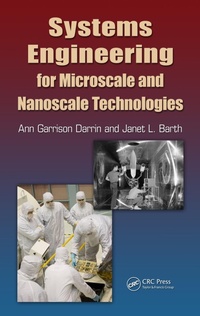
Systems Engineering for Microscale and Nanoscale Technologies
Published on 19. April 2016
592 pages
978-1-040-21018-5 (ISBN)
Description

To realize the full potential of micro- and nanoscale devices in system building, it is critical to develop systems engineering methodologies that successfully integrate stand-alone, small-scale technologies that can effectively interface with the macro world. So how do we accomplish this?Systems Engineering for Microscale and Nanoscale Technologie
More details
Language
English
Place of publication
London
United Kingdom
Publishing group
Taylor & Francis Ltd
Target group
College/higher education
File size
20,90 MB
ISBN-13
978-1-040-21018-5 (9781040210185)
Copyright in bibliographic data and cover images is held by Nielsen Book Services Limited or by the publishers or by their respective licensors: all rights reserved.
Schweitzer Classification
Other editions
Additional editions
M. Ann Garrison Darrin | Janet L. Barth
Systems Engineering for Microscale and Nanoscale Technologies
Book
11/2017
1st Edition
CRC Press
€85.60
Shipment within 10-20 days
M. Ann Garrison Darrin | Janet L. Barth
Systems Engineering for Microscale and Nanoscale Technologies
Book
12/2011
1st Edition
CRC Press
€179.51
Shipment within 15-20 days
Persons
M. Ann Garrison Darrin is a member of the principal professional staff and the managing executive of the Space Department at The Johns Hopkins University Applied Physics Laboratory. She has held several engineering management positions at the laboratory, including in the research center. She has more than 30 years experience in both government (NASA, U.S. Department of Defense) and private industry, particularly with technology development, application, transfer, and insertion into space flight missions. She holds an M.S. in technology management and has authored several papers on technology insertion in addition to coauthoring several patents. Ms. Darrin was the division chief at NASA's GSFC for Electronic Parts, Packaging and Material Sciences from 1993 to 1998. She has extensive background in aerospace engineering management, microelectronics and semiconductors, packaging, and advanced miniaturization. Ms. Darrin is a co-founder of the Mid Atlantic Micro Nano Alliance and the author/editor on two books related to aerospace engineering.
Janet L. Barth is the Chief of the Electrical Engineering Division (EED) at NASA's Goddard Space Flight Center (GSFC) where she is responsible for the delivery of spacecraft and instrument avionics to several of NASA's science missions. These include the Solar Dynamics Observatory, the Lunar Reconnaissance Orbiter, and the Thermal InfraRed Sensor instrument on the Landsat Data Continuity Mission. She also oversees development of microwave and communications systems and suborbital avionics systems for the GSFC's Wallops Flight Facility. Barth received her B.S. degree in Mathematics from the University of Maryland in 1978 and pursued graduate studies in computer science. She is a senior member of the Institute of Electrical and Electronics Engineers (IEEE) and is an elected member of the IEEE Nuclear and Plasma Sciences Society Administrative Committee, and she is active
Janet L. Barth is the Chief of the Electrical Engineering Division (EED) at NASA's Goddard Space Flight Center (GSFC) where she is responsible for the delivery of spacecraft and instrument avionics to several of NASA's science missions. These include the Solar Dynamics Observatory, the Lunar Reconnaissance Orbiter, and the Thermal InfraRed Sensor instrument on the Landsat Data Continuity Mission. She also oversees development of microwave and communications systems and suborbital avionics systems for the GSFC's Wallops Flight Facility. Barth received her B.S. degree in Mathematics from the University of Maryland in 1978 and pursued graduate studies in computer science. She is a senior member of the Institute of Electrical and Electronics Engineers (IEEE) and is an elected member of the IEEE Nuclear and Plasma Sciences Society Administrative Committee, and she is active
Content
PART 1: Systems Engineering MethodologiesSystems Engineering for Micro- and Nanoscale Technologies. Introduction to Systems Engineering. Systems Engineering in Technology Development Phases. Agile Systems Engineering.PART 2: Technology Development ProcessScaling. Micro Electro Mechanical Systems-Systems Engineering's Transition into the Nanoworld. Introduction to Nanotechnology. Nanoscale Systems-Top-Down Assembly. Nanoscale Systems-Bottom-Up Assembly.PART 3: Systems Engineering Process ElementsModeling and Simulation in the Small World. Interfaces at the Micro and Nano Scale. Systems Reliability. Test and Evaluation Techniques from Very-Large-Scale Integration (VLSI) to New Developments in Micro- and Nanoscale Technology (MNT). Developing and Implementing Robust Micro- and Nanoscale Technology Programs.PART 4: Systems Engineering Applications-Toward the FutureFuture Generations of Nanotechnology. Biomedical Microsystems. Stability and Uncertainty in Self-Assembled Systems. The Role of Mechanoevolution in Predicting the Future of Micro- and Nanoscale Technologies.
