

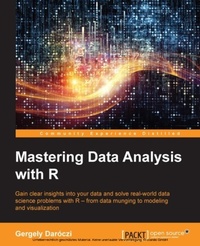
Mastering Data analysis with R
Gain sharp insights into your data and solve real-world data science problems with R-from data munging to modeling and visualization
Published on 8. July 2025
396 pages
978-1-78398-203-5 (ISBN)
Description

Gain sharp insights into your data and solve real-world data science problems with R-from data munging to modeling and visualization
Key Features
Book DescriptionGain sharp insights into your data and solve real-world data science problems with R-from data munging to modeling and visualization About This Book Handle your data with precision and care for optimal business intelligence Restructure and transform your data to inform decision-making Packed with practical advice and tips to help you get to grips with data mining Who This Book Is For If you are a data scientist or R developer who wants to explore and optimize your use of R's advanced features and tools, this is the book for you. A basic knowledge of R is required, along with an understanding of database logic. What You Will Learn Connect to and load data from R's range of powerful databases Successfully fetch and parse structured and unstructured data Transform and restructure your data with efficient R packages Define and build complex statistical models with glm Develop and train machine learning algorithms Visualize social networks and graph data Deploy supervised and unsupervised classification algorithms Discover how to visualize spatial data with R In Detail R is an essential language for sharp and successful data analysis. Its numerous features and ease of use make it a powerful way of mining, managing, and interpreting large sets of data. In a world where understanding big data has become key, by mastering R you will be able to deal with your data effectively and efficiently. This book will give you the guidance you need to build and develop your knowledge and expertise. Bridging the gap between theory and practice, this book will help you to understand and use data for a competitive advantage. Beginning with taking you through essential data mining and management tasks such as munging, fetching, cleaning, and restructuring, the book then explores different model designs and the core components of effective analysis. You will then discover how to optimize your use of machine learning algorithms for classification and recommendation systems beside the traditional and more recent statistical methods. Style and approach Covering the essential tasks and skills within data science, Mastering Data Analysis provides you with solutions to the challenges of data science. Each section gives you a theoretical overview before demonstrating how to put the theory to work with real-world use cases and hands-on examples.What you will learn
Who this book is for
Key Features
Book DescriptionGain sharp insights into your data and solve real-world data science problems with R-from data munging to modeling and visualization About This Book Handle your data with precision and care for optimal business intelligence Restructure and transform your data to inform decision-making Packed with practical advice and tips to help you get to grips with data mining Who This Book Is For If you are a data scientist or R developer who wants to explore and optimize your use of R's advanced features and tools, this is the book for you. A basic knowledge of R is required, along with an understanding of database logic. What You Will Learn Connect to and load data from R's range of powerful databases Successfully fetch and parse structured and unstructured data Transform and restructure your data with efficient R packages Define and build complex statistical models with glm Develop and train machine learning algorithms Visualize social networks and graph data Deploy supervised and unsupervised classification algorithms Discover how to visualize spatial data with R In Detail R is an essential language for sharp and successful data analysis. Its numerous features and ease of use make it a powerful way of mining, managing, and interpreting large sets of data. In a world where understanding big data has become key, by mastering R you will be able to deal with your data effectively and efficiently. This book will give you the guidance you need to build and develop your knowledge and expertise. Bridging the gap between theory and practice, this book will help you to understand and use data for a competitive advantage. Beginning with taking you through essential data mining and management tasks such as munging, fetching, cleaning, and restructuring, the book then explores different model designs and the core components of effective analysis. You will then discover how to optimize your use of machine learning algorithms for classification and recommendation systems beside the traditional and more recent statistical methods. Style and approach Covering the essential tasks and skills within data science, Mastering Data Analysis provides you with solutions to the challenges of data science. Each section gives you a theoretical overview before demonstrating how to put the theory to work with real-world use cases and hands-on examples.What you will learn
Who this book is for
All prices
More details
Edition
Digital original
Language
English
Place of publication
Birmingham
United Kingdom
Target group
Professional and scholarly
US School Grade: College Graduate Student
Edition type
Digital original
File size
7,77 MB
ISBN-13
978-1-78398-203-5 (9781783982035)
Copyright in bibliographic data and cover images is held by Nielsen Book Services Limited or by the publishers or by their respective licensors: all rights reserved.
Schweitzer Classification
Other editions
Additional editions
Gergely Daróczi
Mastering Data Analysis with R
Book
09/2015
Packt Publishing
€69.80
Shipment within 3-4 weeks
Person
Daroczi Gergely :
Gergely Darczi is a former assistant professor of statistics and an enthusiastic R user and package developer. He is the founder and CTO of an R-based reporting web application at http://rapporter.net and a PhD candidate in sociology. He is currently working as the lead R developer/research data scientist at https://www.card.com/ in Los Angeles. Besides maintaining around half a dozen R packages, mainly dealing with reporting, Gergely has coauthored the books Introduction to R for Quantitative Finance and Mastering R for Quantitative Finance (both by Packt Publishing) by providing and reviewing the R source code. He has contributed to a number of scientific journal articles, mainly in social sciences but in medical sciences as well.
Gergely Darczi is a former assistant professor of statistics and an enthusiastic R user and package developer. He is the founder and CTO of an R-based reporting web application at http://rapporter.net and a PhD candidate in sociology. He is currently working as the lead R developer/research data scientist at https://www.card.com/ in Los Angeles. Besides maintaining around half a dozen R packages, mainly dealing with reporting, Gergely has coauthored the books Introduction to R for Quantitative Finance and Mastering R for Quantitative Finance (both by Packt Publishing) by providing and reviewing the R source code. He has contributed to a number of scientific journal articles, mainly in social sciences but in medical sciences as well.
Content
Table of Contents
Hello Data
Getting the data
Building Data
Building Models
Beyond the Linear Trend Line
Restructuring Data
Unstructured Data
Polishing Data
From Big to Smaller Data
Classification and Clustering
Social Network in the R Community
Analysing Stock Prices
Data Around Us
All in one: Mining Social Data
Hello Data
Getting the data
Building Data
Building Models
Beyond the Linear Trend Line
Restructuring Data
Unstructured Data
Polishing Data
From Big to Smaller Data
Classification and Clustering
Social Network in the R Community
Analysing Stock Prices
Data Around Us
All in one: Mining Social Data

