

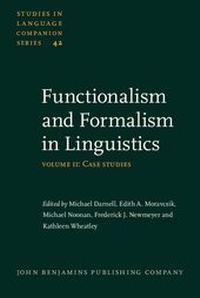
Functionalism and Formalism in Linguistics
Volume II: Case studies
1st Edition
Published on 15. March 1999
VI, 407 pages
978-90-272-9878-2 (ISBN)
Description

The 23rd UWM Linguistics Symposium (1996) brought together linguists of opposing theoretical approaches - functionalists and formalists - in order to determine to what extent these approaches really differ from each other and to what extent the approaches complement each other. The two volumes of Functionalism and Formalism in Linguistics contain a careful selection of the papers originally presented at the symposium.
Volume I includes papers discussing the two basic approaches to linguistics; with contributions by: Werner Abraham, Stephen R. Anderson, Joan L. Bybee, William Croft, Alice Davidson, Mark Durie, Ken Hale, Michael Hammond, Bruce P. Hayes, Nina Hyams, Howard Lasnik, Brian MacWhinney, Geoffrey S. Nathan, Daniell Nettle, Frederick J. Newmeyer, Edith A. Moravcsik, Doris Payne, Janet Pierrehumbert, Kathleen M. Wheatley.
Volume II consists of case studies which draw upon the strengths of both approaches and thus help to bridge the gap between the two camps; with contributions by: Mira Ariel, Melissa Axelrod, Robbin Clamons, Bernard Comrie, Kees Hengeveld, Erika Hoff-Ginsberg, James Hurford, Lizanne Kaiser, Nicholas Kibre, Simon Kirby, Feng-hsi Liu, André Meinunger, Viola Miglio, Ann Mulkern, Waturu Nakamura, Maria Polinsky, Elizabeth Purnell, Gerald Sanders, Nancy Stenson, Maggie Tallerman, Ronnie Wilbur.
Volume I includes papers discussing the two basic approaches to linguistics; with contributions by: Werner Abraham, Stephen R. Anderson, Joan L. Bybee, William Croft, Alice Davidson, Mark Durie, Ken Hale, Michael Hammond, Bruce P. Hayes, Nina Hyams, Howard Lasnik, Brian MacWhinney, Geoffrey S. Nathan, Daniell Nettle, Frederick J. Newmeyer, Edith A. Moravcsik, Doris Payne, Janet Pierrehumbert, Kathleen M. Wheatley.
Volume II consists of case studies which draw upon the strengths of both approaches and thus help to bridge the gap between the two camps; with contributions by: Mira Ariel, Melissa Axelrod, Robbin Clamons, Bernard Comrie, Kees Hengeveld, Erika Hoff-Ginsberg, James Hurford, Lizanne Kaiser, Nicholas Kibre, Simon Kirby, Feng-hsi Liu, André Meinunger, Viola Miglio, Ann Mulkern, Waturu Nakamura, Maria Polinsky, Elizabeth Purnell, Gerald Sanders, Nancy Stenson, Maggie Tallerman, Ronnie Wilbur.
More details
Other editions
Additional editions
Michael Darnell | Edith A. Moravcsik | Michael Noonan
Functionalism and Formalism in Linguistics
Volume II: Case studies
Book
03/1999
John Benjamins Publishing Co
€132.50
Shipment within 10-15 days
Persons
Content
- FUNCTIONALISM AND FORMALISM IN LINGUISTICS
- Editorial page
- Title page
- LCC data
- Table of Contents
- Introduction
- Part I
- Mapping So-called "Pragmatic" Phenomena According to a "Linguistic-Extralinguistic" Distinction
- Lexis, Grammar, and Grammatical Change: The Koyukon classifier prefixes
- The Limits of Formal Analysis: Pragmatic motivation in Oromo grammar
- Form and Function in Syntax: Relative clauses in Tsez
- Formalizing Functionally
- Representing the Structure-Discourse Iconicity of the Japanese Post-Verbal Construction
- Between Irregular and Regular: "Imperfect generalizations" in Istanbul Turkish and the status of phonological rules
- Constraints on Constraints, or the Limits of Functional Adaptation
- Structure-preservation and Transitivity: The case of Chinese ba sentences
- Topicality and Agreement
- Explanatory Power of Functional and Formal Approaches to Language Change
- Functional Optimality Theory: Evidence from split case systems
- Welsh Soft Mutation and Marked Word Order
- A Functional Journey with a Formal Ending: What do brow raises do in American Sign Language?
- Part II. First Language Acquisition
- Formalism or Functionalism? Evidence from the study of language development
- Functional Innateness: Explaining the critical period for language acquisition
- The Holophrastic Hypothesis Revisited: Structural and functional approaches
- Index of Authors
- Index of Languages
- Index of Subjects
- the STUDIES IN LANGUAGE COMPANION SERIES
