

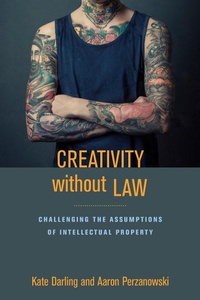
Creativity Without Law
Challenging the Assumptions of Intellectual Property
Published on 28. February 2017
277 pages
978-1-4798-0740-6 (ISBN)
Description

Behind the scenes of the many artists and innovators flourishing beyond the bounds of intellectual property laws
Intellectual property law, or IP law, is based on certain assumptions about creative behavior. The case for regulation assumes that creators have a fundamental legal right to prevent copying, and without this right they will under-invest in new work. But this premise fails to fully capture the reality of creative production. It ignores the range of powerful non-economic motivations that compel creativity, and it overlooks the capacity of creative industries for self-governance and innovative social and market responses to appropriation.
This book reveals the on-the-ground practices of a range of creators and innovators. In doing so, it challenges intellectual property orthodoxy by showing that incentives for creative production often exist in the absence of, or in disregard for, formal legal protections. Instead, these communities rely on evolving social norms and market responses-sensitive to their particular cultural, competitive, and technological circumstances-to ensure creative incentives. From tattoo artists to medical researchers, Nigerian filmmakers to roller derby players, the communities illustrated in this book demonstrate that creativity can thrive without legal incentives, and perhaps more strikingly, that some creative communities prefer, and thrive, in environments defined by self-regulation rather than legal rules.
Beyond their value as descriptions of specific industries and communities, the accounts collected here help to ground debates over IP policy in the empirical realities of the creative process. Their parallels and divergences also highlight the value of rules that are sensitive to the unique mix of conditions and motivations of particular industries and communities, rather than the monoculture of uniform regulation of the current IP system.
Intellectual property law, or IP law, is based on certain assumptions about creative behavior. The case for regulation assumes that creators have a fundamental legal right to prevent copying, and without this right they will under-invest in new work. But this premise fails to fully capture the reality of creative production. It ignores the range of powerful non-economic motivations that compel creativity, and it overlooks the capacity of creative industries for self-governance and innovative social and market responses to appropriation.
This book reveals the on-the-ground practices of a range of creators and innovators. In doing so, it challenges intellectual property orthodoxy by showing that incentives for creative production often exist in the absence of, or in disregard for, formal legal protections. Instead, these communities rely on evolving social norms and market responses-sensitive to their particular cultural, competitive, and technological circumstances-to ensure creative incentives. From tattoo artists to medical researchers, Nigerian filmmakers to roller derby players, the communities illustrated in this book demonstrate that creativity can thrive without legal incentives, and perhaps more strikingly, that some creative communities prefer, and thrive, in environments defined by self-regulation rather than legal rules.
Beyond their value as descriptions of specific industries and communities, the accounts collected here help to ground debates over IP policy in the empirical realities of the creative process. Their parallels and divergences also highlight the value of rules that are sensitive to the unique mix of conditions and motivations of particular industries and communities, rather than the monoculture of uniform regulation of the current IP system.
Reviews / Votes
This important collection of case studies adds significantly to the emerging body of empirical evidence that challenges IPs orthodoxy. Creativity and innovation do not necessarily depend on copyrights and patents. The book documents the fact that community self-governance can produce and sustain creative production across a broad range of subject matter. Eclecticism powers the book. The fascinating, provocative, and entertaining cases here range from more traditional IP-focused creative domains like film and fiction to creative fields operating beyond IP, like cuisine and medical practice, to outsider creative groups that have rejected IP, like tattoo artists and roller derby participants. - Michael Madison,Professor of Law, University of Pittsburgh Understanding how and why people create is central to the project of IP. This important new book catalogs the many ways in which people create without the benefit of IP law. One can find theories of copyright and creativity elsewhere. Here you will find real-world evidence of how people are creating without, and even despite, IP law. - Mark A. Lemley,William H. Neukom Professor, Stanford Law School For years, physicists insisted bumble bees couldnt fly. And yet, the laws of physics notwithstanding, bumblebees flew. Likewise, for years, IP lawyers have insisted that without strong IP protection, creativity cannot flourish. IP lawyers: meet the bumblebee. In this beautifully written and powerfully structured collection, the best of IPs scholars show that actual complexity of creativity, and its inspiration. - Lawrence Lessig,Roy L. Furman Professor of Law and Leadership, Harvard Law School This volume expands our understanding of organic systems of protection designed to preserve incentives for innovation in IPs negative spaces. It willundoubtedly provoke much debate, stimulate new research, and give rise to some interesting future conferences. (Journal of Economic Literature)More details
Language
English
Place of publication
New York
United States
Target group
Professional and scholarly
ISBN-13
978-1-4798-0740-6 (9781479807406)
Copyright in bibliographic data and cover images is held by Nielsen Book Services Limited or by the publishers or by their respective licensors: all rights reserved.
Schweitzer Classification
Other editions
Additional editions
Kate Darling | Aaron Perzanowski
Creativity Without Law
Challenging the Assumptions of Intellectual Property
Book
02/2017
New York University Press
€36.50
Shipment within 10-20 days
Persons
Kate Darling is Research Specialist at the MIT Media Lab, where she advises on intellectual property issues and researches the intersection of technology, law, and society.
Aaron Perzanowski is Professor of Law at Case Western Reserve University School of Law. He is the author of The End of Ownership: Personal Property in the Digital Economy.
Aaron Perzanowski is Professor of Law at Case Western Reserve University School of Law. He is the author of The End of Ownership: Personal Property in the Digital Economy.
