

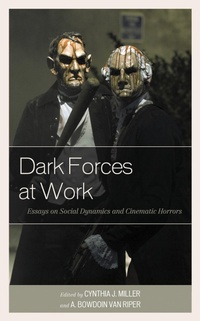
Dark Forces at Work
Essays on Social Dynamics and Cinematic Horrors
Lexington Books (Publisher)
1st Edition
Published on 6. November 2019
348 pages
978-1-4985-8856-0 (ISBN)
Description

Dark Forces at Work examines the role of race, class, gender, religion, and the economy as they are portrayed in, and help construct, horror narratives across a range of films and eras. These larger social forces not only create the context for our cinematic horrors, but serve as connective tissue between fantasy and lived reality, as well.
While several of the essays focus on "name" horror films such as IT, Get Out, Hellraiser, and Don't Breathe, the collection also features essays focused on horror films produced in Asia, Europe, and Latin America, and on American classic thrillers such as Alfred Hitchcock's Psycho. Key social issues addressed include the war on terror, poverty, the housing crisis, and the Time's Up movement. The volume grounds its analysis in the films, rather than theory, in order to explore the ways in which institutions, identities, and ideologies work within the horror genre.
While several of the essays focus on "name" horror films such as IT, Get Out, Hellraiser, and Don't Breathe, the collection also features essays focused on horror films produced in Asia, Europe, and Latin America, and on American classic thrillers such as Alfred Hitchcock's Psycho. Key social issues addressed include the war on terror, poverty, the housing crisis, and the Time's Up movement. The volume grounds its analysis in the films, rather than theory, in order to explore the ways in which institutions, identities, and ideologies work within the horror genre.
More details
Series
Edition
1. Auflage
Language
English
Place of publication
New York
United States
Publishing group
Bloomsbury Publishing Plc
Target group
Professional and scholarly
Illustrations
29 b/w photos;
ISBN-13
978-1-4985-8856-0 (9781498588560)
Copyright in bibliographic data and cover images is held by Nielsen Book Services Limited or by the publishers or by their respective licensors: all rights reserved.
Schweitzer Classification
Other editions
Additional editions
Cynthia J. Miller | A. Bowdoin Van Riper
Dark Forces at Work
Essays on Social Dynamics and Cinematic Horrors
Book
11/2019
Lexington Books
€137.50
Article exhausted; check different version
Persons
Cynthia J. Miller is senior faculty at the Emerson College Institute for the Liberal Arts and Interdisciplinary Studies.
A. Bowdoin Van Riper is a historian who specializes in depictions of science and technology in popular culture.
A. Bowdoin Van Riper is a historian who specializes in depictions of science and technology in popular culture.
Content
Introduction
Part I. National Identity: Haunting the Homeland
Chapter One: Ringing Home, Missed Calls, and Unbroken Land-lines: Domestication of, and Miscommunication in, K- and J- Horror
Rea Amit
Chapter Two: Redefining the Heimat: Austrian Horror Cinema and the "Home" in a Global Age
Michael Fuchs
Chapter Three: Korean National Trauma and the Myth of Hypermasculinity in The Wailing (2016)
Luisa Koo
Chapter Four: The Witch, the Wolf, and the Monster: Monstrous Bodies and Empire in Penny Dreadful
Allyson Marino
Part II. Market Forces and Their Monsters
Chapter Five: Recession Horror: The Haunted Housing Crisis in Contemporary Fiction
Lindsey Michael Banco
Chapter Six: Classism and Horror in the Seventies: The Rural Dweller as a Monster
Erika Tiburcio Moreno
Chapter Seven: All Against All: Dystopia, Dark Forces, and Hobbesian Anarchy in the Purge Films
A. Bowdoin Van Riper
Chapter Eight: Motor City Gothic: White Youth and Economic Anxiety in It Follows and Don't Breathe
Russell Meeuf and Benjamin James
Part III. Ideology: You Just Have to Believe
Chapter Nine: Gothic Neoliberalism in 1980s British Horror Cinema
Fernando Gabriel Pagnoni Berns, Juan Juvé, and Emiliano Aguilar
Chapter Ten: Infringing on Cycles of Oppression: Artisanal Bricolage and Synthesis in Mumblegore
Brandon Niezgoda
Chapter Eleven: Faith as Confinement: Alejandro Amenábar's The Others (2004)
Maria Gil Poisa
Part IV. History Never Dies
Chapter Twelve: The Pursuit of Certainty: Legends and Local Knowledge in Candyman
Cynthia J. Miller
Chapter Thirteen: "Nothing Is What It Seems": Montage and Misread Histories in Nicolas Roeg's Don't Look Now (1973)
Thomas Prasch
Chapter Fourteen: "Tens of Thousands of Men Died Here": Desire, Revenge, and Memories of War in Edgar G. Ulmer's The Black Cat
James J. Ward
Chapter Fifteen: Peril, Imprisonment, and the Power of Place in Jordan Peele's Get Out
Michael C. Reiff
Part V. The Horrors of Place
Chapter Sixteen: The Hovel Condemned: The Environmental Psychology of Place in Horror
Jacqueline Morrill
Chapter Seventeen: Coming Home to Horror: Stephen King's Derry and Castle Rock
Alissa Burger
Chapter Eighteen: It Follows and the Uncertainties of the Middle Class
Katherine Lizza
Chapter Nineteen: "We're all in our private traps": Reconfiguring Suburbia's Protective Borders in Psycho (1960)
Kevin Thomas McKenna
Part I. National Identity: Haunting the Homeland
Chapter One: Ringing Home, Missed Calls, and Unbroken Land-lines: Domestication of, and Miscommunication in, K- and J- Horror
Rea Amit
Chapter Two: Redefining the Heimat: Austrian Horror Cinema and the "Home" in a Global Age
Michael Fuchs
Chapter Three: Korean National Trauma and the Myth of Hypermasculinity in The Wailing (2016)
Luisa Koo
Chapter Four: The Witch, the Wolf, and the Monster: Monstrous Bodies and Empire in Penny Dreadful
Allyson Marino
Part II. Market Forces and Their Monsters
Chapter Five: Recession Horror: The Haunted Housing Crisis in Contemporary Fiction
Lindsey Michael Banco
Chapter Six: Classism and Horror in the Seventies: The Rural Dweller as a Monster
Erika Tiburcio Moreno
Chapter Seven: All Against All: Dystopia, Dark Forces, and Hobbesian Anarchy in the Purge Films
A. Bowdoin Van Riper
Chapter Eight: Motor City Gothic: White Youth and Economic Anxiety in It Follows and Don't Breathe
Russell Meeuf and Benjamin James
Part III. Ideology: You Just Have to Believe
Chapter Nine: Gothic Neoliberalism in 1980s British Horror Cinema
Fernando Gabriel Pagnoni Berns, Juan Juvé, and Emiliano Aguilar
Chapter Ten: Infringing on Cycles of Oppression: Artisanal Bricolage and Synthesis in Mumblegore
Brandon Niezgoda
Chapter Eleven: Faith as Confinement: Alejandro Amenábar's The Others (2004)
Maria Gil Poisa
Part IV. History Never Dies
Chapter Twelve: The Pursuit of Certainty: Legends and Local Knowledge in Candyman
Cynthia J. Miller
Chapter Thirteen: "Nothing Is What It Seems": Montage and Misread Histories in Nicolas Roeg's Don't Look Now (1973)
Thomas Prasch
Chapter Fourteen: "Tens of Thousands of Men Died Here": Desire, Revenge, and Memories of War in Edgar G. Ulmer's The Black Cat
James J. Ward
Chapter Fifteen: Peril, Imprisonment, and the Power of Place in Jordan Peele's Get Out
Michael C. Reiff
Part V. The Horrors of Place
Chapter Sixteen: The Hovel Condemned: The Environmental Psychology of Place in Horror
Jacqueline Morrill
Chapter Seventeen: Coming Home to Horror: Stephen King's Derry and Castle Rock
Alissa Burger
Chapter Eighteen: It Follows and the Uncertainties of the Middle Class
Katherine Lizza
Chapter Nineteen: "We're all in our private traps": Reconfiguring Suburbia's Protective Borders in Psycho (1960)
Kevin Thomas McKenna
