

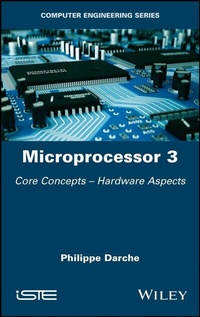
Microprocessor 3
Core Concepts - Hardware Aspects
1st Edition
Published on 3. November 2020
240 pages
978-1-119-78799-0 (ISBN)
Description

Calculation is the main function of a computer. The central unit is responsible for executing the programs. The microprocessor is its integrated form. This component, since the announcement of its marketing in 1971, has not stopped breaking records in terms of computing power, price reduction and integration of functions (calculation of basic functions, storage with integrated controllers). It is present today in most electronic devices. Knowing its internal mechanisms and programming is essential for the electronics engineer and computer scientist to understand and master the operation of a computer and advanced concepts of programming.
This first volume focuses more particularly on the first generations of microprocessors, that is to say those that handle integers in 4 and 8-bit formats. The first chapter presents the calculation function and reminds the memory function. The following is devoted to notions of calculation model and architecture. The concept of bus is then presented. Chapters 4 and 5 can then address the internal organization and operation of the microprocessor first in hardware and then software. The mechanism of the function call, conventional and interrupted, is more particularly detailed in a separate chapter. The book ends with a presentation of architectures of the first microcomputers for a historical perspective.
The knowledge is presented in the most exhaustive way possible with examples drawn from current and old technologies that illustrate and make accessible the theoretical concepts. Each chapter ends if necessary with corrected exercises and a bibliography. The list of acronyms used and an index are at the end of the book.
This first volume focuses more particularly on the first generations of microprocessors, that is to say those that handle integers in 4 and 8-bit formats. The first chapter presents the calculation function and reminds the memory function. The following is devoted to notions of calculation model and architecture. The concept of bus is then presented. Chapters 4 and 5 can then address the internal organization and operation of the microprocessor first in hardware and then software. The mechanism of the function call, conventional and interrupted, is more particularly detailed in a separate chapter. The book ends with a presentation of architectures of the first microcomputers for a historical perspective.
The knowledge is presented in the most exhaustive way possible with examples drawn from current and old technologies that illustrate and make accessible the theoretical concepts. Each chapter ends if necessary with corrected exercises and a bibliography. The list of acronyms used and an index are at the end of the book.
More details
Other editions
Additional editions
Book
12/2020
1st Edition
ISTE Ltd
€164.50
Shipment within 3-4 weeks
Software
11/2020
Wiley
€173.48
No shipping information available
Person
Philippe Darche : Associate Professor, University of Paris (formerly Paris Descartes / Paris V)
Content
Quotation ix
Preface xi
Introduction xv
Chapter 1. Basic and Historical Definitions 1
1.1. Basic definitions 1
1.2. History 3
1.3. Conclusion 15
Chapter 2. Microprocessor Interfacing 17
2.1. Microprocessor bus 17
2.1.1. Address bus 18
2.1.2. Data bus 22
2.1.3. Control bus 23
2.2. Hardware interface 23
2.3. Peripheral logic 24
2.4. Temporal aspects 25
2.4.1. Clock 25
2.4.2. Exchange protocol 34
2.4.3. Asynchronism 37
2.5. Conclusion 38
Chapter 3. Internal Constitution 39
3.1. Registers 39
3.1.1. Definition 40
3.1.2. Accumulators and auxiliary registers 44
3.1.3. Program counter 45
3.1.4. Instruction register 46
3.1.5. Status and control register 46
3.1.6. Index register 53
3.1.7. Indirection register 54
3.1.8. Stack pointer register 54
3.1.9. Special registers 54
3.1.10. Synthesis 55
3.1.11. Register structures 56
3.1.12. Notions related to registers 60
3.2. Internal memories 63
3.3. Integer processing unit 63
3.4. Control unit 69
3.4.1. Internal states 70
3.4.2. Generation of internal synchronization signals 72
3.4.3. Phases of the execution cycle 74
3.4.4. Other subsets 77
3.5. Bus interface 78
3.6. Note 79
3.7. Conclusion 79
Chapter 4. Commercial Microprocessors: From a Single Bit to 128 Bits 81
4.1. Single-bit microprocessor 81
4.2. 4-bit family 82
4.3. 8-bit family 85
4.4. 12-bit family 92
4.5. 16-bit family 92
4.6. 32 bits 94
4.7. New generations 99
4.8. Conclusion 101
Chapter 5. Special Cases 103
5.1. Bit-slice processor 103
5.2. Digital signal processor 104
5.3. Microcontroller 112
5.4. Coprocessor 119
5.5. Parallelism processors 122
5.6. Conclusion 123
Chapter 6. Datasheet 125
6.1. Electrical specifications 125
6.1.1. Supply voltage 125
6.1.2. Power consumption 127
6.1.3. Power supply profiles 128
6.1.4. Energy savings 130
6.1.5. Peripheral components 133
6.2. Processor hardware initialization 134
6.3. Mechanical, electrical and thermal aspects of the package 135
6.4. Conclusion 137
Conclusion of Volume 3 139
Exercises 141
Appendices 151
Acronyms 155
References 179
Index 193
Preface xi
Introduction xv
Chapter 1. Basic and Historical Definitions 1
1.1. Basic definitions 1
1.2. History 3
1.3. Conclusion 15
Chapter 2. Microprocessor Interfacing 17
2.1. Microprocessor bus 17
2.1.1. Address bus 18
2.1.2. Data bus 22
2.1.3. Control bus 23
2.2. Hardware interface 23
2.3. Peripheral logic 24
2.4. Temporal aspects 25
2.4.1. Clock 25
2.4.2. Exchange protocol 34
2.4.3. Asynchronism 37
2.5. Conclusion 38
Chapter 3. Internal Constitution 39
3.1. Registers 39
3.1.1. Definition 40
3.1.2. Accumulators and auxiliary registers 44
3.1.3. Program counter 45
3.1.4. Instruction register 46
3.1.5. Status and control register 46
3.1.6. Index register 53
3.1.7. Indirection register 54
3.1.8. Stack pointer register 54
3.1.9. Special registers 54
3.1.10. Synthesis 55
3.1.11. Register structures 56
3.1.12. Notions related to registers 60
3.2. Internal memories 63
3.3. Integer processing unit 63
3.4. Control unit 69
3.4.1. Internal states 70
3.4.2. Generation of internal synchronization signals 72
3.4.3. Phases of the execution cycle 74
3.4.4. Other subsets 77
3.5. Bus interface 78
3.6. Note 79
3.7. Conclusion 79
Chapter 4. Commercial Microprocessors: From a Single Bit to 128 Bits 81
4.1. Single-bit microprocessor 81
4.2. 4-bit family 82
4.3. 8-bit family 85
4.4. 12-bit family 92
4.5. 16-bit family 92
4.6. 32 bits 94
4.7. New generations 99
4.8. Conclusion 101
Chapter 5. Special Cases 103
5.1. Bit-slice processor 103
5.2. Digital signal processor 104
5.3. Microcontroller 112
5.4. Coprocessor 119
5.5. Parallelism processors 122
5.6. Conclusion 123
Chapter 6. Datasheet 125
6.1. Electrical specifications 125
6.1.1. Supply voltage 125
6.1.2. Power consumption 127
6.1.3. Power supply profiles 128
6.1.4. Energy savings 130
6.1.5. Peripheral components 133
6.2. Processor hardware initialization 134
6.3. Mechanical, electrical and thermal aspects of the package 135
6.4. Conclusion 137
Conclusion of Volume 3 139
Exercises 141
Appendices 151
Acronyms 155
References 179
Index 193
