

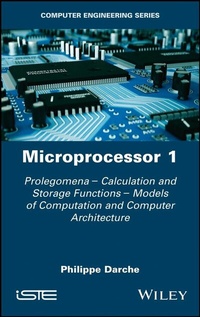
Microprocessor 1
Prolegomena - Calculation and Storage Functions - Models of Computation and Computer Architecture
1st Edition
Published on 9. October 2020
224 pages
978-1-119-77965-0 (ISBN)
Description

Since its commercialization in 1971, the microprocessor, a
modern and integrated form of the central processing unit, has
continuously broken records in terms of its integrated functions,
computing power, low costs and energy saving status. Today, it is
present in almost all electronic devices. Sound knowledge of its
internal mechanisms and programming is essential for
electronics and computer engineers to understand and master
computer operations and advanced programming concepts.
This book in five volumes focuses more particularly on the first
two generations of microprocessors, those that handle 4- and 8-
bit integers. Microprocessor 1 the first of five volumes
presents the computation function, recalls the memory function
and clarifies the concepts of computational models and
architecture. A comprehensive approach is used, with examples
drawn from current and past technologies that illustrate
theoretical concepts, making them accessible.
modern and integrated form of the central processing unit, has
continuously broken records in terms of its integrated functions,
computing power, low costs and energy saving status. Today, it is
present in almost all electronic devices. Sound knowledge of its
internal mechanisms and programming is essential for
electronics and computer engineers to understand and master
computer operations and advanced programming concepts.
This book in five volumes focuses more particularly on the first
two generations of microprocessors, those that handle 4- and 8-
bit integers. Microprocessor 1 the first of five volumes
presents the computation function, recalls the memory function
and clarifies the concepts of computational models and
architecture. A comprehensive approach is used, with examples
drawn from current and past technologies that illustrate
theoretical concepts, making them accessible.
More details
Other editions
Additional editions
Philippe Darche
Microprocessor 1: Prolegomena - Calculation and Storage Functions - Models of Computation and Computer Architecture
Prolegomena - Calculation and Storage Functions - Models of Computation and Computer Architecture
Book
11/2020
1st Edition
ISTE Ltd
€164.50
Shipment within 3-4 weeks
Person
Philippe Darche is Maître de conférences in Information Technology at the Institut Universitaire de Technologie (IUT) de Paris and a researcher at LIP6 at Sorbonne University in the Inria DeLyS (DistributEd aLgorithms and sYstemS) team, France. He is the author of five books in the field of computer architecture.
Content
Quotation vii
Preface ix
Introduction xiii
Chapter 1. The Function of Computation 1
1.1. Beginnings 2
1.2. Classes of computers 10
1.3. Analog approach 36
1.4. Hardware-software relationship 37
1.5. Integration and its limits 43
1.6. Conclusion 47
Chapter 2. The Function of Memory 49
2.1. Definition 50
2.2. Related concepts 56
2.2.1. A story of endianness 56
2.2.2. Alignment 56
2.3. Modeling 57
2.4. Classification 59
2.5. Conclusion 61
Chapter 3. Computation Model and Architecture: Illustration with the von Neumann Approach 63
3.1. Basic concepts 64
3.1.1. The idea of a program 64
3.1.2. Control and data flows and mechanisms 65
3.1.3. Models of computation 67
3.1.4. Architectures 72
3.1.5. The semantic gap 80
3.2. The original von Neumann machine 81
3.2.1. von Neumann's computation model 81
3.2.2. von Neumann's (machine) architecture 82
3.2.3. Control 89
3.3. Modern von Neumann machines 90
3.3.1. Abstraction level 91
3.3.2. Base execution outline 97
3.3.3. Possible transfers 100
3.3.4. Summary: advantages and disadvantages of this model 102
3.4. Variations on a theme 104
3.4.1. Classification by bus 104
3.4.2. Harvard architectures 111
3.4.3. Parallelism 113
3.5. Instruction set architecture 117
3.5.1. Storage components 118
3.5.2. Data format and type 126
3.5.3. Instruction set 126
3.5.4. Memory model 127
3.5.5. Execution modes 128
3.5.6. Miscellaneous 128
3.6. Basic definitions for this book 128
3.7. Conclusion 129
Conclusion of Volume 1 131
Exercises 133
Acronyms 135
References 153
Index 173
Preface ix
Introduction xiii
Chapter 1. The Function of Computation 1
1.1. Beginnings 2
1.2. Classes of computers 10
1.3. Analog approach 36
1.4. Hardware-software relationship 37
1.5. Integration and its limits 43
1.6. Conclusion 47
Chapter 2. The Function of Memory 49
2.1. Definition 50
2.2. Related concepts 56
2.2.1. A story of endianness 56
2.2.2. Alignment 56
2.3. Modeling 57
2.4. Classification 59
2.5. Conclusion 61
Chapter 3. Computation Model and Architecture: Illustration with the von Neumann Approach 63
3.1. Basic concepts 64
3.1.1. The idea of a program 64
3.1.2. Control and data flows and mechanisms 65
3.1.3. Models of computation 67
3.1.4. Architectures 72
3.1.5. The semantic gap 80
3.2. The original von Neumann machine 81
3.2.1. von Neumann's computation model 81
3.2.2. von Neumann's (machine) architecture 82
3.2.3. Control 89
3.3. Modern von Neumann machines 90
3.3.1. Abstraction level 91
3.3.2. Base execution outline 97
3.3.3. Possible transfers 100
3.3.4. Summary: advantages and disadvantages of this model 102
3.4. Variations on a theme 104
3.4.1. Classification by bus 104
3.4.2. Harvard architectures 111
3.4.3. Parallelism 113
3.5. Instruction set architecture 117
3.5.1. Storage components 118
3.5.2. Data format and type 126
3.5.3. Instruction set 126
3.5.4. Memory model 127
3.5.5. Execution modes 128
3.5.6. Miscellaneous 128
3.6. Basic definitions for this book 128
3.7. Conclusion 129
Conclusion of Volume 1 131
Exercises 133
Acronyms 135
References 153
Index 173
