

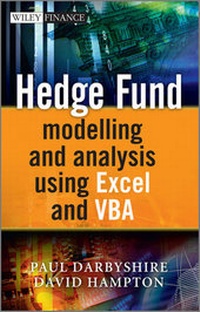
Hedge Fund Modeling and Analysis Using Excel and VBA
Description

More details
Other editions
Additional editions
Persons
Content
Preface xi
1 The Hedge Fund Industry 1
1.1 What Are Hedge Funds? 1
1.2 The Structure of a Hedge Fund 4
1.2.1 Fund Administrators 5
1.2.2 Prime Brokers 5
1.2.3 Custodian, Auditors and Legal 6
1.3 The Global Hedge Fund Industry 7
1.3.1 North America 8
1.3.2 Europe 10
1.3.3 Asia 11
1.4 Specialist Investment Techniques 12
1.4.1 Short Selling 12
1.4.2 Leverage 14
1.4.3 Liquidity 15
1.5 New Developments for Hedge Funds 16
1.5.1 UCITS III Hedge Funds 16
1.5.2 The European Passport 19
1.5.3 Restrictions on Short Selling 20
2 Major Hedge Fund Strategies 23
2.1 Single- and Multi-Strategy Hedge Funds 23
2.2 Fund of Hedge Funds 25
2.3 Hedge Fund Strategies 27
2.3.1 Tactical Strategies 28
2.3.1.1 Global Macro 28
2.3.1.2 Managed Futures 31
2.3.1.3 Long/Short Equity 36
2.3.1.4 Pairs Trading 38
2.3.2 Event-Driven 42
2.3.2.1 Distressed Securities 42
2.3.2.2 Merger Arbitrage 46
2.3.3 Relative Value 49
2.3.3.1 Equity Market Neutral 49
2.3.3.2 Convertible Arbitrage 50
2.3.3.3 Fixed Income Arbitrage 54
2.3.3.3.1 Capital Structure Arbitrage 56
2.3.3.3.2 Swap-Spread Arbitrage 57
2.3.3.3.3 Yield Curve Arbitrage 58
3 Hedge Fund Data Sources 61
3.1 Hedge Fund Databases 61
3.2 Major Hedge Fund Indices 65
3.2.1 Non-investable and Investable Indices 66
3.2.2 Dow Jones Credit Suisse Hedge Fund Indexes 68
3.2.2.1 Liquid Alternative Betas 70
3.2.3 Hedge Fund Research 73
3.2.4 HedgeFund.net 77
3.2.5 FTSE Hedge 77
3.2.5.1 FTSE Hedge Momentum Index 78
3.2.6 Greenwich Alternative Investments 79
3.2.6.1 GAI Investable Indices 80
3.2.7 Morningstar Alternative Investment Center 83
3.2.7.1 MSCI Hedge Fund Classification Standard 83
3.2.7.2 MSCI Investable Indices 85
3.2.8 EDHEC Risk and Asset Management Research Centre (www.edhec-risk.com) 86
3.3 Database and Index Biases 88
3.3.1 Survivorship Bias 89
3.3.2 Instant History Bias 90
3.4 Benchmarking 91
3.4.1 Tracking Error 92
Appendix A: Weighting Schemes 95
4 Statistical Analysis 99
4.1 Basic Performance Plots 99
4.1.1 Value Added Monthly Index 99
4.1.2 Histograms 102
4.2 Probability Distributions 105
4.2.1 Populations and Samples 106
4.3 Probability Density Function 107
4.4 Cumulative Distribution Function 108
4.5 The Normal Distribution 109
4.5.1 Standard Normal Distribution 110
4.6 Visual Tests for Normality 111
4.6.1 Inspection 111
4.6.2 Normal Q-Q Plot 112
4.7 Moments of a Distribution 114
4.7.1 Mean and Standard Deviation 114
4.7.2 Skewness 117
4.7.3 Excess Kurtosis 119
4.7.4 Data Analysis Tool: Descriptive Statistics 120
4.8 Geometric Brownian Motion 122
4.8.1 Uniform Random Numbers 125
4.9 Covariance and Correlation 126
4.10 Regression Analysis 131
4.10.1 Ordinary Least Squares 131
4.10.1.1 Coefficient of Determination 133
4.10.1.2 Residual Plots 134
4.10.1.3 Jarque-Bera Normality Test 135
4.10.1.4 Data Analysis Tool: Regression 138
4.11 Portfolio Theory 142
4.11.1 Mean-Variance Analysis 142
4.11.2 Solver: Portfolio Optimisation 145
4.11.3 Efficient Portfolios 148
5 Risk-Adjusted Return Metrics 151
5.1 The Intuition behind Risk-Adjusted Returns 152
5.1.1 Risk-Adjusted Returns 154
5.2 Common Risk-Adjusted Performance Ratios 157
5.2.1 The Sharpe Ratio 160
5.2.2 The Modified Sharpe Ratio 162
5.2.3 The Sortino Ratio 163
5.2.4 The Drawdown Ratio 167
5.3 Common Performance Measures in the Presence of a Market Benchmark 170
5.3.1 The Information Ratio 172
5.3.2 The M-Squared Metric 173
5.3.3 The Treynor Ratio 174
5.3.4 Jensen's Alpha 178
5.4 The Omega Ratio 181
6 Asset Pricing Models 185
6.1 The Risk-Adjusted Two-Moment Capital Asset Pricing Model 185
6.1.1 Interpreting H 189
6.1.2 Static Alpha Analysis 191
6.1.3 Dynamic Rolling Alpha Analysis 193
6.2 Multi-factor Models 195
6.3 The Choice of Factors 196
6.3.1 A Multi-Factor Framework for a Risk-Adjusted Hedge Fund Alpha League Table 202
6.3.2 Alpha and Beta Separation 208
6.4 Dynamic Style Based Return Analysis 210
6.5 The Markowitz Risk-Adjusted Evaluation Method 214
7 Hedge Fund Market Risk Management 223
7.1 Value-at-Risk 223
7.2 Traditional Measures 226
7.2.1 Historical Simulation 226
7.2.2 Parametric Method 229
7.2.3 Monte Carlo Simulation 230
7.3 Modified VaR 233
7.4 Expected Shortfall 236
7.5 Extreme Value Theory 239
7.5.1 Block Maxima 240
7.5.2 Peaks over Threshold 241
References 245
Important Legal Information 249
Index 251
2
Major Hedge Fund Strategies
Hedge funds can be classified in a number of different ways, e.g. by particular asset, geographical location of strategy or industrial sector. The most common hedge fund classification is by strategy and then by style within that strategy. There are three major hedge fund strat- egies, namely relative value, event-driven and tactical, each with its own individual strategy styles.
This chapter introduces the most common investment strategies within each of the major hedge fund strategy styles. Emphasis is placed on equity related strategies since these will be the focus of more detailed quantitative modelling and analysis in later chapters.
2.1 SINGLE- AND MULTI-STRATEGY HEDGE FUNDS
Hedge funds are a private investment vehicle with a collective pool of money designed to exploit superior manager skills in order to make above average returns for investors. Single-strategy funds rely heavily on the expertise and knowledge of the hedge fund manager(s) to provide such returns using a specific investment strategy (see Figure 2.1). Considerable and effective due diligence is required when attempting to select top (or star) managers in single strategy funds. Such research can be very time-consuming and costly along with the additional problems associated with gaining access to a professional network of top managers.
Figure 2.1 A schematic of the single-strategy, single- and multi-manager hedge fund
Figure 2.2 A schematic of the multi-strategy hedge fund
Although fund managers are usually willing to discuss the general structure of a particular chosen strategy, they are unlikely to divulge sensitive or potentially profitable information. Those involved in single-strategy hedge fund investing will usually have a high degree of ex- perience in qualitative and quantitative analysis. There are obvious drawbacks to single-strategy hedge fund investing and the investor needs to accept a suitable trade-off between ongoing exhaustive research and the return expected on their investment. There is also the problem of investing in a fund that offers no diversification, making the investor extremely vulnerable to the success of a single strategy.
Multi-strategy hedge funds can provide an attractive alternative to single-strategy funds. Their objective is to provide positive returns regardless of the directional movement in a variety of asset classes and sectors, such as equity, fixed income and currency markets. The general multi-strategy fund is based on a selection of hedge fund strategies in a single portfolio operated by a team of managers in a single hedge fund (see Figure 2.2). Such a strategy can prove lucrative to investors who have strong knowledge of, or confidence in, a particular hedge fund management team as well as the added benefits of diversification of investing across a range of asset classes and sectors. This can, however, also be the most convincing argument against multi-strategy hedge funds since the majority of failures are related to operational inefficiencies within the hedge fund. Multi-strategy hedge funds are also faced with the problem of retaining and employing highly skilled managers that have expertise across a range of different investment strategies and sectors. It is often thought that the best managers concentrate on a single or limited group of hedge fund strategies and these can be difficult to source and locate without the necessary experience and network of contacts.
Figure 2.3 A schematic of the FoHFs structure
2.2 FUND OF HEDGE FUNDS
A common investment vehicle for an inexperienced investor or one who has had limited exposure to the alternative investment market is the fund of hedge funds (FoHFs) strategy. Of course, this strategy is not necessarily only for inexperienced investors. If an investor does not have the time or resources to design an efficient hedge fund, select qualified managers for each strategy, determine optimal weightings of investable assets, negotiate the legal documents and then monitor monthly per- formance, a FoHFs strategy may be a more realistic approach to investing. Such investments are also ideal for individual investors who may not be able to attract the interest of leading hedge fund managers.
Funds of hedge funds allocate their capital by investing in hedge funds with different strategies, or investing in multiple hedge funds with the same strategy (see Figure 2.3). A FoHFs manager will usually construct a portfolio of hedge funds (on average 10-20 hedge funds) in order to achieve a certain risk-return profile and level of diversification that is suitable to a range of investors. The manager is responsible for all the due diligence and qualitative and quantitative analysis of potential hedge funds and the termination of poorly performing ones, as well as deciding the management fee structure. Since there are fees associated with each individual hedge fund making up the FoHFs and an additional fee for the FoHFs manager, such investments are normally more expensive than standard hedge fund investing.
Despite the additional layer of fees, there are clear advantages to investing in FoHFs when considering the extent of the skills and expertise offered by the fund manager as well as the expected higher risk-adjusted returns. It is often the case that gaining access to the hedge fund arena can be very expensive with prohibitively high initial minimum investments, whereas FoHFs investors can get involved in the market with much lower minimums whilst accessing the same potential underlying hedge funds. Another advantage of FoHFs is that the manager will also have access to a professional network of individual hedge funds and information usually not available to normal investors along with detailed market knowledge. They will also be highly trained in sourcing talented and often undiscovered star managers whom the general investment community would be much less likely to reach.
This well-diversified portfolio of hedge fund investments can protect an investor from suffering large losses due to the poor performance or failure of a single strategy. However, over the past several years, AuMs in global FoHFs have experienced a dramatic downturn since peaking in early 2008. During the financial crisis, FoHFs suffered massive losses and record redemptions (see Figure 2.4).
Figure 2.4 Growth of the global FoHFs industry since 2000
Source: Eurekahedge
The poor asset flows into the FoHFs industry over the past several years are mainly a result of investors preferring to allocate capital to a single hedge fund rather than multiple managers. As a result of single hedge funds outperforming FoHFs in 2008 and 2009, and the use of gated provisions during the financial crisis, investors have had a change of sentiment towards investing in multi-manager structures. Investors are also unwilling to pay an additional layer of fees to FoHFs managers without the level of returns expected from similar investments. Managers have since begun to address these issues by offering investors lower fee structures, more frequent redemptions and increased transparency. Despite these changes, FoHFs managers need to show improved performance and consistently higher returns in order to entice investors back to investing in the FoHFs industry.
2.3 HEDGE FUND STRATEGIES
Hedge funds can be classified in a number of different ways, for example by particular asset, geographical location of strategy or industrial sector. The most common hedge fund classification is by strategy and then by style within that strategy. As can be seen in Table 2.1 there are three major hedge fund strategies, namely relative value, event-driven and tactical, each with its own individual strategy styles. However, it is important to note that there is no definitive hedge fund strategy classification and the boundaries between them are very blurred.
Table 2.1 The major hedge fund strategies and their individual strategy styles
Relative value Event-driven Tactical Equity market neutral Distressed securities Global macro Convertible arbitrage Risk arbitrage Long/short equity Fixed income arbitrage Managed futures Capital structure arbitrage Swap-spread arbitrage Yield curve arbitrageIn addition to classifying hedge funds by strategy and individual strategy styles, they can also be categorised in terms of their risk-return characteristics and the volatility of each strategy. Figure 2.5 is a schematic diagram of the relationship between each major hedge fund strategy and the associated risk, return and volatility. Tactical strategies offer the highest return but for the greatest risk and are generally highly volatile strategies requiring exceptional skills, ability and experience from the fund manager. On the other hand, relative value strategies offer a much lower return but with the added incentive of lower risk and volatility.
Figure 2.5 The major hedge fund strategies in relation to increasing return, volatility and risk
2.3.1 Tactical Strategies
2.3.1.1 Global Macro
The global macro strategy attempts to make superior returns based on leveraged trades on price...
