

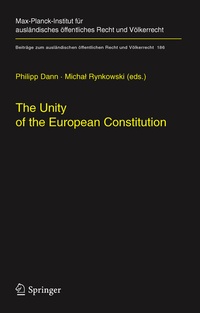
The Unity of the European Constitution
Published on 10. May 2010
X, 396 pages
978-3-540-37721-4 (ISBN)
Description

This book collects the contributions to a conference of a group of young Polish and German public law scholars on the Constitutional Law of the European Union. The articles present a multi-faceted examination of unity and its realization in the primary and constitutional law of the EU, an analysis of EU constitutional structure in the face of diversity, and the independence of EU law from international common law, among other topics.
More details
Other editions
Additional editions
Philipp Dann | Michal Rynkowski
The Unity of the European Constitution
Book
06/2006
1st Edition
Springer
€53.49
Shipment within 7-9 days
Content
European Ungleichzeitigkeit: Introductory Remarks on a Binational Discussion about Unity in the European Union.- European Ungleichzeitigkeit: Introductory Remarks on a Binational Discussion about Unity in the European Union.- General Questions.- The Constitutional Treaty as a Reflexive Constitution.- Thoughts on a Methodology of European Constitutional Law.- Comment on Philipp Dann: Some Remarks on the Methodology of the "Constitutional Law" of the European Union.- The Primacy of European Union Law Over National Law Under the Constitutional Treaty.- Supremacy - Lost? Comment on Roman Kwiecie?.- The Democracy Concept of the European Union: Coherent Constitutional Principle or Prosaic Declaration of Intent?.- Comment on Niels Petersen: A Democratic Union: Coherent Constitutional Principle or Prosaic Declaration of Intent.- Institutional Aspects of the Constitution - Towards a New Institutional Balance?.- The Plurality of the Legislative Process and a System for Attributing Procedures to Competences.- The Concept of the "Legislative" Act in the Constitutional Treaty.- Comment on Alexander Türk: The Concept of the "Legislative Act".- The Emperor's New Clothes: The ECB and the New Institutional Concept.- Comment on Timo Tohidipur.- The Right to an Effective Remedy Pursuant to Article II-107 Paragraph 1 of the Constitutional Treaty.- Comment on Katharina Pabel: The Right to an Effective Remedy in a Polycentric Legal System.- Sectoral Differentiation in the Constitution.- Developments in the Area of Freedom, Security and Justice Brought About by the Constitutional Treaty.- Comment on Dagmara Kornobis-Romanowska: Conceptual Changes in the Area of Freedom, Security and Justice through the Constitutional Treaty.- Constitutionalization of the Common Foreign andSecurity Policy of the European Union: Implications of the Constitutional Treaty.- Comment on Ireneusz Pawel Karolewski: Constitutionalization of the Common Foreign and Security Policy of the European Union: Implications of the Constitutional Treaty.- Common Commercial Policy: The Expanding Competence of the European Union in the Area of International Trade.- Comment on Dorota Leczykiewicz: Common Commercial Policy: The Expanding Competence of the European Union in the Area of International Trade.- Fundamental Rights Concerning Biomedicine in the Constitutional Treaty and Their Effect on the Diverse Legal Systems of Member States.- Comment on Atina Krajewska: Plural Concepts of Human Dignity and the Constitutional Treaty.- Remarks on Art. I-52 of the Constitutional Treaty: New Aspects of the European Ecclesiastical Law?.- Territorial and Temporal Aspects of Unity.- "United in Diversity" - The Integration of Enhanced Cooperation into the European Constitutional Order.- Comment on Daniel Thym: United in Diversity or Diversified in the Union?.- Observations on the Right to Withdraw from the European Union: Who Are the "Masters of the Treaties"?.
"Comment on Dorota Leczykiewicz: Common Commercial Policy: The Expanding Competence of the European Union in the Area of International Trade (S. 305-306)
By Karen Kaiser
I would like to elaborate on some of the elements of unity and differentiation with regard to the Unions common commercial policy under the Constitutional Treaty. I do not want to touch upon the elements of differentiation that are already part of the common commercial policy under the EC Treaty (EC) and would remain so under the Constitutional Treaty, such as the special so-called 133-committee1 and the principle of unanimous voting in cases where agreements include provisions for which unanimit y is required for the adoption of internal rules.> However, I try to find out whether the Constitutional Treaty introduces new elements of differentiation. A. Elements of Unity I would like to distinguish between elements of internal and external unity.
As understood here, internal unity reflects the unity of the Union as a political community vis-a-vis its Member States, illustrated most prominently by the "Community method,">while external unity reflects the unity of the Union vis-a-vis third countries. I. Internal Unity: Parliamentary Consent to International Agreements Dorota Leczykiewicz has pointed out one element of internal unity: the regular involvement of the European Parliament within the context of the common commercial policy, foreseen for the first time under the Constitutional Treaty.
Hereunder, the common commercial policy would be implemented by means of European laws, which are adopted according to the ordinary legislative, i.e. co-decision, procedure. However, unlike Dorota Leczykiewicz, I think that the common commercial policy has not arrived at the "Community method" in only this respect. Parliamentary consent would not only be required where European laws are adopted, but also where international agreements are concluded . According to Art. III -325 (6) (a) of the Constitutional Treaty, "agreements covering fields to which [...] the ordinary legislative procedure applies" would require parliamentary consent.
As has been shown, the common commercial policy is a field to which the ordinary legislative procedure applies. An exception applicable to agreements under Art. 111-315 (3) of the Constitutional Treaty has not been provided for.4 This would not only strengthen democratic control within the Union, but also within the World Trade Organization (WTO). Two different suggestions for strengthening democratic control within the WTO have been discussed so far: establishing a standing Parliamentary Assembly with consultative power and, alternatively, convening regular interparliamentary meetings through existing structures such as the International Parliamentary Union."
By Karen Kaiser
I would like to elaborate on some of the elements of unity and differentiation with regard to the Unions common commercial policy under the Constitutional Treaty. I do not want to touch upon the elements of differentiation that are already part of the common commercial policy under the EC Treaty (EC) and would remain so under the Constitutional Treaty, such as the special so-called 133-committee1 and the principle of unanimous voting in cases where agreements include provisions for which unanimit y is required for the adoption of internal rules.> However, I try to find out whether the Constitutional Treaty introduces new elements of differentiation. A. Elements of Unity I would like to distinguish between elements of internal and external unity.
As understood here, internal unity reflects the unity of the Union as a political community vis-a-vis its Member States, illustrated most prominently by the "Community method,">while external unity reflects the unity of the Union vis-a-vis third countries. I. Internal Unity: Parliamentary Consent to International Agreements Dorota Leczykiewicz has pointed out one element of internal unity: the regular involvement of the European Parliament within the context of the common commercial policy, foreseen for the first time under the Constitutional Treaty.
Hereunder, the common commercial policy would be implemented by means of European laws, which are adopted according to the ordinary legislative, i.e. co-decision, procedure. However, unlike Dorota Leczykiewicz, I think that the common commercial policy has not arrived at the "Community method" in only this respect. Parliamentary consent would not only be required where European laws are adopted, but also where international agreements are concluded . According to Art. III -325 (6) (a) of the Constitutional Treaty, "agreements covering fields to which [...] the ordinary legislative procedure applies" would require parliamentary consent.
As has been shown, the common commercial policy is a field to which the ordinary legislative procedure applies. An exception applicable to agreements under Art. 111-315 (3) of the Constitutional Treaty has not been provided for.4 This would not only strengthen democratic control within the Union, but also within the World Trade Organization (WTO). Two different suggestions for strengthening democratic control within the WTO have been discussed so far: establishing a standing Parliamentary Assembly with consultative power and, alternatively, convening regular interparliamentary meetings through existing structures such as the International Parliamentary Union."
