

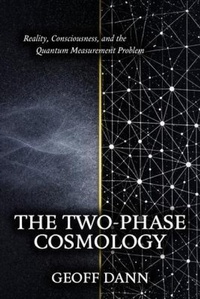
The Two-Phase Cosmology
Description

The Two-Phase Cosmology argues that neither science nor philosophy has yet produced a coherent, unified account of existence, and offers a revolutionary alternative.
This book proposes a two-phase model of existence. Phase 1 consists of the timeless, non-local domain of physically possible states described by quantum theory, while Phase 2 is the dynamically unfolding world of embodied, classical reality. In this model, consciousness is not an accidental byproduct of matter, nor the whole of being, but the phase transition itself: the process through which a single world is selected from the physically available futures (or histories). The collapse of the quantum wavefunction is the same process.
This framework resolves thirty of the deepest problems in science and philosophy, including the riddle of free will, the nature of time, the evolution of consciousness, and the role of the observer in quantum mechanics. It also offers an integrated, elegant, parsimonious resolution of almost every anomaly that troubles modern cosmology, including the fine-tuning and preferred basis problems, the Hubble and S8 tensions, the cosmological constant problem, the identity of dark matter, the mystery of dark energy, the failure to quantise gravity, and the Fermi paradox. The result is a coherent vision of a participatory cosmos in which value and meaning shape the unfolding of reality.
It is not physicalism, not dualism, not idealism, and not panpsychism, but a quantum neutral monism, closest historically to the work of Kant, Whitehead, James, Bergson, Pauli and Wheeler, and more recently Roger Penrose, Thomas Nagel, Iain McGilchrist and Donald Hoffman, though its roots go all the way back to Anaximander and Pythagoras.
More details
Content
Introduction
Part One : The crisis of knowledge and meaning
Chapter 1: From the Apeiron to the Abyss
Chapter 2: The whole elephant
Chapter 3: The broken paradigm
Chapter 4: How might we recognise the new paradigm?
Part Two : A survey of the problem space
Chapter 5: The epicycles of ¿CDM
Chapter 6: The unfinished quantum revolution
Chapter 7: The missing science of consciousness
Part Three: The Two-Phase Cosmology
Chapter 8: 0|8
Chapter 9: In search of a threshold
Chapter 10: The Embodiment Threshold
Chapter 11: Psychegenesis and the Psychetelic Principle
Chapter 12: Free will
Chapter 13: Time
Chapter 14: Two-Phase Cosmology
Chapter 15: A new kind of paradigm shift
Chapter 16: The praeternatural and the New Epistemic Deal
