

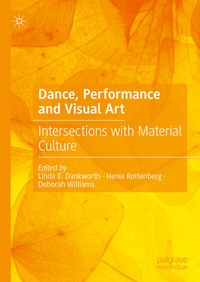
Dance, Performance and Visual Art
Description

More details
Other editions
Additional editions
Persons
Linda E Dankworth is an independent dance ethnographer and ethnochoreologist and has published extensively on Mallorquin dance. She is the joint editor of Dance Ethnography and Global Perspectives: Identity, Embodiment and Culture, Palgrave Macmillan (2014). She established the 'Dance Histories' Degree Course at the School of Liberal and Performing Arts, University of Gloucestershire in 2019. Linda is also Co-Director and founder of the workshops of the World Folk Dance Festival, Palma, Mallorca (2005-2011).
Henia Rottenberg is a dance studies scholar, whose interests focus on the dialogue between dance and visual art and on dance in Israel. She is co-editor of Resling books (in Hebrew): Dance Discourse in Israel (2009), Sara Levi-Tanai (2015) Points of Contact (2018), editor of Bat-Dor: The Story of a Dance Company (2020), and a co-editor of Moving through Conflict (2020). Henia lectures in the Theatre Studies faculty at Western Galilee College, Israel, and was Head of the Dance Theatre Program from 2012-2019.
Deborah Williams is a senior lecturer in Dance Studies at the University of Malta. She holds a BA in Dance with a focus on education and community partnerships from Smith College (Five College Dance Department) USA. From the University of Roehampton in London, Deborah received both an MA in Dance Anthropology and a PhD in Dance. Her research is rooted in the fields of dance anthropology, ethnography, and oral history, and centres around highlighting the voices of non-professional dancers. Her current research areas include investigating dance, social value, and representation, and dance/movement within digital game design.
Content
Chapter 1 - The Politics of Movement Appropriation: From Visual Art to Contemporary Dance.- Chapter 2 - Mauro Bigonzetti's Caravaggio (2008): Exploring painting techniques as choreographic devices.- Chapter 3 - Escapist-Escaping Performances of Hats Theatre, Belgrade.- Chapter 4 - From Page to Stage: Irish dance costumes and the use of illustrations from The Book of Kells.- Chapter 5 - Articulating Dancing Bodies: Social and Pictorial Representations in Early Indian Art.- Chapter 6 - Dancing Clay: on kinaesthetic experience and tactile materialization.- Chapter 7 - Process as Performance: The collaborative methods of choreographer, Merce Cunningham and Pop artist, Richard Hamilton.- Chapter 8 - From Physical Sensation to Digital Presentation: Exploring Interdisciplinary World Building.- Chapter 9 - Frozen Scenography: Extending Somatic Movement Practice through 3D- Scanning.
