

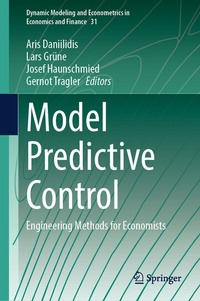
Model Predictive Control
Description

The book explores the field of model predictive control (MPC). It reports on the latest developments in MPC, current applications, and presents various subfields of MPC. The book features topics such as uncertain and stochastic MPC variants, learning and neural network approaches, easy-to-use numerical implementations as well as multi-agent systems and scheduling and coordination tasks. While MPC is rooted in engineering science, this book illustrates the potential of using MPC theory and methods in non-engineering sciences and applications such as economics, finance, and environmental sciences.
More details
Other editions
Additional editions
Persons
Aris Daniilidis is a professor of Applied Mathematics specializing in Variational Analysis and Optimization. He held faculty positions at the Autonomous University of Barcelona and the University of Chile before joining TU Wien (Austria) in 2021. Currently, he leads the research group Variational Analysis, Dynamics, and Operations Research (VADOR) and has held various visiting positions in France and Italy.
Lars Grüne is a professor and the chair of Applied Mathematics at the University of Bayreuth (Germany). He joined the university in 2002 after previous positions at the University of Augsburg and Goethe University in Frankfurt/M, Germany. He has held visiting positions in Rome, Italy, Newcastle, and Australia.
Josef Haunschmied is a senior lecturer at TU Wien (Austria) and has actively participated in multiple research projects and served as the principal investigator in four of them. His expertise spans scientific computing, optimal control of ordinary systems, operations research, mathematical programming, and mathematical modeling.
Gernot Tragler is an associate professor of Operations Research at TU Wien (Austria) and focuses on dynamic optimization with applications in energy, environment, finance, health, and socio-economics. He also teaches graduate courses in Nonlinear Programming and various methods in Dynamic Optimization and their practical uses.
Content
Chapter 1. Multi-horizon MPC and Its Application to theIntegrated Power and Thermal Management ofElectri?ed Vehicles (Qiuhao Hu).- Chapter 2. Data/Moment-Driven Approaches for FastPredictive Control of Collective Dynamics (Giacomo Albi).- Chapter 3. Finite-Dimensional Receding Horizon Control ofLinear Time-Varying Parabolic PDEs: StabilityAnalysis and Model-Order Reduction (Behzad Azmi).- Chapter 4. Solving Hybrid Model Predictive ControlProblems via a Mixed-Integer Approach (Iman Nodozi).- Chapter 5. nMPyC - A Python Package for Solving OptimalControl Problems via Model Predictive Control (Jonas Schießl).- Chapter 6. Controllability of Continuous Networks and aKernel-Based Learning Approximation (Michael Herty).- Chapter 7. Economic Model Predictive Control as aSolution to Markov Decision Processes (Dirk Reinhardt).- Chapter 8. Reinforcement Learning with Guarantees (Mario Zanon).
