

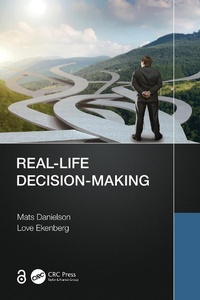
Real-Life Decision-Making
1st Edition
Published on 8. August 2023
140 pages
978-1-000-93689-6 (ISBN)
Description

Have you ever experienced a decision situation that was hard to come to grips with? Did you ever feel a need to improve your decision-making skills? Is this something where you feel that you have not learned enough practical and useful methods? In that case, you are not alone! Even though decision-making is both considered and actually is a very important skill in modern work-life as well as in private life, these skills are not to any reasonable extent taught in schools at any level. No wonder many people do indeed feel the need to improve but have a hard time finding out how. This book is an attempt to remedy this shortcoming of our educational systems and possibly also of our common, partly intuition-based, decision culture. Intuition is not at all bad, quite the contrary, but it has to co-exist with rationality. We will show you how.
Methods for decision-making should be of prime concern to any individual or organisation, even if the decision processes are not always explicitly or even consciously formulated. All kinds of organisations, as well as individuals, must continuously make decisions of the most varied nature in order to prosper and attain their objectives. A large part of the time spent in any organisation, not least at management levels, is spent gathering, processing, and compiling information for the purpose of making decisions supported by that information. The same interest has hitherto not been shown for individual decision-making, even though large gains would also be obtained at a personal level if important personal decisions were better deliberated. This book aims at changing that and thus attends to both categories of decision-makers.
This book will take you through a journey starting with some history of decision-making and analysis and then go through easy-to-learn ways of structuring decision information and methods for analysing the decision situations, beginning with simple decision situations and then moving on to progressively harder ones, but never losing sight of the overarching goal that the reader should be able to follow the progression and being able to carry out similar decision analyses in real-life situations.
The Open Access version of this book, available at www.taylorfrancis.com, has been made available under a Creative Commons Attribution-Non Commercial-No Derivatives 4.0 license.
Methods for decision-making should be of prime concern to any individual or organisation, even if the decision processes are not always explicitly or even consciously formulated. All kinds of organisations, as well as individuals, must continuously make decisions of the most varied nature in order to prosper and attain their objectives. A large part of the time spent in any organisation, not least at management levels, is spent gathering, processing, and compiling information for the purpose of making decisions supported by that information. The same interest has hitherto not been shown for individual decision-making, even though large gains would also be obtained at a personal level if important personal decisions were better deliberated. This book aims at changing that and thus attends to both categories of decision-makers.
This book will take you through a journey starting with some history of decision-making and analysis and then go through easy-to-learn ways of structuring decision information and methods for analysing the decision situations, beginning with simple decision situations and then moving on to progressively harder ones, but never losing sight of the overarching goal that the reader should be able to follow the progression and being able to carry out similar decision analyses in real-life situations.
The Open Access version of this book, available at www.taylorfrancis.com, has been made available under a Creative Commons Attribution-Non Commercial-No Derivatives 4.0 license.
More details
Edition
1. Auflage
Language
English
Place of publication
London
United Kingdom
Publishing group
Taylor & Francis Ltd
Target group
College/higher education
Professional and scholarly
Illustrations
22 Tables, black and white; 11 Line drawings, black and white; 8 Halftones, black and white; 19 Illustrations, black and white
File size
12,76 MB
ISBN-13
978-1-000-93689-6 (9781000936896)
Copyright in bibliographic data and cover images is held by Nielsen Book Services Limited or by the publishers or by their respective licensors: all rights reserved.
Schweitzer Classification
Other editions
Additional editions
Mats Danielson | Love Ekenberg
Real-Life Decision-Making
Book
08/2023
1st Edition
CRC Press
€38.30
Shipment within 10-20 days
Mats Danielson | Love Ekenberg
Real-Life Decision-Making
Book
08/2023
1st Edition
CRC Press
€175.30
Shipment within 10-20 days
Persons
Mats Danielson is a Full Professor in Computer and Systems Sciences at Stockholm University, a Senior Advisor to the President, and a UNESCO Chair Professor. He is a former Dean of the Faculty of Social Sciences as well as a former Vice President for External Relations, Innovation, and ICT. He has a PhD in Computer and Systems Sciences from KTH Royal Institute of Technology (KTH) as well as university degrees in Computer Science and Engineering (from KTH) and in Economics and Business Administration (from Stockholm University). He worked in the software industry for almost 20 years before joining academia to work with research and algorithm and software design and development within decision analysis and decision support.
Love Ekenberg was a Full Professor in Computer and Systems Sciences at Stockholm University and was a UNESCO Professor. He received a PhD in Computer and Systems Sciences as well as a PhD in Mathematics, both from Stockholm University. He worked with risk and decision analysis, i.e. with development of theoretical frameworks and models, products, and methodologies within these areas, for more than 20 years, along with carrying out a large number of consultancy assignments.
Love Ekenberg was a Full Professor in Computer and Systems Sciences at Stockholm University and was a UNESCO Professor. He received a PhD in Computer and Systems Sciences as well as a PhD in Mathematics, both from Stockholm University. He worked with risk and decision analysis, i.e. with development of theoretical frameworks and models, products, and methodologies within these areas, for more than 20 years, along with carrying out a large number of consultancy assignments.
Content
Chapter 1 Introduction
Chapter 2 Decision Modelling
Chapter 3 Bayesian Decision Analysis
Chapter 4 Imprecise Information
Chapter 5 Multi-Criteria Decision-Making
Chapter 6 The Pilot Method
Chapter 7 Real-Life Case Studies
Chapter 8 Guidelines for Real-Life Decisions
Appendix: The DecideIT Software
Chapter 2 Decision Modelling
Chapter 3 Bayesian Decision Analysis
Chapter 4 Imprecise Information
Chapter 5 Multi-Criteria Decision-Making
Chapter 6 The Pilot Method
Chapter 7 Real-Life Case Studies
Chapter 8 Guidelines for Real-Life Decisions
Appendix: The DecideIT Software
