

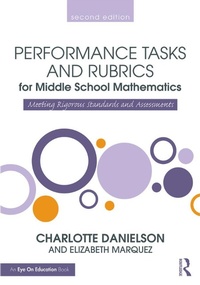
Performance Tasks and Rubrics for Middle School Mathematics
Meeting Rigorous Standards and Assessments
2nd Edition
Published on 2. March 2016
196 pages
978-1-317-44252-3 (ISBN)
Description

Performance tasks are highly effective tools to assist you in implementing rigorous standards. But how do you create, evaluate, and use such tools? In this bestselling book, educational experts Charlotte Danielson and Elizabeth Marquez explain how to construct and apply performance tasks to gauge students' deeper understanding of mathematical concepts at the middle school level. You'll learn how to:
Evaluate the quality of performance tasks, whether you've written them yourself or found them online;
Use performance tasks for instructional decision-making and to prepare students for summative assessments;
Create your own performance tasks, or adapt pre-made tasks to best suit students' needs;
Design and use scoring rubrics to evaluate complex performance tasks;
Use your students' results to communicate more effectively with parents.
This must-have second edition is fully aligned to the Common Core State Standards and assessments and includes a variety of new performance tasks and rubrics, along with samples of student work. Additionally, downloadable student handout versions of all the performance tasks are available as free eResources from our website (www.routledge.com/9781138906914), so you can easily distribute them to your class.
Evaluate the quality of performance tasks, whether you've written them yourself or found them online;
Use performance tasks for instructional decision-making and to prepare students for summative assessments;
Create your own performance tasks, or adapt pre-made tasks to best suit students' needs;
Design and use scoring rubrics to evaluate complex performance tasks;
Use your students' results to communicate more effectively with parents.
This must-have second edition is fully aligned to the Common Core State Standards and assessments and includes a variety of new performance tasks and rubrics, along with samples of student work. Additionally, downloadable student handout versions of all the performance tasks are available as free eResources from our website (www.routledge.com/9781138906914), so you can easily distribute them to your class.
Reviews / Votes
"The book provides an excellent overview of the rationale for, and the strengths and limitations of, the use of performance tasks to assess student achievement and progress in mathematics. [The authors] offer a user-friendly, field-tested process for developing performance tasks and rubrics, along with practical advice for evaluating student work, selecting "anchors," and establishing performance standards. Finally, the sample tasks, rubrics and student work samples provide tried and true resources for immediate use, while serving as models to guide development of additional tasks and scoring tools." --From the Foreword by Jay McTighe, Educational Author and Consultant"In this series, the authors offer a sharply focused description of performance assessments for teaching and learning mathematics. The structure and content of the books is very strong, centering on the specifics of task development, rubric refinement and integration of the methodology into instruction. Our challenge is to help teachers develop the assessment literacy needed to manage assessment effectively day to day in the classroom. This series helps us meet that challenge." --Rick Stiggins, Assessment Consultant, Portland, Oregon
"The second edition of the Danielson series on performance tasks and rubrics brings clarity to the complex but important responsibility of creating and using authentic assessments in the classroom. Advocating the complementary roles both of traditional tests and performance tasks in a balanced assessment system, Danielson and her colleagues provide practical guidelines for and useful examples of performance tasks in K-12 mathematics. Their focus on the rigorous yet fair and engaging assessment of authentic performance tasks is as timely as it is timeless to teaching." --Chris Gareis and Leslie Grant, authors of Teacher-Made Assessments: How to Connect Curriculum, Instruction, and Student Learning (2nd ed.)
"This book would be a great resource for any math teacher or group of teachers looking to work on improving their assessments and thereby improving the instruction leading up to these assessments."
-Jan Roberts, Middleweb.com
More details
Series
Edition
2nd edition
Language
English
Place of publication
London
United Kingdom
Publishing group
Taylor & Francis Ltd
Target group
Professional and scholarly
Edition type
Revised edition
Illustrations
38 s/w Tabellen, 40 s/w Photographien bzw. Rasterbilder, 14 s/w Zeichnungen
38 Tables, black and white; 14 Line drawings, black and white; 40 Halftones, black and white
File size
2,82 MB
ISBN-13
978-1-317-44252-3 (9781317442523)
Copyright in bibliographic data and cover images is held by Nielsen Book Services Limited or by the publishers or by their respective licensors: all rights reserved.
Schweitzer Classification
Other editions
Additional editions
Charlotte Danielson | Elizabeth Marquez
Performance Tasks and Rubrics for Middle School Mathematics
Meeting Rigorous Standards and Assessments
Book
01/2019
2nd Edition
Routledge
€170.50
Shipment within 10-20 days
Charlotte Danielson | Elizabeth Marquez
Performance Tasks and Rubrics for Middle School Mathematics
Meeting Rigorous Standards and Assessments
Book
03/2016
2nd Edition
Routledge
€46.20
Shipment within 10-20 days
Persons
Charlotte Danielson is an educational consultant now based in San Francisco, California. She has taught at all levels from kindergarten through college, and has worked as an administrator, a curriculum director, and a staff developer.
Elizabeth (Liz) Marquez is a mathematics assessment specialist at Educational Testing Service. She has taught mathematics in both middle and high school. Liz is a recipient of the Presidential Award for Excellence in Mathematics Teaching and the Princeton University Prize for Distinguished Secondary School Teaching.
Elizabeth (Liz) Marquez is a mathematics assessment specialist at Educational Testing Service. She has taught mathematics in both middle and high school. Liz is a recipient of the Presidential Award for Excellence in Mathematics Teaching and the Princeton University Prize for Distinguished Secondary School Teaching.
Content
eResources
Meet the Authors
Foreword by Jay McTighe
Preface
Acknowledgements
Chapter 1: Introduction: What Is Performance Assessment?
Chapter 2: Why Use Performance Assessment?
Chapter 3: Making an Evaluation Plan
Chapter 4: Understanding Quality Performance Tasks
Chapter 5: Creating and Adapting Performance Tasks
Chapter 6: Using Rubrics to Evaluate Complex Performance
Chapter 7: Creating and Adapting Rubrics
Chapter 8: Middle School Mathematics Performance Tasks
Meet the Authors
Foreword by Jay McTighe
Preface
Acknowledgements
Chapter 1: Introduction: What Is Performance Assessment?
Chapter 2: Why Use Performance Assessment?
Chapter 3: Making an Evaluation Plan
Chapter 4: Understanding Quality Performance Tasks
Chapter 5: Creating and Adapting Performance Tasks
Chapter 6: Using Rubrics to Evaluate Complex Performance
Chapter 7: Creating and Adapting Rubrics
Chapter 8: Middle School Mathematics Performance Tasks
