

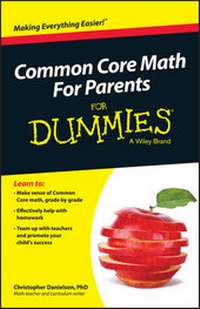
Common Core Math For Parents For Dummies with Videos Online
Description

More details
Other editions
Additional editions
Person
Content
Chapter 2
Looking at Math Teaching Then and Now
In This Chapter
Comprehending the history of reform in math education
Understanding the role of testing and accountability in the development of the Common Core
The Common Core State Standards for mathematics are a sequence of math concepts and skills that students should learn in kindergarten through 12th grade. But these standards didn't just drop out of the sky like the tablets upon which the Ten Commandments were written. These standards have a history. Knowing a little bit about this history can help you understand why the standards are as they are and exactly what problems the standards are purported to solve.
In this chapter, I give you a whirlwind tour of the last 100 years (or so) of math education in the United States so you can grasp why Common Core is here today.
Setting Goals for the 1900s
In 1892, the Committee of Ten met with the charge of making reform recommendations for the structure and content of secondary education in the United States. At the time, Germany, Britain, and France were seen as the major international competitors against which to compare US schools and achievement.
This question of international competitiveness is frequently the concern in education reform initiatives (see the sections "Competing Globally with Advanced Math and Science" and "Reaching Consensus with the Common Core" later in this chapter for specific reforms).
This committee, established by the National Education Association (NEA), put in place a structure for the high school curriculum that continues to predominate today - algebra in ninth grade, geometry in tenth grade, algebra 2 in 11th grade, and trigonometry or more advanced algebra in 12th grade.
With the exception of some initiatives that have sought to place eighth graders in algebra, some districts that view calculus in 12th grade as an important goal and some other tinkering around the edges, very little has changed about the structure of high school mathematics in the 130 years since the Committee of Ten produced its report.
Nonetheless, education reform initiatives have continued, and the question of international competitiveness is frequently the concern. Only the players have changed. The basic game of comparing the United States internationally to other systems of education remains the same.
Competing Globally with Advanced Math and Science
In 1957, the Soviet Union launched Sputnik - the first man-made satellite. This launch was a symbolic victory for the Soviet Union. It also was an event that sparked a great deal of concern about whether the United States had the scientific and mathematical infrastructure to be competitive in the so-called Space Race. As with both earlier reforms and later ones, international comparison was the catalyst for action.
One of the primary concerns was that the United States wasn't adequately preparing a generation of advanced research scientists and mathematicians for the work of outpacing the Soviets in space and defense. As is often the case, the nation looked to the public schools to solve this societal problem.
As one part of the effort to address the perceived lack of math and science research capacity, the National Science Foundation funded curriculum writing in mathematics - most notably through the School Mathematics Study Group. The writers on this project were primarily research mathematicians at institutions such as Yale University and Stanford University. These mathematicians set out to write the math curriculum they wished they had been offered as K-12 students. The resulting texts focused on the abstract foundations of mathematics - set theory, functions, formal logic, and so on. The collection of ideas in these texts became popularly known as New Math.
The important thing to know about the New Math textbooks is that their purpose was to better prepare the students who were supposed to go on to be the nation's mathematical and scientific elite. By contrast, later reforms (see the section "Rethinking Math Teaching in the Age of Information" in this chapter) were based on an interest in raising the mathematical achievement of the general population of students.
Eventually, the New Math reforms failed as a result of public distaste for the unfamiliar ideas coupled with a teaching corps that hadn't been adequately prepared to teach these ideas. Whether the programs would have been effective in an ideal situation is unclear, but in the messy world of American schools, they were a failure. The School Mathematics Study Group closed up shop in the 1970s, and by this time, few of the textbooks were still in use in the United States.
Returning to Basics
The 1970s were characterized by a call to get back to basics. The prevailing mood was that earlier reform efforts that had focused on preparing advanced mathematicians and research scientists had left out large numbers of students by inadequately preparing them in arithmetic and basic algebra. The feeling was that students had been taught the foundations of mathematics, but few of them could actually do any mathematics.
The popular argument of the time was that mathematics is a subject that builds from simple concepts to more advanced ones in a linear way and that the press to focus on advanced mathematical ideas throughout the public school curriculum rejected this basic truth. Step-by-step development of skills, with mastery at each stage before moving on to the next one, became the rule of the day.
Extreme versions of the back-to-basics perspective presented math as a disconnected series of facts. The job of teaching math - in this perspective - was to elicit the correct response to each stimulus. Two plus three should make a child say five, and three plus five should make a child say eight.
The 1970s was the era of timed math tests, a practice that is still common in American math education. In a timed math test, students may have had to write all of the multiplication facts involving 9 in one minute with the facts out of order - so 9 × 2, 9 × 7, 9 × 1, and so on. Students who mastered their nines times tables this way would move on to the tens times tables and so on. The key to a timed test is that it doesn't allow time to think: The goal is memorization.
Later reforms were based on different ideas about how children learn mathematics, as I discuss in the next section.
Teaching Math in the Info Age
In 1989, after quite a few years of discussion and work, the National Council of Teachers of Mathematics (NCTM) released the Curriculum and Evaluation Standards for School Mathematics, commonly referred to as the NCTM Standards. This document was controversial from the get-go, but it was notable for two reasons:
- It presented a comprehensive view of the contemporary and future landscape of math teaching.
- A professional organization of teachers, rather than a government entity, produced it.
A prominent feature of the NCTM Standards was a call for reconsidering the role of mathematics education in the era of computational technology. By 1989 people had been able to carry around calculators and had access to them for simple daily living tasks, such as balancing a checkbook, for a number of years. Also, the committee clearly could see that access to computational power would be greatly increasing in the ensuing years, which has certainly proven to be the case.
The NCTM Standards built the case that the mathematics taught in schools ought to be reconsidered in light of this ready availability of computing power. Much of the mathematics that students studied in school at the time was focused on training students to compute. The NCTM Standards offered a vision for how this should change in an era where computers would crunch numbers with unprecedented speed and economy.
The NCTM Standards laid out proposals for these changes in detail. They called for less paper-and-pencil computation, and more estimation and problem solving.
Many members of the public interpreted (rightly or wrongly) these changes to be calls to do away with teaching students computational skills. As with earlier reform efforts, this public pushback led to controversy and conflict. This time, the conflict had a name - the Math Wars.
The Math Wars were focused in particular on curriculum projects developed through funding in the 1990s by the National Science Foundation. Certain groups of mathematicians and scientists saw in these curricula an overemphasis on student-developed methods and too many traditional topics being left out. Over time, the Math Wars settled down with both sides tempering their language and tactics. Most of the curricula in question persisted in some form beyond the Math Wars, and several are still in common use today.
One important feature of the NCTM Standards was that math topics were arranged by grade bands rather than by individual grades. The standards called for children to learn something in sixth grade through eighth grade, but didn't specify which grade. This allowed for some diversity in curricular approaches. One set of materials could teach operations with integers (as I discuss in Chapter 12) in sixth grade, for example, while another could teach it in seventh grade. To be aligned with NCTM Standards, all that mattered was that this topic appeared somewhere in middle school.
