

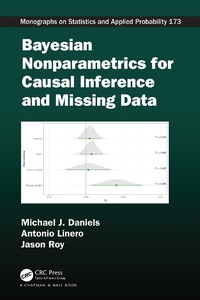
Bayesian Nonparametrics for Causal Inference and Missing Data
1st Edition
Published on 23. August 2023
262 pages
978-1-000-92773-3 (ISBN)
Description

Bayesian Nonparametrics for Causal Inference and Missing Data provides an overview of flexible Bayesian nonparametric (BNP) methods for modeling joint or conditional distributions and functional relationships, and their interplay with causal inference and missing data. This book emphasizes the importance of making untestable assumptions to identify estimands of interest, such as missing at random assumption for missing data and unconfoundedness for causal inference in observational studies. Unlike parametric methods, the BNP approach can account for possible violations of assumptions and minimize concerns about model misspecification. The overall strategy is to first specify BNP models for observed data and then to specify additional uncheckable assumptions to identify estimands of interest.
The book is divided into three parts. Part I develops the key concepts in causal inference and missing data and reviews relevant concepts in Bayesian inference. Part II introduces the fundamental BNP tools required to address causal inference and missing data problems. Part III shows how the BNP approach can be applied in a variety of case studies. The datasets in the case studies come from electronic health records data, survey data, cohort studies, and randomized clinical trials.
Features
* Thorough discussion of both BNP and its interplay with causal inference and missing data
* How to use BNP and g-computation for causal inference and non-ignorable missingness
* How to derive and calibrate sensitivity parameters to assess sensitivity to deviations from uncheckable causal and/or missingness assumptions
* Detailed case studies illustrating the application of BNP methods to causal inference and missing data
* R code and/or packages to implement BNP in causal inference and missing data problems
The book is primarily aimed at researchers and graduate students from statistics and biostatistics. It will also serve as a useful practical reference for mathematically sophisticated epidemiologists and medical researchers.
The book is divided into three parts. Part I develops the key concepts in causal inference and missing data and reviews relevant concepts in Bayesian inference. Part II introduces the fundamental BNP tools required to address causal inference and missing data problems. Part III shows how the BNP approach can be applied in a variety of case studies. The datasets in the case studies come from electronic health records data, survey data, cohort studies, and randomized clinical trials.
Features
* Thorough discussion of both BNP and its interplay with causal inference and missing data
* How to use BNP and g-computation for causal inference and non-ignorable missingness
* How to derive and calibrate sensitivity parameters to assess sensitivity to deviations from uncheckable causal and/or missingness assumptions
* Detailed case studies illustrating the application of BNP methods to causal inference and missing data
* R code and/or packages to implement BNP in causal inference and missing data problems
The book is primarily aimed at researchers and graduate students from statistics and biostatistics. It will also serve as a useful practical reference for mathematically sophisticated epidemiologists and medical researchers.
Reviews / Votes
"Overall, I would characterize this book as ambitious, concise, imperfect, and valuable. It isn't exactly a beach read, but in the right hands, this book would be an excellent crash course in advanced Bayesian modeling for healthcare applications, with all of the messiness that kind of data entails. Highly recommended for strong PhD students looking to do cutting edge methods work in health related fields."~P. Richard Hahn (04 Nov 2024), Journal of the American Statistical Association
More details
Series
Edition
1. Auflage
Language
English
Place of publication
London
United Kingdom
Publishing group
Taylor & Francis Ltd
Target group
Adult education
Product notice
Reflowable
Illustrations
8 Tables, black and white; 42 Line drawings, black and white; 42 Illustrations, black and white
ISBN-13
978-1-000-92773-3 (9781000927733)
Copyright in bibliographic data and cover images is held by Nielsen Book Services Limited or by the publishers or by their respective licensors: all rights reserved.
Schweitzer Classification
Other editions
Additional editions
Michael J. Daniels | Antonio Linero | Jason Roy
Bayesian Nonparametrics for Causal Inference and Missing Data
Book
08/2023
1st Edition
Chapman & Hall/CRC
€145.20
Shipment within 15-20 days
Persons
Dr. Daniels received his undergraduate degree from Brown University in Applied Mathematics and doctoral degree from Harvard University in Biostatistics. He has been on the faculty at Iowa State and University of Texas at Austin.
Currently, Dr. Daniels is Professor, Andrew Banks Family Endowed Chair, and Chair in the Department of Statistics at the University of Florida. He is a past president of ENAR. He is a fellow of the American Statistical Association, past chair of the Statistics in Epidemiology Section of the American Statistical Association (ASA), former chair of the Biometrics Section of the ASA, and former editor of Biometrics.
He has received the Lagakos Distinguished Alumni Award from Harvard Biostatistics and the L. Adrienne Cupples Award from Boston University.
He has published extensively on Bayesian methods for missing data, longitudinal data and causal inference and has been funded by NIH R01 grants as PI and/or MPI since 2001. He also has a strong and productive record of collaborative research, with a focus on behavioral trials in smoking cessation and weight management, muscular dystrophy, and HIV.
Dr. Linero received his PhD in Statistics from the University of Florida. He is currently Assistant Professor in the Department of Statistics and Data Sciences at the University of Texas at Austin. His research is broadly focused on developing flexible Bayesian methods for complex longitudinal data, as well as developing tools for model selection, variable selection, and causal inference within the Bayesian nonparametric framework for high-dimensional problems.
Dr. Roy received his PhD in Biostatistics from the University of Michigan. He is currently Professor of Biostatistics and Chair of the Department of Biostatistics and Epidemiology at Rutgers School of Public Health. He directs the biostatistics core of the New Jersey Alliance for Clinical and Translational Science. He is a fellow of the American Statistical Association (ASA) and recipient of the Causality in Statistics Education Award from the ASA. His methodological research has focused on flexible Bayesian methods for causal inference. As a collaborative statistician, he has worked on studies in many areas of medicine and public health, including chronic kidney disease, hepatotoxicity of medications, and SARS-CoV-2.
Currently, Dr. Daniels is Professor, Andrew Banks Family Endowed Chair, and Chair in the Department of Statistics at the University of Florida. He is a past president of ENAR. He is a fellow of the American Statistical Association, past chair of the Statistics in Epidemiology Section of the American Statistical Association (ASA), former chair of the Biometrics Section of the ASA, and former editor of Biometrics.
He has received the Lagakos Distinguished Alumni Award from Harvard Biostatistics and the L. Adrienne Cupples Award from Boston University.
He has published extensively on Bayesian methods for missing data, longitudinal data and causal inference and has been funded by NIH R01 grants as PI and/or MPI since 2001. He also has a strong and productive record of collaborative research, with a focus on behavioral trials in smoking cessation and weight management, muscular dystrophy, and HIV.
Dr. Linero received his PhD in Statistics from the University of Florida. He is currently Assistant Professor in the Department of Statistics and Data Sciences at the University of Texas at Austin. His research is broadly focused on developing flexible Bayesian methods for complex longitudinal data, as well as developing tools for model selection, variable selection, and causal inference within the Bayesian nonparametric framework for high-dimensional problems.
Dr. Roy received his PhD in Biostatistics from the University of Michigan. He is currently Professor of Biostatistics and Chair of the Department of Biostatistics and Epidemiology at Rutgers School of Public Health. He directs the biostatistics core of the New Jersey Alliance for Clinical and Translational Science. He is a fellow of the American Statistical Association (ASA) and recipient of the Causality in Statistics Education Award from the ASA. His methodological research has focused on flexible Bayesian methods for causal inference. As a collaborative statistician, he has worked on studies in many areas of medicine and public health, including chronic kidney disease, hepatotoxicity of medications, and SARS-CoV-2.
Content
Part I. Overview of Bayesian inference in causal inference and missing data and identifiability. 1. Overview of causal inference. 2. Overview of missing data. 3. Overview of Bayesian Inference for Missing Data and Causal Inference. Part II. Bayesian nonparametrics for causal inference and missing data. 4. Identifiability and Sensitivity Analysis. 5. Bayesian Decision Trees and their Ensembles. Part III. Identification and sensitivity analysis. 6. Dirichlet Process Mixtures and extensions. 7. Gaussian process prior and Dependent Dirichlet processes. 8. Causal Inference on Quantiles using Propensity scores. 9. Causal Inference with a point treatment using an EDPM model. 10. DDP+GP for causal inference using marginal structural models. 11. DPMs for Dropout in Longitudinal Studies. 12. DPMs for Non-Monotone Missingness.
