

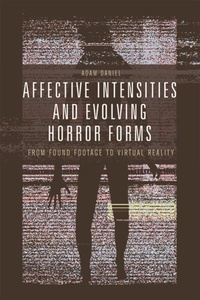
Affective Intensities and Evolving Horror Forms
From Found Footage to Virtual Reality
1st Edition
Published on 3. February 2020
232 pages
978-1-4744-5638-8 (ISBN)
Description

Horror cinema is a genre that is undergoing constant evolution, from the sub-genre of 'found footage,' to post-cinematic new media forms such as Youtube horror, horror video games and cinematic virtual reality horror. By investigating how these new forms alter the dynamics of spectatorship, this book charts how cinema's affective capacities have shifted in relation to these modifications in the forms of cinematic horror. It applies a rich theoretical synthesis of phenomenological and Deleuzian approaches to a number of case studies, including films like The Blair Witch Project, Paranormal Activity and Creep as well as video games such as Alien: Isolation and new media forms such as Youtube horror and virtual reality horror.
More details
Other editions
Additional editions
Book
12/2021
Edinburgh University Press
€29.00
Shipment within 15-20 days
Content
- Intro
- Half Title
- Title page
- Copyright
- Contents
- List of Figures
- Acknowledgements
- Introduction
- Evolving Forms, Evolving Affects
- Affect and Horror Media
- Horror Media and the 'Lived Body'
- Deleuze, Embodiment, Neuroscience and Horror: A 'Machinic Assemblage'
- The Book
- 1. From the Semantic to the Somatic: Affective Engagement with Horror Cinema
- Cognitivist Frameworks of Spectatorship
- Towards the Somatic
- The Phenomenology of Horror
- 2. From Identification to Embodied Spectatorship in the Found Footage Horror Film
- To Look (or Not to Look)
- Technologies of Perception in Horror Film
- Bleeding Binaries: When a Screen Becomes a Portal
- The Birth and Emergence of 'Found Footage' Horror Cinema
- The Unreal Reality of Found Footage
- Found Footage and the Embodied Spectator
- 3. Camera Supernaturalis
- The Out-of-Frame of Found Footage
- Into the Woods: Willow Creek and The Blair Witch Project
- The 'Empty' Frame of Found Footage Horror
- Cinematic Dread and the Camera of Paranormal Activity
- The Monster as Visual and Aural Intensification
- 4. Perception and Point of View in the Found Footage Horror Film: New Understandings via Deleuze's Perception-Image
- How Do We Get 'Inside' a Movie?
- 'Becoming-with' the Film
- Deleuzian 'Spectatorship'
- The Perception-Image
- Found Footage Horror and 'Camera Consciousness'
- Deleuze and Representation
- 5. Horrific Entwinement: Affective Neuroscience and the Body of the Horror Spectator
- The Question of Empathy
- Empathic Identification and 'Embodied Simulation Theory'
- Mimetic Innervation
- Foraging through Found Footage: Panksepp's SEEKING Instinct
- 6. What Hides behind the Stream: Post-Cinematic Hauntings of the Digital
- The Affect of Apocrypha: Suicidemouse and 11bx1371
- The Soundscapes of Post-Cinematic Horror
- Denson and the 'Horror of Discorrelation'
- 7. The Evolving Screen Forms of New Media Horror
- Always Watching: The Evolving Screen Form of Horror and Marble Hornets
- The Embodied Experience of New Media Artefacts
- The Aesthetics of Distortion: Synaesthetic Qualities of Sound and Image
- New Modalities, New Tensions
- 'Screenlife' Horror and Unfriended
- On the Threshold
- 8. The Embodied Player of Horror Video Games
- Fear in the First Person
- Lo-fi, High Tension: Marginalia and Anatomy
- Deleuze and the Video Game
- Spatial and Temporal Apertures in Alien: Isolation
- 9. The Spectator-Interactor of Virtual Reality Horror
- The Meeting Place of Virtual Reality and Horror Cinema
- Virtual Reality and Presence
- Virtual Reality and Cinema: Strange Bedfellows?
- The Melding of Spectator and Interactor
- The Radical Potential of Virtual Reality
- What Cinema Can Return to VR
- The Future of Cinematic VR
- Conclusion
- Bibliography
- Books, Articles and Websites
- Videos
- Films
- Television
- Games
- Index
