

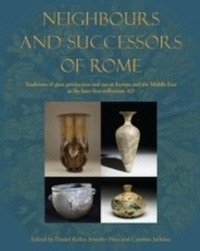
Neighbours and Successors of Rome
Traditions of Glass Production and use in Europe and the Middle East in the Later 1st Millennium AD
1st Edition
Published on 30. May 2014
352 pages
978-1-78297-400-0 (ISBN)
Description

Presented through 20 case studies covering Europe and the Near East, Neighbours and Successors of Rome investigates development in the production of glass and the mechanisms of the wider glass economy as part of a wider material culture in Europe and the Near East around the later first millennium AD. Though highlighting and solidifying chronology, patterns of distribution, and typology, the primary aims of the collection are to present a new methodology that emphasises regional workshops, scientific data, and the wider trade culture.
This methodology embraces a shift in conceptual approach to the study of glass by explaining typological change through the existence of a thriving supra-national commercial network that responded to market demands and combines the results of a range of new scientific techniques into a framework that stresses co-dependence and similarities between the various sites considered. Such an approach, particularly within Byzantine and Early Islamic glass production, is a pioneering concept that contextualises individual sites within the wider region.
By twinning a critique of archaeometric methods with the latest archaeological research, the contributors present a foundation for glass research, seen through the lens of consumption demands and geographical necessity, that analyses production centres and traditional typological knowledge. In so doing the they bridge an important divide by demonstrating the co-habitability of diverse approaches and disciplines, linking, for example, the production of Campanulate bowls from Gallaecia with the burgeoning international late antique style. Equally, the particular details of those pieces allow us to identify a regional style as well as local production. As such this compilation provides a highly valuable resource for archaeologists, anthropologists, and art historians.
This methodology embraces a shift in conceptual approach to the study of glass by explaining typological change through the existence of a thriving supra-national commercial network that responded to market demands and combines the results of a range of new scientific techniques into a framework that stresses co-dependence and similarities between the various sites considered. Such an approach, particularly within Byzantine and Early Islamic glass production, is a pioneering concept that contextualises individual sites within the wider region.
By twinning a critique of archaeometric methods with the latest archaeological research, the contributors present a foundation for glass research, seen through the lens of consumption demands and geographical necessity, that analyses production centres and traditional typological knowledge. In so doing the they bridge an important divide by demonstrating the co-habitability of diverse approaches and disciplines, linking, for example, the production of Campanulate bowls from Gallaecia with the burgeoning international late antique style. Equally, the particular details of those pieces allow us to identify a regional style as well as local production. As such this compilation provides a highly valuable resource for archaeologists, anthropologists, and art historians.
More details
Other editions
Additional editions
Daniel Keller | Jennifer Price | Caroline Jackson
Neighbours and Successors of Rome
Traditions of Glass Production and use in Europe and the Middle East in the Later 1st Millennium AD
Book
05/2014
Oxbow Books
€81.90
Shipment within 3-4 weeks
Content
- Cover
- Title Page
- Copyright Page
- Contents
- Acknowledgements
- List of Contributors
- Chapter 1: Glass from the later first millennium AD: current state of research
- Chapter 2: The last Roman glass in Britain: recycling at the periphery of the empire
- Chapter 3: Opaque yellow glass production in the early medieval period: new evidence
- Chapter 4: The vessel glass assemblage from Anglo-Saxon occupation at West Heslerton, North Yorkshire
- Chapter 5: Glassworking at Whitby Abbey and Kirkdale Minster in North Yorkshire
- Chapter 6: Glass workshops in northern Gaul and the Rhineland in the first millennium AD as hints of a changing land use - including some results of the chemical analyses of glass from Mayen
- Chapter 7: Campanulate bowls from Gallaecia: evidence for regional glass production in late antiquity
- Chapter 8: The Wilshere Collection of late Roman gold-glass at the Ashmolean Museum, University of Oxford
- Chapter 9: The "proto-history" of Venetian glassmaking
- Chapter 10: Late Roman glass from South Pannonia and the problem of its origin
- Chapter 11: Glass supply and consumption in the late Roman and early Byzantine site Dichin, northern Bulgaria
- Chapter 12: An early Christian glass workshop at 45, Vasileos Irakleiou Street in the centre of Thessaloniki
- Chapter 13: Glass tesserae from Hagios Polyeuktos, Constantinople: their early Byzantine affiliations
- Chapter 14: Successors of Rome? Byzantine glass mosaics
- Chapter 15: Glass from the Byzantine Palace at Ephesus in Turkey
- Chapter 16: Late Roman and early Byzantine glass from Heliopolis/Baalbek
- Chapter 17: Changes in glass supply in southern Jordan in the later first millennium AD
- Chapter 18: Egyptian glass abroad: HIMT glass and its markets
- Chapter 19: Continuity and change in Byzantine and early Islamic glass from Syene/Aswan and Elephantine, Egypt
- Chapter 20: Sasanian glass: an overview
