

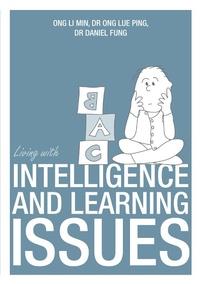
Living With Intelligence and Learning Issues
Published on 15. August 2015
60 pages
978-981-4721-32-5 (ISBN)
Description

What is the cognitive development of a child like? How does the family cope when the child has learning disorders?
More details
Other editions
Additional editions
Daniel Fung | Ong Li Min | Li Zhong Ying
Living with Intelligence & Learning Issues
Book
03/2016
Marshall Cavendish International (Asia) Pte Ltd
€28.65
Shipment within 3-4 weeks
Content
- Intro
- CONTENTS
- PREFACE
- INTRODUCTION
- 1. CURRENT CONCEPTS OF INTELLIGENCE
- 2. THE DIFFERENT TYPES OF INTELLIGENCE
- 3. MEASURING THE INTELLIGENCE OF CHILDREN
- 4. WHAT IQ SCORES MEAN
- 5. HOW INNATE ABILITY AND TEMPERAMENT AFFECT LEARNING
- 6. HOW ENVIRONMENT AND SUPPORT AFFECT LEARNING
- 7. HOW MOTIVATION AND ATTITUDE AFFECT LEARNING
- 8. HOW PHYSICAL AND MENTAL HEALTH AFFECT LEARNING
- 9. NEURODEVELOPMENTALDISORDERS
- 10. SPECIFIC LEARNING DISORDERS
- 11. ASSESSING AND MANAGING LEARNING DISORDERS
- 12. LONG-TERM OUTCOMES
- 13. SUPPORT SERVICES
- 14. MAXIMISING YOUR CHILD'S POTENTIAL
- USEFUL RESOURCES
- ABOUT THE AUTHORS
