

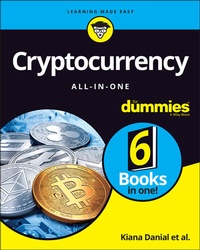
Cryptocurrency All-in-One For Dummies
Description

Learn the skills to get in on the crypto craze
The world of cryptocurrency includes some of the coolest technologies and most lucrative investments available today. And you can jump right into the middle of the action with Cryptocurrency All-in-One For Dummies, a collection of simple and straightforward resources that will get you up to speed on cryptocurrency investing and mining, blockchain, Bitcoin, and Ethereum.
Stop scouring a million different places on the web and settle in with this one-stop compilation of up-to-date and reliable info on what's been called the "21st century gold rush." So, whether you're just looking for some fundamental knowledge about how cryptocurrency works, or you're ready to put some money into the markets, you'll find what you need in one of the five specially curated resources included in this book.
Cryptocurrency All-in-One For Dummies will help you:
- Gain an understanding of how cryptocurrency works and the blockchain technologies that power cryptocurrency
- Find out if you're ready to invest in the cryptocurrency market and how to make smart decisions with your cash
- Build a cryptocurrency mining rig out of optimized and specifically chosen computing hardware
- Dive into the details of leading cryptocurrencies like Bitcoin and Ethereum
Perfect for anyone curious and excited about the potential that's been unlocked by the latest in cryptocurrency tech, this book will give you the foundation you need to become a savvy cryptocurrency consumer, investor, or miner before you know it.
More details
Other editions
Additional editions
Persons
Kiana Danial is an investment trainer and consultant as well as the author of Cryptocurrency Investing For Dummies.
Peter Kent is a veteran technology author. Tyler Bain is a Certified Bitcoin Professional. Peter and Tyler are co-authors of Cryptocurrency Mining For Dummies. Tiana Laurence heads her own venture capital firm and is author of Blockchain For Dummies, 2nd Edition. Michael G. Solomon, PhD, is a professor of Computer Information Sciences as well as author of Ethereum For Dummies.
Content
Introduction. 1
Book 1: Cryptocurrency Basics 5
Chapter 1: What Is a Cryptocurrency? 7
Chapter 2: How Cryptocurrencies Work 15
Chapter 3: Introducing Cryptocurrency Wallets 27
Chapter 4: Different Types of Cryptocurrencies 43
Book 2: Blockchain Basics 59
Chapter 1: Introducing Blockchain 61
Chapter 2: Picking a Blockchain 73
Chapter 3: Getting Your Hands on Blockchain 81
Chapter 4: Beholding the Bitcoin Blockchain 91
Chapter 5: Encountering the Ethereum Blockchain 101
Chapter 6: Getting Your Hands on Hyperledger 115
Chapter 7: Financial Technology 123
Book 3: Bitcoin 133
Chapter 1: Bitcoin Tech Explained 135
Chapter 2: Buying, Using, and Selling Bitcoin 155
Chapter 3: Taking Control of Your Wallet (and Hodling Your Bitcoin) 191
Chapter 4: Keeping Your Bitcoin Safe 227
Book 4: Ethereum 249
Chapter 1: Getting to Know Ethereum 251
Chapter 2: Exploring Use Cases for Ethereum 259
Chapter 3: Examining the Ethereum Ecosystem and Development Life cycle 273
Chapter 4: Getting and Configuring Ethereum Development Tools 289
Chapter 5: Building Your First Ethereum Apps 309
Chapter 6: Discovering Smart Contracts 325
Chapter 7: Writing Your Own Smart Contracts with Solidity 347
Chapter 8: Testing Ethereum Apps 373
Chapter 9: Deploying Ethereum Apps 391
Book 5: Cryptocurrency Investing 405
Chapter 1: Why Invest in Cryptocurrencies? 407
Chapter 2: Recognizing the Risks of Cryptocurrencies 423
Chapter 3: Cryptocurrency Exchanges and Brokers 439
Chapter 4: Identifying Top-Performing Cryptocurrencies 455
Chapter 5: Diversification in Cryptocurrencies 467
Chapter 6: Getting Ahead of the Crowd: Investing in ICOs 479
Chapter 7: Stocks and Exchange-Traded Funds with Cryptocurrency Exposure 491
Chapter 8: Cryptocurrency Futures and Options 499
Chapter 9: Dealing with the Dollar and Other Fiat Currencies 507
Chapter 10: Using Technical Analysis 517
Chapter 11: Short-Term Trading Strategies 529
Chapter 12: Long-Term Investing Strategies 543
Chapter 13: Minimizing Losses and Maximizing Gains 551
Chapter 14: Using Ichimoku and Fibonacci Techniques 561
Chapter 15: Taxes and Cryptocurrencies 569
Book 6: Cryptocurrency Mining 577
Chapter 1: Understanding Cryptocurrency Mining 579
Chapter 2: Exploring the Different Forms of Mining 589
Chapter 3: Mining Made Simple: Finding a Pool and Preparing an Account 609
Chapter 4: Picking a Cryptocurrency to Mine 629
Chapter 5: Gathering Your Mining Gear 659
Chapter 6: Setting Up Your Mining Hardware 681
Chapter 7: Running the Numbers: Is It Worth It? 707
Chapter 8: Reducing Negatives and Gaining an Edge 733
Chapter 9: Running Your Cryptocurrency Business 753
Index 775
Chapter 1
What Is a Cryptocurrency?
IN THIS CHAPTER
Looking at the what, why, and how of the advent of cryptocurrencies
Getting an overview of your first steps before starting your crypto journey
So you've picked up this book, and your first question is probably this: "What the heck is a cryptocurrency, anyway?" Simply stated, a cryptocurrency is a new form of digital money. You can transfer your traditional, non-cryptocurrency money like the U.S. dollar digitally, but that's not quite the same as how cryptocurrencies work. When cryptocurrencies become mainstream, you may be able to use them to pay for stuff electronically, just like you do with traditional currencies.
However, what sets cryptocurrencies apart is the technology behind them. You may say, "Who cares about the technology behind my money? I only care about how much of it there is in my wallet!" The issue is that the world's current money systems have a bunch of problems. Here are some examples:
- Payment systems such as credit cards and wire transfers are outdated.
- In most cases, a bunch of middlemen like banks and brokers take a cut in the process, making transactions expensive and slow.
- Financial inequality is growing around the globe.
- Around three billion unbanked or underbanked people can't access financial services. That's approximately half the population on the planet!
Cryptocurrencies aim to solve some of these problems, if not more. This chapter introduces you to crypto fundamentals.
Beginning with the Basics of Cryptocurrencies
You know how your everyday, government-based currency is reserved in banks? And that you need an ATM or a connection to a bank to get more of it or transfer it to other people? Well, with cryptocurrencies, you may be able to get rid of banks and other centralized middlemen altogether. That's because cryptocurrencies rely on a technology called blockchain, which is decentralized (meaning no single entity is in charge of it). Instead, every computer in the network confirms the transactions. Flip to Book 2 to find out more about the blockchain technology that enables cool things like cryptocurrencies.
The following sections cover the basics of cryptocurrencies: their background, benefits, and more.
The definition of money
Before getting into the nitty-gritty of cryptocurrencies, you need to understand the definition of money itself. The philosophy behind money is a bit like the whole "which came first: the chicken or the egg?" thing. In order for money to be valuable, it must have a number of characteristics, such as the following:
- Enough people must have it.
- Merchants must accept it as a form of payment.
- Society must trust that it's valuable and that it will remain valuable in the future.
Of course, in the old days, when you traded your chicken for shoes, the values of the exchanged materials were inherent to their nature. But when coins, cash, and credit cards came into play, the definition of money and, more importantly, the trust model of money changed.
Another key change in money has been its ease of transaction. The hassle of carrying a ton of gold bars from one country to another was one of the main reasons cash was invented. Then, when people got even lazier, credit cards were invented. But credit cards carry the money that your government controls. As the world becomes more interconnected and more concerned about authorities who may or may not have people's best interests in mind, cryptocurrencies may offer a valuable alternative.
Here's a fun fact: Your normal, government-backed currency, such as the U.S. dollar, must go by its fancy name, fiat currency, now that cryptocurrencies are around. Fiat is described as a legal tender like coins and banknotes that have value only because the government says so. Get the scoop on fiat currencies in Book 5, Chapter 9.
Some cryptocurrency history
The first ever cryptocurrency was (drumroll please) Bitcoin! You probably have heard of Bitcoin more than any other thing in the crypto industry. Bitcoin was the first product of the first blockchain developed by some anonymous entity who went by the name Satoshi Nakamoto. Satoshi released the idea of Bitcoin in 2008 and described it as a "purely peer-to-peer version" of electronic money.
Bitcoin was the first established cryptocurrency, but many attempts at creating digital currencies occurred years before Bitcoin was formally introduced.
Cryptocurrencies like Bitcoin are created through a process called mining. Very different than mining ore, mining cryptocurrencies involves powerful computers solving complicated problems. Book 6 covers mining, but flip to Book 6, Chapter 1 for an introduction to cryptocurrency mining.
Bitcoin remained the only cryptocurrency until 2011. Then Bitcoin enthusiasts started noticing flaws in it, so they decided to create alternative coins, also known as altcoins, to improve Bitcoin's design for things like speed, security, anonymity, and more. Among the first altcoins was Litecoin, which aimed to become the silver to Bitcoin's gold. But at the time of this writing, over 5,000 cryptocurrencies are available, and the number is expected to increase in the future. Check out Chapter 4 of this minibook for just a sampling of cryptocurrencies that are available now.
Key crypto benefits
Still not convinced that cryptocurrencies (or any other sort of decentralized money) are a better solution than traditional government-based money? Here are a number of solutions that cryptocurrencies may be able to provide through their decentralized nature:
- Reducing corruption: With great power comes great responsibility. But when you give a ton of power to only one person or entity, the chances of their abusing that power increase. The 19th-century British politician Lord Acton said it best: "Power tends to corrupt, and absolute power corrupts absolutely." Cryptocurrencies aim to resolve the issue of absolute power by distributing power among many people or, better yet, among all the members of the network. That's the key idea behind blockchain technology, anyway (see Book 2).
-
Eliminating extreme money printing: Governments have central banks, and central banks have the ability to simply print money when they're faced with a serious economic problem. This process is also called quantitative easing. By printing more money, a government may be able to bail out debt or devalue its currency. However, this approach is like putting a bandage on a broken leg. Not only does it rarely solve the problem, but the negative side effects can also sometimes surpass the original issue.
For example, when a country like Iran or Venezuela prints too much money, the value of its currency drops so much that inflation skyrockets and people can't even afford to buy everyday goods and services. Their cash becomes barely as valuable as rolls of toilet paper. Most cryptocurrencies have a limited, set amount of coins available. When all those coins are in circulation, a central entity or the company behind the blockchain has no easy way to simply create more coins or add on to its supply.
- Giving people charge of their own money: With traditional cash, you're basically giving away all your control to central banks and the government. If you trust your government, that's great, but keep in mind that at any point, your government is able to simply freeze your bank account and deny you access to your funds. For example, in the United States, if you don't have a legal will and own a business, the government has the right to all your assets if you pass away. Some governments can even simply abolish bank notes the way India did in 2016. With cryptocurrencies, you and only you can access your funds. (Unless someone steals them from you, that is. To find out how to secure your crypto assets, flip to Chapter 3 of this minibook.)
- Cutting out the middleman: With traditional money, every time you make a transfer, a middleman like your bank or a digital payment service takes a cut. With cryptocurrencies, all the network members in the blockchain are that middleman; their compensation is formulated differently from that of fiat money middlemen and therefore is minimal in comparison. Check out Chapter 2 of this minibook for more on how cryptocurrencies work.
- Serving the unbanked: A vast portion of the world's citizens has no access or limited access to payment systems like banks. Cryptocurrencies aim to resolve this issue by spreading digital commerce around the globe so that anyone with a mobile phone can start making payments. And yes, more people have access to mobile phones than to banks. In fact, more people have mobile phones than have toilets, but at this point the blockchain technology may not be able to resolve the latter issue. (Flip to Book 5, Chapter 1 for more on the social good that can come from cryptocurrencies and blockchain technology.)
Common crypto and blockchain myths
During the 2017 Bitcoin hype, a lot of misconceptions about the whole industry started to circulate. These myths may have played a role in the cryptocurrency crash that followed the surge. The important thing to remember is that...
