

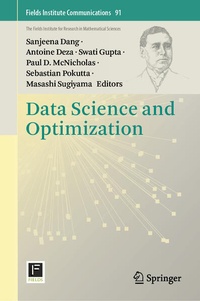
Data Science and Optimization
Description

Data science and optimization are increasingly intertwined as both focus on developing computational and methodological approaches to tackling large and otherwise complex datasets. Optimization is primarily concerned with accuracy, computational efficiency, and robustness while data science emphasizes achieving effective results on real datasets. Although some data science approaches involve the implicit optimization of objective functions, there remains a dearth of work that brings advanced optimization techniques to bear on data science problems. The goal of the Fields Focus Program on Data Science and Optimization held in November 2019 at the Fields Institute in Toronto, was to bring together researchers in data science and optimization, both theoretical and applied, in an effort to bridge the fields and stimulate cross-disciplinary interaction and collaboration.
In the spirit of the program, this volume compiles recent development and connections in the fields of data science and optimization, and the ways in which they overlap. It features novel results and state-of-the-art surveys as well as open problems.
More details
Other editions
Additional editions
Content
Preface.- A General Algorithm for Assortment Optimization Under Random Utility Choice Models.- Design of Poisoning Attacks on Linear Regression Using Bilevel Optimization.- 1-norm Minimization and Minimum-Rank Structured Sparsity for Symmetric and Ah-Symmetric Generalized Inverses: Rank One and Two.- Local and Global Uniform Convexity Conditions.- A Symmetric Loss Perspective of Reliable Machine Learning.- Decoding Noisy Messages: A Method that Just Shouldn't Work.- On Reduction of the Switching Graph Problem to the Independent Set Problem.- Outer Approximations of Core Points for Integer Programming.- Sizing the White Whale.- Too Many Fairness Metrics: Is There a Solution? Equity Across Demographic Groups for the Facility Location Problem.- Adaptive First- and Second-Order Algorithms
for Large-Scale Machine Learning.- Second-Order Conditional Gradient Sliding.- Combinatorial Pure Exploration with Full-Bandit Feedback and Beyond: Solving Combinatorial Optimization Under Uncertainty with Limited Observation.
