

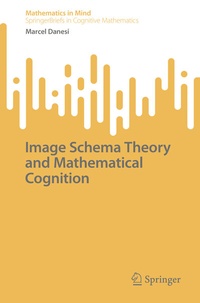
Image Schema Theory and Mathematical Cognition
Description

This book uses blending theory in math cognition, and assesses the main aspect of this theory, called image schema theory. Applied work in math pedagogy has used this theory, but no work has assessed its validity. This book provides an overall assessment of the theory with regard to its validity in the study of math cognition.
Overall, this book presents image schema theory as it has evolved today to mathematicians, cognitive scientists, and math educators, deriving from it any concrete implications for modeling math in computer science and, on the other side, for making math pedagogy more effective.
More details
Other editions
Additional editions
Person
Marcel Danesi is Professor Emeritus of Anthropology at the University of Toronto. He has written extensively on the relation between mathematics and symbol systems, including how puzzles and problems in mathematics are part of a more general dialectic frame of mind for grasping the nature of reality. Among his works in the field are Language and Mathematics (2018) and Ahmes' Legacy (2020). He also founded the CogSci Network at the Fields Institute for Research in Mathematical Sciences, which consists of internationally renowned researchers in the field of cognitive mathematics.
Content
Preface.- The Starting Point: Lakoff and Núñez.- Image Schema Theory.- Related Processes.- Learning, Diagrams, and AI.- Index.
