

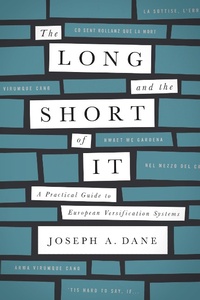
The Long and the Short of It
A Practical Guide to European Versification Systems
Published on 15. March 2010
277 pages
978-0-268-07768-6 (ISBN)
Description

Students of English literature now rarely receive instruction in versification (theory or practice) at either the undergraduate or the graduate level. The Long and the Short of It is a clear, straightforward account of versification that also functions as an argument for a renewed attention to the formal qualities of verse and for a renewed awareness of the forms and traditions that have shaped the way we think about English verse.
After an introduction and discussion of basic principles, Joseph A. Dane devotes a chapter to quantitative verse (Latin), syllabic or isosyllabic verse (French), and accentual verse (Old English/Germanic). In addition to basic versification systems, the book includes a chapter on musical forms, since verse was originally sung. Most serious studies of these systems in English have been designed for language students, and are not accessible to students of English literature or general readers. This book will enable the reader to scan verse in all three systems, and it will also provide a framework within which students can understand points of contention about particular verse forms. The guide includes a chapter addressed to teachers of English, an appendix with examples of verse types, and a glossary of commonly used terms.
After an introduction and discussion of basic principles, Joseph A. Dane devotes a chapter to quantitative verse (Latin), syllabic or isosyllabic verse (French), and accentual verse (Old English/Germanic). In addition to basic versification systems, the book includes a chapter on musical forms, since verse was originally sung. Most serious studies of these systems in English have been designed for language students, and are not accessible to students of English literature or general readers. This book will enable the reader to scan verse in all three systems, and it will also provide a framework within which students can understand points of contention about particular verse forms. The guide includes a chapter addressed to teachers of English, an appendix with examples of verse types, and a glossary of commonly used terms.
Reviews / Votes
" . . . Dane has 'made a career' publishing books that challenge consensus on common myths in the field: 'the critical mythology of irony,' 'the myth of a "textualized" Chaucer,' and 'the myth of print culture.' In this latest book, Dane challenges the ubiquitous notion of iambic pentameter as a purely English form, arguing instead for the simpler practice of counting syllables. A helpful glossary of terms is included. Studious undergraduates may find explanations and models of forms (which appear in the original language as well as in translation) helpful." -Choice"This is a remarkably clear, succinct, and at times witty handbook to literary versification. Its primary goal is to explain the basic forms of prosody in Latin, French, English, and the older Germanic languages. Students of literature, and of creative writing, need to understand that verbal expression is not the unmediated release of sensibility but the crafted and highly nuanced organization of that sensibility in forms." -Seth Lerer, University of California, San Diego
"This book makes an original contribution in its approach, which demonstrates how English prosody depends on and derives from the metrical systems of earlier poetic forms. But it does more than that: it brings into one place a succinct description of Latin prosody-surprisingly hard to find-that is then linked to other forms students might have heard of in other classes." -Sarah Spence, University of Georgia
"Joseph Dane's The Long and the Short of It is simply the clearest, most concise, and also the most elegant book about versification that I have ever read. What a relief to have this extraordinary tool for the classroom and to be able to pass it along to friends who are poetry readers as well. Dane's section on "The Power of Music" is a revelation in its discussion of the practical distinctions between systems of literary and musical notation. This is a long overdue and remarkably precise guide to those practices that have too often remained mysterious to many readers of poetry, both old and new." -David St. John, University of Southern California
More details
Language
English
Place of publication
Notre Dame IN
United States
Target group
Professional and scholarly
Product notice
Reflowable
ISBN-13
978-0-268-07768-6 (9780268077686)
Copyright in bibliographic data and cover images is held by Nielsen Book Services Limited or by the publishers or by their respective licensors: all rights reserved.
Schweitzer Classification
Other editions
Additional editions
Book
03/2010
University of Notre Dame Press
€32.30
Shipment within 10-20 days
Person
Joseph A. Dane is professor of English at the University of Southern California. He is the author of a number of books, including The Myth of Print Culture: Essays on Evidence, Textuality, and Bibliographical Method.
Content
- Intro
- Contents
- Acknowledgments
- Introduction
- Basic Principles
- Quantitative Verse
- Syllabic Verse
- Accentual Verse
- The Power of Music
- Implications for the Study of English Verse
- Conclusion
- Appendix
- Glossary of Commonly Used Terms
