

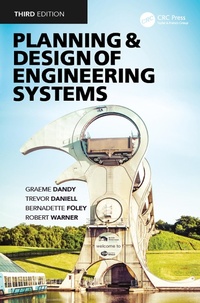
Planning and Design of Engineering Systems
3rd Edition
Published on 6. December 2017
460 pages
978-1-138-03192-0 (ISBN)
Description

This newly updated book offers a comprehensive introduction to the scope and nature of engineering work, taking a rigorous but common sense approach to the solution of engineering problems.
The text follows the planning, modelling and design phases of engineering projects through to implementation or construction, explaining the conceptual framework for undertaking projects, and then providing a range of techniques and tools for solutions. It focuses on engineering design and problem solving, but also involves economic, environmental, social and ethical considerations.
This third edition expands significantly on the economic evaluation of projects and also includes a new section on intractable problems and systems, involving a discussion of wicked problems and soft systems methodology as well as the approaches to software development. Further developments include an array of additional interest boxes, worked examples, problems and up-to date references.
Case studies and real-world examples are used to illustrate the role of the engineer and especially the methods employed in engineering practice. The examples are drawn particularly from the fields of civil and environmental engineering, but the approaches and techniques are more widely applicable to other branches of engineering.
The book is aimed at first-year engineering students, but contains material to suit more advanced undergraduates. It also functions as a professional handbook, covering some of the fundamentals of engineering planning and design in detail.
The text follows the planning, modelling and design phases of engineering projects through to implementation or construction, explaining the conceptual framework for undertaking projects, and then providing a range of techniques and tools for solutions. It focuses on engineering design and problem solving, but also involves economic, environmental, social and ethical considerations.
This third edition expands significantly on the economic evaluation of projects and also includes a new section on intractable problems and systems, involving a discussion of wicked problems and soft systems methodology as well as the approaches to software development. Further developments include an array of additional interest boxes, worked examples, problems and up-to date references.
Case studies and real-world examples are used to illustrate the role of the engineer and especially the methods employed in engineering practice. The examples are drawn particularly from the fields of civil and environmental engineering, but the approaches and techniques are more widely applicable to other branches of engineering.
The book is aimed at first-year engineering students, but contains material to suit more advanced undergraduates. It also functions as a professional handbook, covering some of the fundamentals of engineering planning and design in detail.
Reviews / Votes
"I know of no other textbook that balances as well as this one all these basic technical and non-technical social, political, legal and institutional aspects affecting what we engineers do and how we perform our work... The range and depth of material contained in this book will serve engineering students at all levels of their education."-- D. P. Loucks, Cornell University, USA
"Based on my experience, this is a winning formula ensuring effective learning and efficient absorption of the latest concepts in the planning and design of engineering systems...a must read for undergraduate students."
-- Zoran Kapelan, University of Exeter, UK
"The Third Edition of their captivating and timely book on Engineering Planning and Design... covers not only the hard engineering aspects of engineering but also the closely connected softer topics which directly take into account the social, economic and environmental aspects of engineering projects... the rich range of material is presented in such an encompassing and intuitive fashion."
-- Keith W. Hipel, Professor of Systems Design Engineering, University of Waterloo "I know of no other textbook that balances as well as this one all these basic technical and non-technical social, political, legal and institutional aspects affecting what we engineers do and how we perform our work... The range and depth of material contained in this book will serve engineering students at all levels of their education."
-- D. P. Loucks, Cornell University, USA
"Based on my experience, this is a winning formula ensuring effective learning and efficient absorption of the latest concepts in the planning and design of engineering systems...a must read for undergraduate students."
-- Zoran Kapelan, University of Exeter, UK
"The Third Edition of their captivating and timely book on Engineering Planning and Design... covers not only the hard engineering aspects of engineering but also the closely connected softer topics which directly take into account the social, economic and environmental aspects of engineering projects the rich range of material is presented in such an encompassing and intuitive fashion."
-- Keith W. Hipel, Professor of Systems Design Engineering, University of Waterloo
More details
Edition
3rd edition
Language
English
Place of publication
London
United Kingdom
Publishing group
Taylor & Francis Ltd
Target group
College/higher education
Illustrations
81 s/w Tabellen, 4 s/w Photographien bzw. Rasterbilder, 2 Farbfotos bzw. farbige Rasterbilder, 121 s/w Zeichnungen, 1 farbige Zeichnung
81 Tables, black and white; 1 Line drawings, color; 121 Line drawings, black and white; 2 Halftones, color; 4 Halftones, black and white
File size
21,34 MB
ISBN-13
978-1-138-03192-0 (9781138031920)
Copyright in bibliographic data and cover images is held by Nielsen Book Services Limited or by the publishers or by their respective licensors: all rights reserved.
Schweitzer Classification
Other editions
Additional editions
Graeme Dandy | David Walker | Trevor Daniell
Planning and Design of Engineering Systems
Book
12/2017
3rd Edition
CRC Press
€188.80
Shipment within 10-20 days

Graeme Dandy | David Walker | Trevor Daniell
Planning and Design of Engineering Systems
Book
12/2017
3rd Edition
CRC Press
€78.40
Shipment within 10-20 days
Persons
Graeme Dandy is Emeritus Professor of Civil and Environmental Engineering at the University of Adelaide. He has co-authored more than 100 journal papers in the fields of water resources management and environmental engineering. His research interests include optimisation and artificial intelligence techniques applied to water resources and environmental systems. He is a Fellow of the Australian Academy of Technological Sciences and Engineering and a Fellow of Engineers Australia.
Trevor Daniell is an Honorary Research Fellow at the University of Adelaide. He has co-authored books and edited journals on hydrology and water resources as well as on engineering planning and design. He has had an active interest in the International Hydrological Program of UNESCO for 30 years and is a Fellow of Engineers Australia.
Bernadette Foley is the Associate Dean of Education for the Faculty of Engineering, Computer and Mathematical Sciences at the University of Adelaide. She has a combination of industry and academic experience in urban master planning and storm water management. More recently, she has developed a special interest in the teaching of professional practice within the engineering curriculum.
Robert Warner is Emeritus Professor of Civil Engineering at the University of Adelaide. He has co-authored text books on reinforced concrete and prestressed concrete, as well as on engineering planning and design. His academic interests include non-linear analysis of concrete structures and engineering education. He has been a Fellow of the Australian Academy of Technological Sciences and Engineering since 1998.
Trevor Daniell is an Honorary Research Fellow at the University of Adelaide. He has co-authored books and edited journals on hydrology and water resources as well as on engineering planning and design. He has had an active interest in the International Hydrological Program of UNESCO for 30 years and is a Fellow of Engineers Australia.
Bernadette Foley is the Associate Dean of Education for the Faculty of Engineering, Computer and Mathematical Sciences at the University of Adelaide. She has a combination of industry and academic experience in urban master planning and storm water management. More recently, she has developed a special interest in the teaching of professional practice within the engineering curriculum.
Robert Warner is Emeritus Professor of Civil Engineering at the University of Adelaide. He has co-authored text books on reinforced concrete and prestressed concrete, as well as on engineering planning and design. His academic interests include non-linear analysis of concrete structures and engineering education. He has been a Fellow of the Australian Academy of Technological Sciences and Engineering since 1998.
Content
Chapter One: Engineering and Society. Chapter Two: Engineering Systems Concepts. Chapter Three: Engineering Planning and Design. Chapter Four: Creativity and Creative Thinking. Chapter Five: Project Scheduling Techniques. Chapter Six: Management Processes and Skills. Chapter Seven: Communication. Chapter Eight: Economic Evaluation. Chapter Nine: Sustainability, Environmental and Social Considerations. Chapter Ten: Ethics and Law. Chapter Eleven: Risk and Reliability. Chapter Twelve: Engineering Decision-Making. Chapter Thirteen: Optimisation. Chapter Fourteen: Epilogue.
