

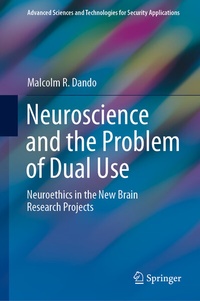
Neuroscience and the Problem of Dual Use
Description

This book discusses recent brain research and the potentially dangerous dual-use applications of the findings of these research projects. The book is divided into three sections: Part I examines the rise in dual-use concerns within various state's chemical and biological non-proliferation regime's during this century, as well as the rapid technologically driven advances in neuroscience and the associated possible misuse considerations in the same period. Part II reviews the brain research projects in the EU, USA, Japan, China and several other countries with regard to their objectives, achievements and measures to deal with the problem of dual-use. Part III assesses the extent to which the results of this civil neuroscience work, which is intended to be benign, are being, and could be protected against future hostile applications in the development of novel chemical and biological weapons.
Reviews / Votes
"Neuroscience and the Problem of Dual Use puts modern brain science into perspective for all readers. Dando's insights and analyses are crucial to making lasting and robust policies to further nonproliferation regimes, and this book serves as a foundation for neuroS/T dual-use research of concern as we emerge from the COVID-19 pandemic." (Joseph DeFranco, World Medical & Health Policy, January 28, 2021)
More details
Other editions
Additional editions
Person
Malcolm Dando is a biologist researching international security at the University of Bradford's Department of Peace Studies with a focus on chemical and biological weapons, arms control, and biosecurity. Dando previously held a Ministry of Defence-funded fellowship in operational research at the University of Sussex.
During the last 26 years, he has worked on strengthening the chemical and biological disarmament regime. He has produced numerous books, papers and policy-related reports in two key areas: the implications of advances in science for the regime and the awareness and education of scientists about dual-use. His key achievements have been to demonstrate the generally low level of awareness of scientists about dual-use, to develop active-learning, educational material on dual-use for scientists and to show that neuroscience is a critical field in which erosion of the regime could occur.
